Kentucky agriculture has moved beyond tobacco. Some wonder what’s been lost.
Sep 17, 2026 | 5:30 am ET
Description
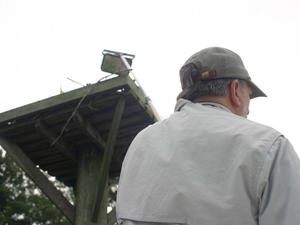
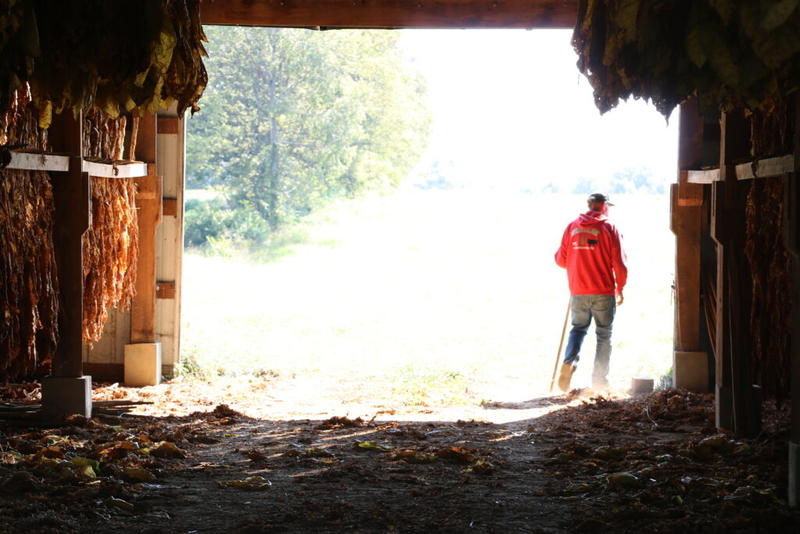
69-year-old Kenneth Anderson has been around tobacco his entire life growing up in Clark County, Kentucky. (Kentucky Lantern photo by Liam Niemeyer)
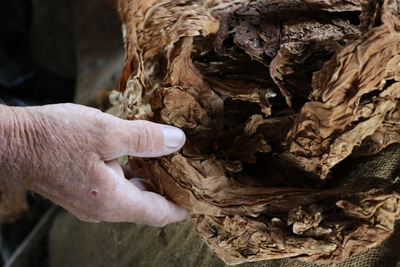
Kenneth Anderson’s father taught him what to look for in high-quality tobacco, cured for weeks in the rafters of a Clark County barn. How to “grade” or rate the quality of the different parts of the plant, looking for slight variations of the deep brown color of the dried leaves.
“Tobacco’s always been a crop that you survived on,” Anderson said as he drove his truck over the rolling hills of his land on an early September morning. “Tobacco paid the bills. It paid for the farm. It sent kids to school.”
Growing the cash crop is a part of a family tradition that’s stretched across four generations for Anderson. He first rode a tractor when he was six years old. By the age of 14, he was high in the tobacco barn rafters himself as he placed plants along tobacco sticks to be cured in the fall.
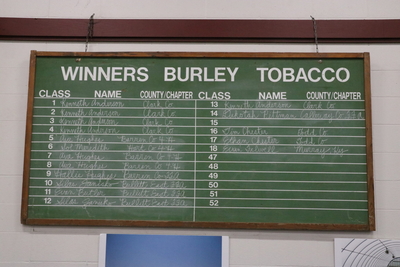
In high school, he’d go on to win ribbons in county and regional tobacco competitions through Future Farmers of America. Just this year, he won several tobacco contests at the state fair.
Growing up was a time when “every farm had a small acre, small acres” of tobacco, Anderson said. In 1978, a few years after he graduated from high school, more than 700 of the 962 farms in Clark County grew the crop, according to federal data. It was a crop — dark tobacco traditionally grown in Western Kentucky and burley tobacco grown elsewhere — that dominated the state’s farm economy, bringing in on average about a quarter of approximately $3.4 billion in annual revenue for Kentucky farms each year during the 1990s.
But Anderson, now 69, also believes change is inevitable. That change has been dramatic over the roughly two decades for the crop he’s grown to know so well. Nearly 60,000 farms grew tobacco in the 1990s to now less than 1,000 as of 2022, according to federal agriculture census data.
By his estimate now, there’s less than 10 tobacco growers left in Clark County.
“I didn’t foresee it, the changes that have happened,” Anderson said in his soft-spoken voice. “I’ve always heard it said, ‘You may not want to be the first to change, but you don’t want to be the last.’”
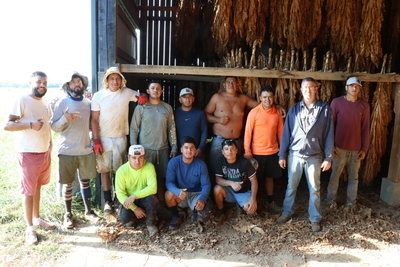
Anderson pulled up in his truck next to a tobacco barn, where one of the last few tobacco growers in his county was having migrant workers from Mexico hang the plants in the rafters. Anderson doesn’t grow the crop anymore, but he leases his land to 45-year-old Jeremy Jones, who grows it on contract for a tobacco company.
The laborers, hired as seasonal labor through H-2A visas, worked to music as they lifted themselves on the beams high in the barn to do the labor of “housing” the tobacco. Over several weeks, the air will cure the tobacco, draining moisture from the plant’s stems and wrinkling the leaf into a dark tan.
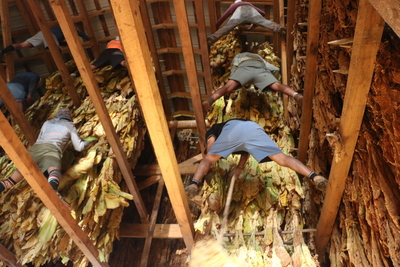
“You see it from start to finish. You’ve touched it. You’ve done it. You know, it’s a sense of pride in the end to know that you’ve started it and completed it, and that’s what you do to make your living,” said Jones, standing inside the barn.
For the farmers who still grow it, there’s a feeling of accomplishment with raising the labor-intensive crop from a seed as small as a “pinhead.”
But even as Kentucky agriculture has moved beyond reliance on the crop, some of those farmers also wonder what’s been lost — community, culture and learned practices and knowledge hanged down by generations — as the number of tobacco farmers continues to dwindle in the state.
A sea change in Kentucky agriculture
University of Kentucky agriculture economist Will Snell points to multiple reasons for the dramatic decline of Kentucky tobacco, some reasons more evident than others.
Rates of smoking and tobacco consumption across the country have fallen drastically over the decades, driving down demand for domestic tobacco. The falling rates coincide with nationwide efforts to discourage smoking and tobacco consumption, cited by the American Lung Association as a driving reason why Kentucky remains among the top states for new cases of lung cancer. Newer products with nicotine — vapes, nicotine pouches — generally use little to no nicotine from Kentucky tobacco.
That trend of falling demand for tobacco, along with competition of cheaper tobacco grown overseas, led Congress in 2004 ending the federal price support program for tobacco farmers that had been in place since the Great Depression. The program controlled how much tobacco each farmer could grow in an effort to manage the supply and selling price of the cash crop. Farmers received more than $9 billion in buyout payments when the program ended; Kentucky received about $2.5 billion in payments.
Snell, who was working at the University of Kentucky at the time of the buyout, calls the roughly 20 years since the buyout in Kentucky agriculture to be the largest “structural change of any ag economy of any state.”
“We’ve lost about 80% of the market, maybe 90% of the growers,” Snell said about Kentucky tobacco. He compared it to if Illinois lost 80% of their corn production, or if Wisconsin lost 80% of their dairy production.
“How in the world would they survive?” Snell said.
But overall, Snell said Kentucky agriculture economy has been able to largely rebound from a past reliance on tobacco.
In the 1990s, according to federal data compiled by Snell, Kentucky’s farm economy averaged about $3.4 billion in annual revenue, with tobacco making up about 25% of the revenue. Tobacco now accounts for only a little more than 2% of revenue in 2025, according to a University of Kentucky estimate. But agriculture revenue is now up to $8.3 billion, with livestock — poultry, cattle, horses — making up over 60% of the state’s revenue. Cattle farmers in Kentucky have grappled with their own financial challenges while dealing with tariffs, competition from abroad and the loss of farmland.
He said diversification of the agricultural economy in the wake of the tobacco buyout, with help from the state in the form of grants to farmers encouraging diversification, is a large part of the state’s success in moving beyond tobacco.
Republican Kentucky Agriculture Commissioner Jonathan Shell told the Lantern that various boards and efforts, ranging from the Kentucky Agricultural Finance Corporation to the Kentucky Agriculture Development Board, have helped with providing farmers more options.
Shell also believes there’s still an opportunity to support Kentucky’s remaining tobacco farmers, one way through stronger tariffs against foreign tobacco imports, to bolster the demand for domestic growers. He said even with efforts to tax “out of existence” cigarettes, tobacco farmers still “deserve the same representation as everybody else” in the agriculture community.
“I think that there is potential, maybe not for growth in the industry, but at least for the hemorrhaging to stop, to where the farmers feel like their profitability has increased, or they’re able to raise enough to where that they can sustain their operation,” Shell said.
But that does not mean every farmer made it through the massive transition. Snell said smaller tobacco farmers in Eastern Kentucky couldn’t compete by growing smaller plots of tobacco after the buyout when competing with other farmers who could win larger contracts with tobacco companies to grow more.
Another organization that small tobacco farmers relied on was the Burley Tobacco Growers Cooperative, founded in Lexington in 1922. The late writer Wendell Berry, whose father helped co-found the cooperative, praised the organization for making small to mid-sized tobacco farms viable by setting production quotas for each farmer and stable pricing for the crop; Berry argued that stability supported the larger economies of agrarian communities.
That cooperative dissolved in 2020 after struggling to find its footing, including making a failed investment in growing hemp, following the 2004 buyout.
Robert Bach, a 80-year-old farmer from Bath County who helps his son raise beef cattle, was one of those Eastern Kentucky tobacco farmers. He still keeps a few burley tobacco plants growing in his backyard garden, even though his wife says they take up too much room.
“It’s just part of Kentucky history. It’s just it’s hard to give history up for me anyway,” Bach said.
Bach grew up in Northern Kentucky and moved to Bath County in the late 1970s after serving in the Vietnam War, helping his wife’s family grow tobacco and raise cattle. He said growing burley tobacco was one of the main ways to make a living in Bath County; the tobacco check helped buy Christmas gifts.
He said tobacco companies are still providing contracts to those who can grow larger acreage of tobacco. But for him, he bowed out of the industry a few years after the buyout, keeping the tobacco plants in the garden to remind people of the past.
“We’ve had a couple people come visit us and wanted to know about what a tobacco plant looked like because they hadn’t seen any of it. I just take them out to the garden,” Bach said.
Wondering about the last generation
One of those larger farmers still raising tobacco on a contract wakes up most mornings this month to check on his tobacco barns. But he doesn’t use the air to cure the tobacco.
Instead, the smoke and heat from smoldering fires inside the barns cure dark tobacco, a variant of the crop that’s used for cigars and chewing tobacco instead of cigarettes.
Most mornings during the fall, 36-year-old Josh Brashears will wake up early to check on his tobacco barns in Trigg County, smoke billowing out of the top of each roof. He said his family has grown dark tobacco since the 1860s. His operation is called Black Patch Farms, hearkening back to an era where his part of Western Kentucky was known as the Black Patch region because of its dark tobacco.
And he wonders if he’ll be the last of his family to continue to do so on his family’s plot of 140 acres.
“I thought that I would see, I would be an old man sitting on my front porch watching my boys take over the tobacco side of the industry,” Brashears said. “I don’t think that’s going to happen.”
He learned the way of growing and curing dark tobacco by watching his father ever since he was a small kid, spending virtually every day outside with him.
“I don’t really know how to explain how I learned it. It was just every single day. I just watched everything that he done,” Brashears said.
His wife Kayla Brashears, a farm management specialist with the University of Kentucky, said all farmers have a draw to the land they own, but that’s especially so with tobacco farmers given how physical the process it is to grow the crop — setting the plants into the ground, chopping out the weeds and “topping” the plant to encourage it to grow larger.
“This is part of our life,” Kayla Brashears, 36, said. “It’s not just a business.”
When he was a kid, Josh would be able to see tobacco plants growing all the way from Trigg County to Bowling Green.
He doesn’t quite know what the future of the crop is, whether there’ll ever be a community surrounding tobacco like he saw growing up. Whether it was his family’s farm or a neighbor who needed help with topping or chopping while he was growing up, he’d be there to help.
“We all kind of sort of come together as a community and would help one another out to make sure that you got your crop in the field and out of the field,” Josh said. “That’s gone.”
But regardless of the disappearance of the crop and all the labor it takes to raise it, he still finds himself coming back to it every year.
“There’s some point where you’re like, ‘I’m done. I’m done dealing with this. I am never doing this again. I’m going to get a town job,” Josh said, referring to jobs that aren’t farming. “Then whenever it’s all over and said and done with, you’re like, ‘You know, that wasn’t too bad.’”


Frankfort