Researcher tells New Mexico lawmakers more funding needed for Holloman Lake wildlife PFAS testing
Sep 16, 2026 | 1:53 pm ET
Description
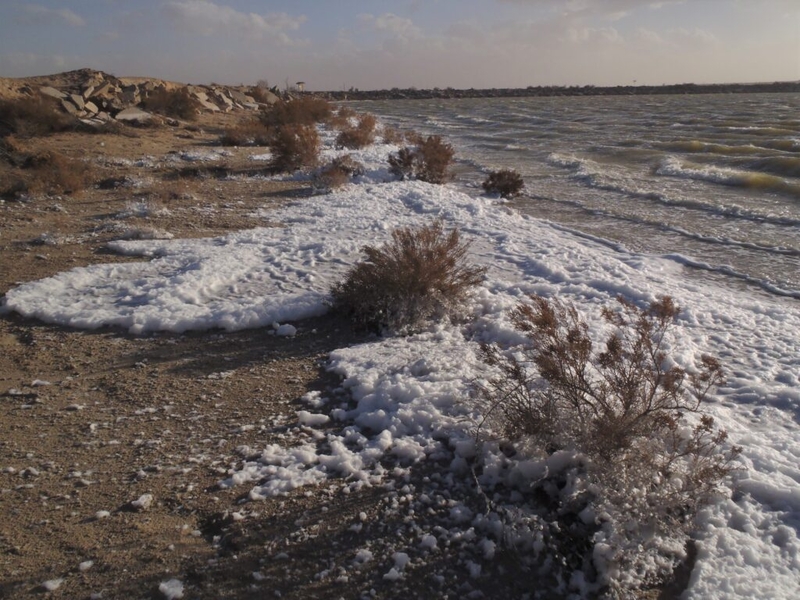
An undated photo of PFAS-laden foam on Holloman Lake, documented by New Mexico environmental officials. High levels of forever chemicals have contaminated the area surrounding Holloman U.S. Air Force Base, including record-setting levels of contamination in wildlife and plant samples. (Courtesy of New Mexico Environment Department)
While previous testing showed plants and wildlife near Holloman Lake in the south-central part of New Mexico contain some of the highest levels of toxic contamination ever recorded, some samples remain untested due to lack of funding, a state university researcher told lawmakers on Tuesday.
Experts believe the leading cause of contamination at Lake Holloman — a man-made, wastewater lake outside of Holloman Air Force Base — comes from firefighting foam containing per- and polyfluoroalkyl substances, PFAS, being used on base from the 1970s until 2019. PFAS exposure is linked to kidney and reproductive cancers, decreased fertility, fetal developmental delays, disruption of immune responses and liver functions in people.
Last year, the New Mexico Environment Department released a report that revealed levels of PFAS wildlife at Holloman Lake. Samples taken from the carcass of dead animals had toxic concentrations of PFAS 2.5 million times greater than the federal standard set by the Environmental Protection Agency. These so-called “forever chemicals” bind to other molecules in the body and build up over time, a process called bioaccumulation, and can move through the food chain when the animal is consumed by a predator.
But some samples have not been collected and others not tested due to a loss of funding, Jean-Luc Cartron, a research biologist from the University of New Mexico, told lawmakers in the interim Military and Veterans Affairs committee on Tuesday. Cartron and his team have been conducting research on PFAS toxicity of Holloman Lake water, soil, plants and wildlife since 2021.
Oryx, which are frequently hunted in the Tularosa Basin, emerged as an animal of concern. Researchers found that a herd of oryx would stay the night at Holloman Lake and samples taken showed slight contamination levels. Hunters in the state could potentially harvest the contaminated animals, Cartron said.
Cartron advised hunters during his committee presentation to refrain from eating liver, where PFAS tend to bioaccumulate more. Once researchers complete the study, he said, guidelines for hunters can be put in place in partnership with the New Mexico Department of Wildlife and Department of Health, which previously released a health advisory for hunters that ate waterfowl between 2010 and 2024 from Lake Holloman.
But many more oryx samples remain in cryopreservation, unable to be tested due to lack of funds. Since the beginning of the investigation in 2021, which led to initial findings being published in a 2024 report, “limited funding” has prevented the team from completing the toxicity study, Cartron said, adding that a mix of private and university funds kept the research going.
Cartron urged the Legislature to support the toxicity surveillance research with funding in the next legislative session starting in January. He estimated that with proper funding, the final report could be published in a year.
“It’s important to know where there are hot spots of contamination, just like we would want to know if an infectious agent presents a threat to any communities,” he said. “That requires some funding.”
The New Mexico Environment Department has been in litigation with the U.S. Department of Defense since 2016 and seeks all past and future clean-up costs and all natural resource damages under an EPA rule that forces polluters to pay the clean up costs of contamination.
Committee Chair Sen. Harold Pope (D-Albuquerque) expressed his appreciation for the researcher’s work and underscored its importance.
“It’s always concerning when we talk about our wildlife that migrates and the effects on the folks who eat the meat and what it can do to our body,” he said.
Santa Fe, NM