Debate about data centers emerges in Donalds-Jolly gubernatorial race
Sep 16, 2026 | 12:05 am ET
Description
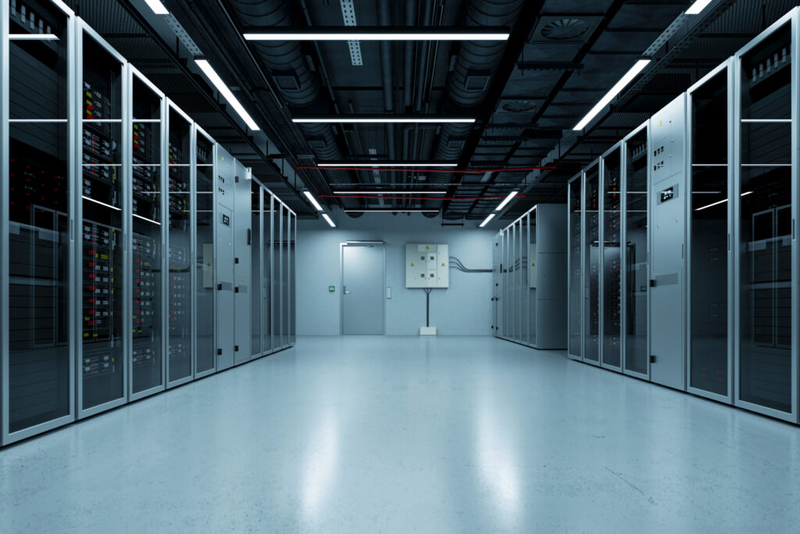
Interior of a modern data center. (Stock photo by Imaginima/Getty Images)
Alarm about the potential threat to the labor economy and even human civilization itself from artificial intelligence sharpened over the weekend and may lead to even more anxiety for Floridians about AI and, specifically data centers, which power that technology.
Anthropic CEO Dario Amodei triggered the escalation Saturday by publishing a 3,800-word essay warning that AI models are advancing so rapidly that they potentially threaten humanity. Anthropic makes Claude AI.
Grassroots opposition to AI infrastructure because of its huge demand on local water supplies and the electrical grid had been growing more pointed since early this year, turning into an issue David Jolly and the Florida Democratic Party are using to attack Republican Byron Donalds in the Florida gubernatorial race.
Jolly, a Pinellas County Democrat, has promised that, if elected, he’ll declare a year-long statewide moratorium on construction of data centers in Florida, echoing a position espoused by lawmakers in 15 other states this year but that has become law only in New York.
Donalds dismisses Jolly’s stance as mere “politics,” but has made a notable retreat from his previous enthusiasm for data centers as the public has turned against such projects.
“I think the future of the state, what’s going to be important are data centers and power. Those are going to be the two critical things for the state of Florida,” Donalds told government affairs consultant and attorney Justin Sayfie in an interview at the Economic Club of Miami in June 2025.
“You’re going to have data centers, tech firms, etc. We need to embrace that, not run away from that. … We are wide open. We have actual land. I mean, not here in Miami, but we have actual land in our state that is still pristine, available to use. We can build out that stuff and still maintain the beauty of our state.”
The Naples Republican voted in May 2025 for the U.S. House’s version of the One Big Beautiful Bill Act, which included a 10-year moratorium on enforcement of state or local regulations for “artificial intelligence models, artificial intelligence systems, or automated decision systems.”
The U.S. Senate later voted to strip that language from the package, and President Trump signed that version into law.
Donalds now says he no longer agrees with the national moratorium.
“That’s one provision that I wasn’t probably the biggest fan of,” he said last week when asked about that vote during a Turning Point USA chapter meeting on the University of Central Florida campus. He added that he supported other provisions of OBBBA. “When you pass these pieces of legislation, especially when they get that big, there’s always going to be one or two things that you don’t agree with.”
State law
Donalds has expressed strong support for a state law (SB 484) regulating data centers pushed by Gov. Ron DeSantis earlier this year, and notes its sponsor was now-former Hialeah Republican state Sen. Bryan Avila, his recently minted running mate.
The legislation requires data centers to pay their own costs of service; establish large-scale consumptive use permits; and that water management districts or the Department of Environmental Protection force large-scale data centers to use reclaimed water for cooling.
It also calls for the Florida Office of Program Policy Analysis and Government Accountability to produce for the governor, House speaker, and Senate president a study related to construction and operation of large-scale data centers by July.
Jolly calls it “a good first start,” but adds, “Why is ratepayer protection considered an accomplishment?”
“I mean, what was the baseline before they suggested that these data centers had to pay for water and pay for electrical usage?” he asks. “Before that, it was tax breaks and hiding it from the public. Now they’re saying, ‘Well, let’s use transparency and make them pay for it.’ But the reality is, people don’t want them.’”
Although Donalds praises Avila’s sponsorship of the data center bill, his campaign isn’t saying anything about a corresponding Avila bill (SB 1118) that would have created a public-records exemption to keep information about potential data centers confidential for up to a year. The bill passed through all three of its assigned committees in the Senate and but died on the floor.
“There’s no reason, at least in the spirit of Florida, there’s no reason why our elected officials should be signing NDAs, right?” Avila acknowledged to the Senate Committee on Community Affairs on Feb. 3, referring to non-disclosure agreements. He tried to soften the impact by telling lawmakers, “You look at other states and they’re signing NDAs for multiple years.”
Sen. Jason Pizzo, an independent from South Florida, was having none of that.
“The greatest implication and consequence of this bill is that local mayors and commissioners will look like they took a kickback — will make it impossible for them to convince their constituents that they didn’t take something from a billionaire developer, data center, whatever, and keep it quiet and not share it with their own neighbors, that one of these things were coming,” he told Avila during the committee meeting about why he could not support his bill.
“That is an impossible position to put local officials in. And it’s one that if any of my local officials in my 20 cities happen to violate, I will represent them for free. So, I have to vote no.”
Industry support for Donalds
Donalds has been a fundraising machine since he entered the race in February 2025, scoring dozens of contributions from artificial intelligence interests including multiple companies seeking to build hyperscale data centers in Florida, as Politico reported in July.
Speaking at the University of Central Florida in Orlando last week, he denied he could be influenced by any single industry despite financial contributions it has sent to his campaign.
“No. Because when I talk about policy and industries and economics, I do it from a laissez-faire approach,” he said. “I do it from essentially the Austrian School of Economics. That’s been my political foundation ever since I got into politics. When I talk about these issues, what you’re hearing right now are my thoughts. Not a white paper. Not some position paper. These are my thoughts. When I go into rooms with companies or interests or donors, I tell them what my plans are for Florida.”
Nineteen Florida local governments have paused or banned data centers, according to FloridaDataCenters.org. There would be a 20th, but although Hillsborough County voted in August to draft such a moratorium, county attorneys informed commissioners that such an ordinance can’t go into effect for another year because of a controversial 2025 state law (SB 180) banning moratoriums on development, which they thought would cover data centers.
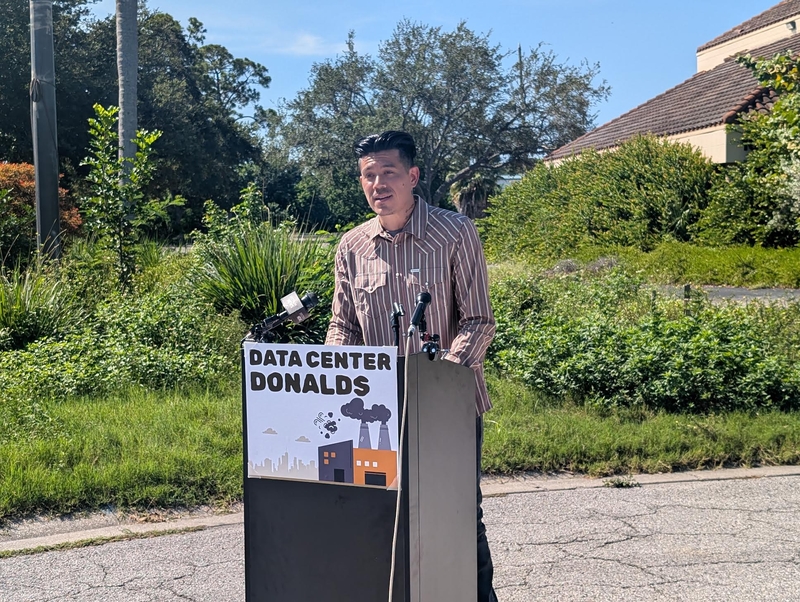
The Florida Democratic Party wants to supercharge the issue. It held a press conference Tuesday at a site where a developer had proposed a 17,000-square-foot data processing facility in Pinellas County. That proposal was quashed for the time being after the county commission imposed a one-year moratorium on data centers last month.
“This November, data centers will be a defining issue for Floridians and voters as they go to the ballot box,” said Joey Mendoza Atkins, the Democratic candidate for agriculture commissioner. “And when I’m Florida’s next commissioner of agriculture, keeping them out of communities is going to be a top priority.”
The Jolly campaign announced this week that the Democratic candidate will visit “Data Center Alley” in Northern Virginia “to see firsthand how out-of-control data center development has upended local communities.” The region has been described as the densest concentration of data centers in the world.
Bipartisan anger
Elizabeth Plantan is an associate professor of political science at Stetson University. She points to widespread uncertainty, anger, and fear about what AI means for the future of work and employment in the country — as well as the environmental concerns — driving bipartisan anger against these facilities.
“I think that this is unique, especially as we have more and more data and research on how polarized the American public is, that it’s quite surprising to have something with this much bipartisan pushback,” she said.
A public opinion poll published in July by the Public Opinion Research Lab at the University of North Florida showed that 68% of respondents said they would oppose building an AI data center in their area. A James Madison Institute poll of 1,400 Floridians also taken in July found that 49% of respondents said they either somewhat or strongly opposed data center investment in the state, while 40% said that they somewhat or strongly support it.
Jonathan Schaeffer is a distinguished professor emeritus at the University of Alberta. He says it’s healthy for local communities to hold public discussions around housing data centers, but people need to know the benefits and potential downfalls of building one in their neighborhoods.
“We are an information technology-rich society,” he said. “Data centers are the reality. We want the internet. We want cloud computing. We want e-commerce. We want lots of things that these data centers provide. Not just AI. The real issue only comes into focus when you talk about one of these hyperscale centers because of their enormous size and impact.”
Donalds is hardly the only public official who has curbed his enthusiasm for data centers. Both Texas Republican Gov. Greg Abbott and Pennsylvania Democratic Gov. Josh Shapiro also have made notable pullbacks from their previous support.
Donalds was attacked for his stance on data centers during the GOP primary campaign by his opponents. In July, he responded by introducing federal legislation called the “Protecting the Ratepayers Act,” to ensure entities that build, own, or operate data centers obtain all their energy and water from alternative sources that don’t use or interfere with the electric grid or public water systems.
Plantan warns of unintended consequences from such legislation, however, because it doesn’t regulate how those companies obtain their energy or water resources.
A case in point is Elon Musk’s supercomputer facility called xAI in Memphis. Since breaking ground last year, the company has operated dozens of unpermitted methane gas turbines without public notice, permits, or air pollution controls. In response to growing community outrage, SpaceX agreed to remove all 69 gas turbines by July 2027.
Donalds “is shifting his positions because they’re politically unpopular,” Jolly argues.
“He went through the framing of ratepayer protection that you can plunder our state as long as you pay us for it,” he told the Phoenix during a Labor Day event last week in Tampa.
“Now he’s saying local control, but when he had a chance to stand up for local control, he voted against it. The Big Beautiful Bill, the House version, said that they were going to preempt local control of data center decisions. He named a running mate that actually tried to hide [via his proposed NDA legislation] from residents when AI data centers were being contemplated or being planned. We know what he’s doing. He’s doing everything but saying, ‘We should keep data centers out of the state,” because he’s furthering the special interests of people who are benefitting from them.”
Donalds told the Phoenix earlier this month the state’s law is “a really strong step in the right direction. … It starts with local control. If local governments don’t want them, they won’t build them, and that’s just the way it is.”
Perhaps complicating Donalds’ stance is the attitude of the president of the United States, who has been dismissive of concerns about data centers.
“AI and Data Centers, will be the Greatest Economic Development Engine in History — Bigger than Oil, Gold, Diamonds or even the Internet,” Trump said Monday on his Truth Social page. “It will not be stopped by brilliantly run Destructive Forces during the Term of President DONALD J TRUMP!”
Tallahassee, FL