Arkansas lawmakers question utility on data center projects, impact on ratepayers
Sep 15, 2026 | 8:35 pm ET
Description
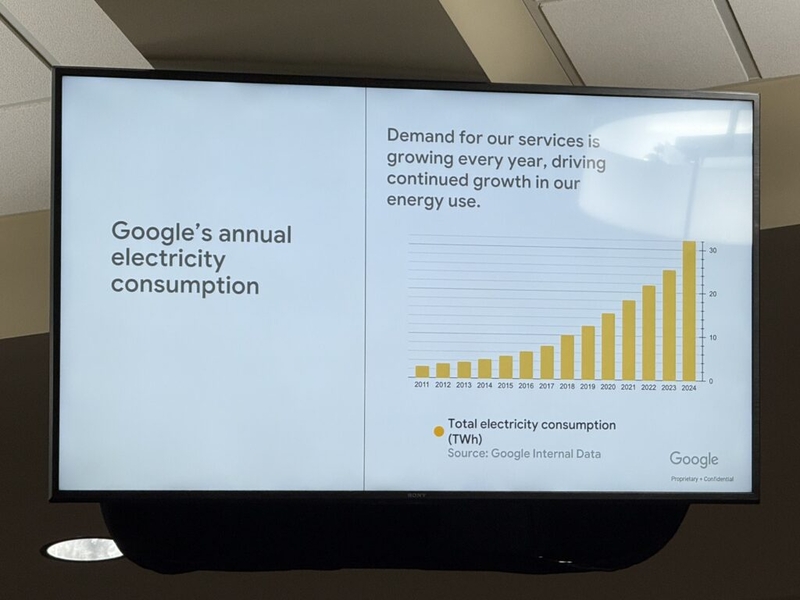
A slide from a presentation shown by Google to Arkansas lawmakers shows the internet giant's electricity demands over the last several years on Sept. 15, 2026. (Photo by Ainsley Platt/Arkansas Advocate)
Lawmakers questioned Entergy officials Tuesday on the Arkansas data center projects it is powering, with several expressing concerns with the utility’s decision to recoup from ratepayers the costs of a solar and battery storage facility for a West Memphis project.
Republican Sen. Mark Johnson, the co-chair of the Joint Energy Committee, also criticized the utility’s decision to sue the Arkansas Democrat-Gazette over its reporting on documents it obtained regarding Entergy’s power agreements with Google. A federal judge rejected the utility’s attempt to block the newspaper from publishing further details about the documents.
Judge denies effort to block Arkansas outlets from publishing details about data center agreement
“I would be remiss if I didn’t say I’m disappointed to see Entergy suing in federal court over a First Amendment issue,” Johnson said. “This was unprecedented. I’ve never seen anything quite like this.”
After back-and-forth about the lawsuit, Johnson then pulled out his own Entergy power bill, saying he had “a problem digesting this stuff.”
“I’m the chairman of this committee. I’ve served on it since I’ve been in the General Assembly, and this whole thing, starting with the Generating Arkansas Jobs Act and subsequently — it boggles my mind sometimes to figure this out,” Johnson said.
His power bill had an added $22.81, a result of a new rider that Entergy Arkansas tacked onto power bills earlier this summer.
It was added as a result of a state law, the Generating Arkansas Jobs Act of 2025, that allows utilities to begin recouping the costs of building new power generation facilities from ratepayers before those facilities are completed. It charges just over half a cent per kilowatt hour used, per month.
The rider was approved by the Arkansas Public Service Commission earlier this year, and pays for three power generation facilities being built by Entergy Arkansas. One of the facilities is Cypress Solar, which will be used to cover power demand from Google’s $4 billion West Memphis data center. None of the generation projects covered by the rider have been completed yet.
“Now, some of the justification is, well, we don’t want to hit everybody with a great big bill all at once,” Johnson said. “Well, for 100 years we’ve been doing it this way, why is it suddenly not going to work to use the traditional model, where if you’re a private company, a regulated utility, you get a guaranteed rate of return determined by the PSC, and you pay your own upfront costs.”
Outside of Little Rock, Arkansas counties and cities move ahead on data center moratoriums
John Bethel, Entergy Arkansas’ director of public affairs, told lawmakers that the rider just shifts up costs that ratepayers would eventually have to pay and ultimately saves ratepayers money by reducing interest and other costs that increase over time.
“It’s the same cost, but it’s a timing difference,” Bethel said. “It saves money in financing costs that customers pay, and it saves money in what actually comes out of their pocket over the time that the assets in service is serving them.”
According to reporting by the Arkansas Democrat-Gazette, Google is paying Entergy hundreds of millions upfront for electric service at its under-construction West Memphis facility, as well as millions in yearly payments. In all, the internet giant will pay $2.1 billion over the next 20 years in connection to the facility in West Memphis — but those payments are not specifically going towards the $1.6 billion Cypress Solar project.
Republican Sen. Matt McKee said that while Entergy said Google was covering all costs associated with serving its data centers under the utility’s “Fair Share Plus” pledge, he said he needed an explanation for why Entergy was still recouping costs for Cypress Solar from regular ratepayers through the rider. According to Entergy, data center agreements under the Fair Share Plus pledge “ensure that data centers pay their fair share for the power they use plus produce additional savings or benefits for existing customers on the power grid.”
“Help me understand the process of why that benefits ratepayers, because unfortunately I don’t think that’s how most ratepayers look at that,” McKee said.
David Palmer, Entergy Arkansas’ vice president of regulatory affairs, said the need to ensure the solar facility was built in time for the data center to go online on schedule, plus the utility’s pursuit of tax credits associated with Cypress Solar, played into that decision.
“There are requirements that have shifted even as we were negotiating with Google. So, from a timing standpoint, we’re faced with, well, we’ve got to get the construction started. We need the financial support for the construction of the project,” Palmer said. “There’s also this build out that Google is going to have to do before they’re actually spinning that meter and paying those rates.”
Little Rock