Deportation decision for Salah Sarsour expected before end of September
Sep 15, 2026 | 4:36 pm ET
Description
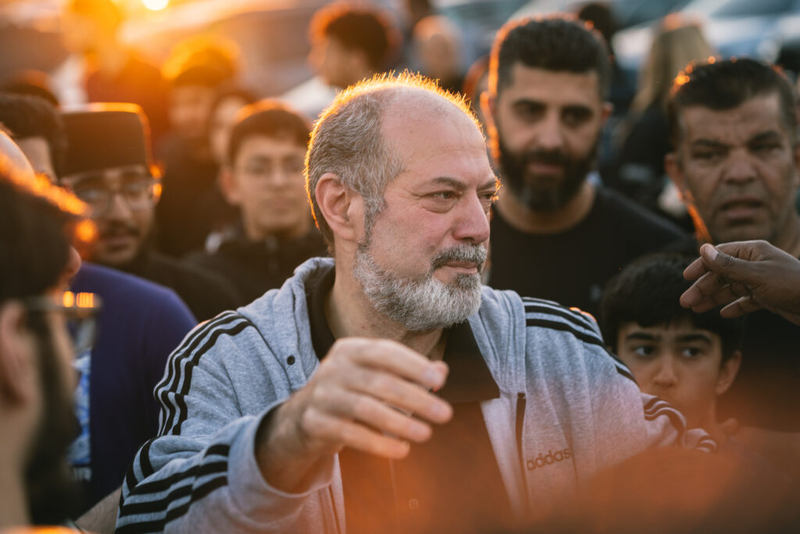
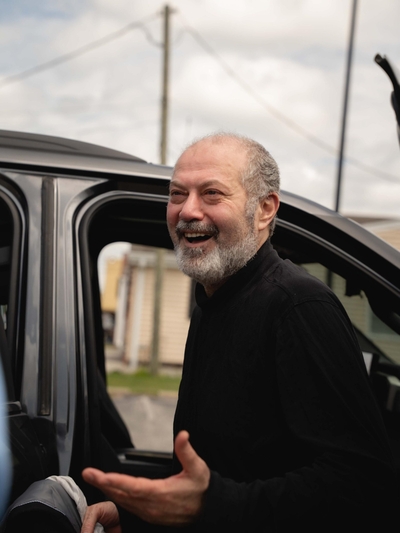
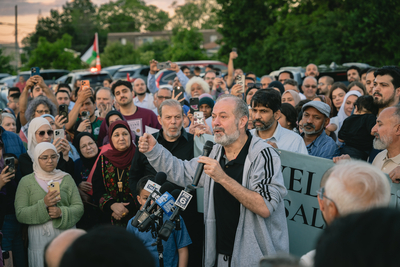
Salah Sarsour is released from immigration detention in June, 2026 . (Photo by Yaseen Najeed)
The fate of Salah Sarsour, president of the Islamic Society of Milwaukee, is now in the hands of a federal immigration judge in Kansas City who, by Sept. 30, will decide whether Sarsour can be deported from the place where he has lived as a legal permanent resident for over 30 years.
Monday concluded court testimony from experts and witnesses in Sarsour’s deportation case. Sarsour was arrested in late March by armed federal immigration agents in Milwaukee. He had never been arrested in the United States before.
“What’s at stake here is not just whether this good man can stay here, but whether people can speak freely in this country without fear of unlawful retribution,” Sarsour’s lawyer Patrick Taurel said after the Monday hearing.
The Department of Homeland Security claimed that Sarsour lied on his green card application when he came to the United States in the late 1990s. DHS also claims that Sarsour, a Palestinian man, had been convicted in Israeli military courts of throwing Molotov cocktails at the homes of Israeli soldiers in 1988, and separately accused of illegally attempting to possess weapons and ammunition in 1995.
Taurel, representing Sarsour, disputed those accusations Monday saying DHS had broadcast them in “libelous press releases.” Taurel said Sarsour had been detained as a Palestinian teenager by Israel’s occupying army and convicted in military court for throwing stones and disorderly conduct, not for throwing Molotov cocktails. This occurred during the First Intifada, a mass Palestinian uprising against the Israeli army which lasted from 1987 to 1993.
Amahl Bishara, a professor at Tufts University, testified during one of Sarsour’s hearings in late July that stone throwing was an act of political expression against the occupation carried out by Palestinian youth. Taruel described it as “a kind of screaming into the void that they don’t approve of the occupation,” during a Monday press conference.
Jawad Boulos, who represented Sarsour as an attorney in the West Bank, addressed the military court record from the 1990s.
He recommended that Sarsour take a plea in the 1995 case because the Israelis were offering what Boulos felt was an unusually good deal by reducing four charges to just one of procuring weapons, and having Sarsour agree to time served. The plea deal also allowed Sarsour to avoid waiting up to two more years in detention for a trial. The lenient deal was evidence to Boulos that even the Israelis did not take their own accusations against Sarsour seriously.
Responding to DHS arguments that if Sarsour were tortured the record of his imprisonment would have shown that he suffered harm, Boulos said that the Israeli authorities sometimes did not allow him to see his client. He noted a no-contact order among the Israeli documents barring Boulos from seeing Sarsour during the first several weeks of Sarsour’s confinement. During hearings in July, Sari Bashi, an Israeli lawyer and human rights investigator, described the West Bank, where Sarsour grew up, as a place under “belligerent occupation” where confessions are coerced through torture, and the local Israeli commander acts as the executive, lawmaker, judge, and executor of law.
Dr. Jackie Bashkoff, a forensic psychologist, testified in July that after evaluating Sarsour, she determined that he suffers from Post Traumatic Stress Disorder stemming from his experiences of being tortured.
Prosecutors said Monday that Sarsour’s defense team “completely glossed over” that Sarsour never “complained about mistreatment” by the Israelis. “That silence says everything,” said attorney Scott Jebson, representing the Department of Homeland Security. He added that Sarsour never mentioned having gone to the hospital due to torture, and that Israeli court records don’t mention that he claimed he was abused by the Israeli interrogators.
In earlier hearings, prosecutors also attempted to cast doubt on Sarsour’s PTSD diagnosis. Jebson said that Dr. Bashkoff used “buzz words” to describe Sarsour as having a “startle response.” Prosecutors also suggested in earlier hearings that symptoms of his type 2 diabetes could be confused for PTSD. “I can go through every witness they called” and discredit or undermine their testimony, Jebson told the judge on Monday.
Besides Sarsour’s detention by Israeli authorities, DHS is also accusing him of attempting to register to vote despite not being a U.S. citizen in the lead-up to the 2004 elections. Prosecutors have pointed to a voter registration card with Sarsour’s name on it.
Sarsour never attempted to cast a ballot, and his defense team suggested that the registration card could be linked to documented problems with a voter registration drive involving about 3,000 special registration deputies in Milwaukee. The Legislative Audit Bureau issued a letter in 2005 highlighting problems with the deputies. “Some special registration deputies are municipal officials, but many work for interest groups or political parties,” the report read. “Problems have been identified with registrations completed by some special registration deputies, including inaccurate, illegible, and falsified registration forms.”
Taurel said Sarsour had no recollection of signing the card and that when he learned about it in 2009, he took steps to remove it. Taurel also said that even if Sarsour signed the card it wouldn’t matter because he never actually voted, and thus would not have received a benefit by claiming to be a U.S. citizen under the law.
Mark Robel, an FBI polygraph examiner, testified in July that he examined Sarsour asking him whether he ever knowingly voted as a non-citizen during the 2004 election and whether he ever registered to vote. Robel said Sarsour passed the polygraph with no deception detected. “If he had tried to register to vote in any election, he would not have passed that test,” Robel told prosecutors when they questioned the polygraph’s accuracy.
A check of MyVote Wisconsin shows that Sarsour is not currently registered to vote.
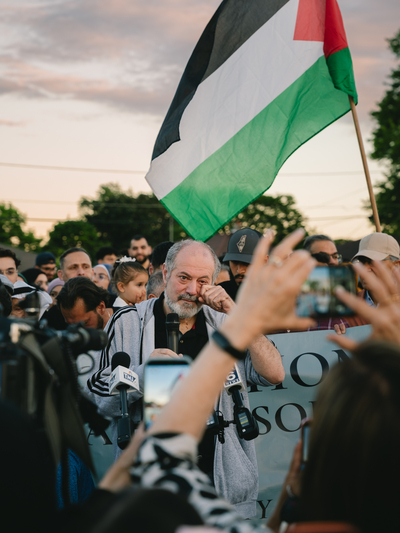
Taurel said the Trump administration has targeted Sarsour because of his outspoken advocacy for Palestinian rights. “We are here because of Salah’s speech,” he said. “I’m not speculating about this,” Taurel said, citing the government’s reasoning in the case, which claims Sarsour is a national security threat. “The reason they arrested him, the reason we’re here, is his speech.”
In June, Sarsour was released from an Indiana immigration detention center, where he was held for more than 80 days. He was ordered released by a Trump-appointed federal judge, who ruled that Sarsour had a “substantial” claim that his arrest was First Amendment retaliation.
Sarsour is both the president of Wisconsin’s largest mosque and a board member of American Muslims for Palestine, which has been labeled by the conservative Heritage Foundation as part of a support network for Hamas.
In June 2025, Secretary of State Marco Rubio issued a memorandum stating that Sarsour was eligible for deportation because “his actions undermine U.S. foreign policy.” In February of this year, the Justice Department announced that it would target groups like American Muslims for Palestine. The following month in March, Sarsour’s profile on a pro-Israel doxxing website called the Canary Mission was updated. Four days later he was arrested by federal immigration agents.
Taurel said that while he believes that Sarsour has a strong case against being deported, immigration judges are under extraordinary pressure from the Trump administration and the neutrality of the immigration court system “has been severely undermined.”
The judge in Sarsour’s immigration case, Jayme Salinardi, is expected to make a ruling on whether he can be deported by the end of the month. The Milwaukee Journal Sentinel reports that Salinardi has a record of denying asylum claims 90% of the time — far above the national average of 59%. A Democratic appointee, he previously worked as an attorney for ICE.
On Sept. 30, the court will hold a status conference on the case. If the judge decides that Sarsour can be deported, then his attorneys will push for relief. Taurel said that “we fear the worst,” if he is sent back to Israel-occupied territory.
Taurel said that Sarsour is not backing down, adding that Sarsour will appear with Taruel on a podcast in the coming weeks, and is expected to travel to Washington D.C. to speak with elected officials. “Salah refuses to be cowed by this,” he said on Monday. “He is a brave, courageous advocate for Palestine. He won’t be silenced. He is not required to be muzzled in any way.”
Madison, WI