Nearly 150 Allina hospital doctors walk off the job in historic 4-day strike in Minnesota
Sep 14, 2026 | 3:48 pm ET
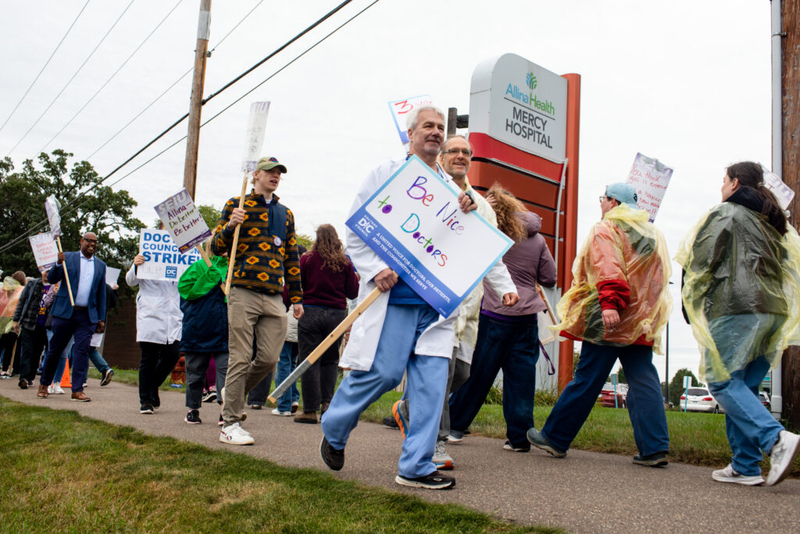
Description
Doctors Council-SEIU members at Allina picket during a historic four-day Unfair Labor Practice strike at Allina Mercy Hospital in Coon Rapids, Minnesota Monday, Sept. 14, 2026. (Photo by Nicole Neri/Minnesota Reformer)
Nearly 150 unionized doctors at two Twin Cities area hospitals began a four-day strike on Monday in what’s believed to be the first walkout by private-sector hospital doctors in U.S. history.
Doctors clad in their white coats walked picket lines outside Allina Health’s Mercy Hospital in Coon Rapids and Unity campus in Fridley, carrying signs that read “patients over profits” and “burn out hurts.”
Union leaders say the strike — and potential disruption to patient care — is a necessary last resort after negotiating for more than three years for a first labor contract governing wages and working conditions.
Their fight, they say, goes beyond pay and benefits: It’s a fight against profit-focused hospital executives who demand workloads so punishing that doctors are burning out, with patients’ care at risk.
“We need to be able to stand up for ourselves,” said Dr. Amber Galarowicz, an Allina hospitalist and bargaining team member for the union Doctors Council SEIU. “The voice that we’ll be able to have for our patients far outweighs the next four days.”
Allina Health, one of Minnesota’s largest health systems with 12 hospitals and over 60 primary care clinics, downplayed the potential impact of a strike by a “small portion of physicians,” noting the union represents only about 10% of the physicians who can provide care at both facilities.
In a statement on Thursday, Allina Health said that both hospitals “will continue normal operations, with no disruption to services.”
“A strike does not benefit anyone. It only adds pressure for patients, families, care teams and the broader community who rely on Mercy Hospital, a Level 2 trauma hospital and one of the busiest hospitals in the metro,” the health system said in a statement on its website.
Allina Health, which had more than $6 billion in revenue in 2025, has seen significant labor unrest in recent years. More than 60 Allina hospice nurses began a seven-day strike on Friday, after failing to reach a deal that addresses their concerns about low staffing levels.
“We have spent so much time caring for our patients and not feeling that we matter,” said Allina hospice nurse Susie Smerz at a Monday news conference outside Mercy hospital.
Last November, hundreds of Allina doctors, physician assistants and nurse practitioners across its primary and urgent care clinics went on strike for a day in what was believed to be the first by doctors in state history and the largest in U.S. history. The advanced care providers then voted to strike indefinitely this spring before reaching an agreement on a three-year contract.
The doctors at Mercy and Unity hospitals voted to unionize in 2023 and have met more than 60 times with health system leaders to negotiate a first contract, including on Sunday night. They voted to authorize a strike with 90% support in July and gave 10-day’s notice before beginning the work stoppage.
One of the top issues is paid sick leave, said Dr. Alia Sharif, a hospitalist and bargaining team member. While state law entitles all workers to paid sick leave — six days a year for full time workers — Allina hospital doctors say they aren’t able to take paid time off when sick.
“It’s become unsustainable for us to continue working like that,” Sharif said. “Doctors get sick.”
The union and the health system are also stuck over pay raises, with doctors complaining they haven’t received cost of living adjustments amid high inflation.
And, the two sides continue to be at odds over which doctors can be covered by a union contract because doctors often work across various Allina hospitals. While doctors must spend at least 20% of their time working at Unity and Mercy hospitals to be included in the union, how that time is calculated is disputed.
Hanging over the negotiations is the proposed merger between Allina and the far-larger California-based Sutter Health to create a combined $26 billion system with 39 hospitals serving more than 5 million patients in California, Minnesota and Wisconsin.
The merger, which is fiercely opposed by labor unions, is under review by the Minnesota Attorney General’s Office.
Unions and health care advocates warn the increasing consolidation in healthcare is driving up costs for patients, hurting care and suppressing wage growth for workers.
Sharif said she doesn’t expect her union to stop the merger, but does hope to see a community benefits agreement to shield against immediate service cuts and layoffs like the one recently reached between the state and Sanford Health in acquiring North Memorial’s Robbinsdale hospital.

Saint Paul, MN