New report explores barriers and possible improvements to state childcare assistance program
Sep 14, 2026 | 12:01 pm ET
Description
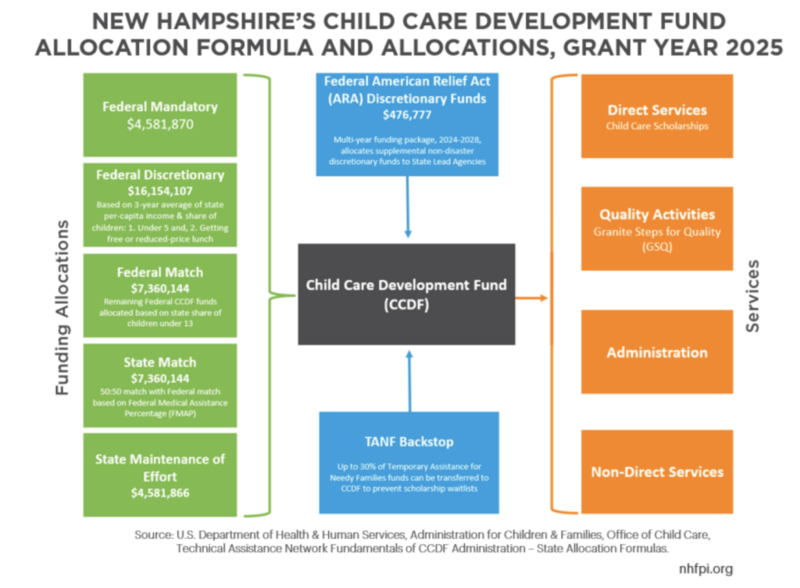
This chart shows how New Hampshire's Child Care Development Fund, which pays for the state's childcare assistance program, is funded. (Screenshot)
The New Hampshire Fiscal Policy Institute published a new report Monday analyzing the state’s childcare tuition assistance program and its problems, and offered potential expansion strategies and improvements for providers and families.
The New Hampshire Child Care Scholarship Program helps families afford childcare by subsidizing tuition costs and paying childcare programs directly for services. The program is designed to reduce the cost of child care services for working parents, so long as they are working, in school, or in a training program.
Children must be under 13 years old, or 18 years old if they have a disability, and families must meet work and financial eligibility requirements to enroll. As of July 2026, more than 5,800 children were enrolled in the scholarship and connected to a childcare program.
The report, written by senior analyst Dow Drukker, explores how the scholarship program works for families and childcare programs, how it is funded using state and federal dollars, and its impact on Granite State families and the economy, as well as its fiscal toll on the state.
“We want folks to recognize New Hampshire has expanded the scholarship program substantially in recent years. We’re seeing increased demand and enrollment, but I think the system is constrained in a lot of ways,” Drukker said in an interview with the Bulletin. “We (want) to be able to provide policymakers with sort of a lay of the land of how other states are looking at expanding or strengthening their program, so then we could start to think a little bit more about how can we apply or think about our own scholarship program in similar or differing ways.”
For young families, access to childcare is crucial to allowing them to go to work and contribute to the state’s economy. Provider shortages and a lack of available, affordable childcare cause families and the state to lose out on revenue.
Between 2023 and 2025, the state’s childcare workforce declined by 6%, representing a loss of about 330 educators and staff. Research suggests that in 2023, the state’’s childcare shortage may have cost businesses up to $56 million and state and local governments up to $14 million in lost revenue. Overall, from 2017 to 2025, the number of licensed childcare programs in New Hampshire declined by 16%.
“The program serves as both an early childhood support and a financial support, helping families access care while supporting labor force participation and provider stability,” Drukker wrote.
The report also examines the recent shift in New Hampshire’s reliance on federal funds, instead of state general funds, for the program.
From the 2020-2021 biennium to the current 2026-27 biennium, state general fund appropriations for early childhood education have declined by 11%, including a 19% reduction in funding for the scholarship program. In the same time period, reliance on federal funding, primarily coming from transferred Temporary Assistance for Needy Families, or TANF, dollars has increased by 62%.
Enrollment in the childcare scholarship program has increased substantially since 2021, with a large increase in 2024 after the state expanded financial eligibility. As a result, the state is spending more on the program to prevent a waitlist, but with less state money to do it. If TANF funds run out, a waitlist may be needed anyway.
The report also explores policy approaches and lessons that other states employed to stabilize their childcare tuition assistance programs and maximize their ability to work within the broad federal rules. Drukker gives examples of states that have employed tactics to improve affordability, strengthen provider participation in the scholarship program, and enhance program administration, and how those tactics could be used in New Hampshire.
Potential considerations include broadening family income eligibility requirements to prevent parents, specifically mothers, from leaving the workforce and risking future economic and employment instability; targeted eligibility waivers to childcare professionals so they can have access to the scholarship and continue to work in the workforce; embracing the flexibility that the federal government gives states in designing their scholarship programs; and more.
The scholarship program, provider shortages, and affordability are all interconnected and directly related to New Hampshire’s and families’ economic well-being. The report suggests that a well-funded scholarship program with a reimagined design could improve the lives of families and childcare programs alike.
“It can’t just be about affordability. It needs to be about investments in provider capacity, the workforce, administratively, from a funding perspective,” Drukker said. “New Hampshire families need both affordable care and a sufficiently large financially sustainable provider network that can serve them, and that there are levers that can be pulled within the scholarship program design that can get at that.”
Concord, NH