Misinformation, hesitancy could blunt impact of new cancer vaccines
Sep 14, 2026 | 5:03 am ET
Description
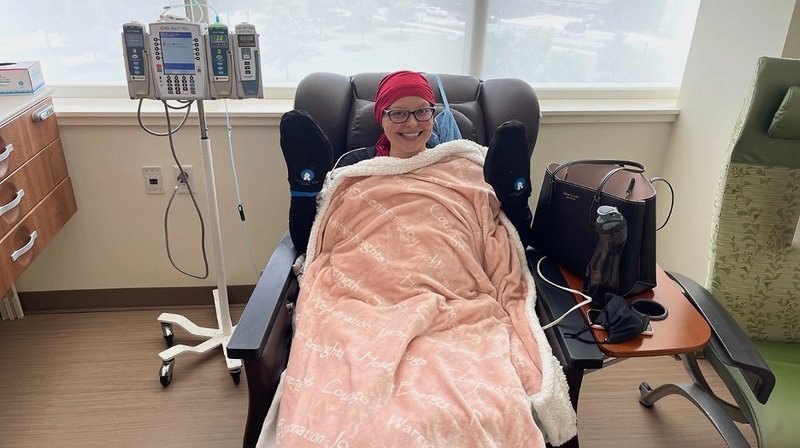
Chase Johnson of Cary, North Carolina, is among the cancer survivors and patients participating in a clinical trial for a new breast cancer vaccine. New cancer vaccines could be coming, but doctors and researchers are worried that rising vaccine hesitancy, fueled in part by the Trump administration, could blunt their impact. (Photo courtesy of Chase Johnson)
Nearly five years ago, Chase Johnson was cured of breast cancer — but not of the profound anxiety that it would return.
When Johnson was originally diagnosed in 2021, the resident of Cary, North Carolina, was only 31 — nearly a decade away from the age at which regular mammograms are recommended — and she had no history of breast cancer in her family. She only got screened because her dog, Cato, kept poking her chest with his nose, which helped her discover a lump.
Doctors discovered that Johnson had stage 2B triple-negative breast cancer, a rare and aggressive form. They treated her with chemotherapy, radiation, and surgery, and in 2022, they declared her cancer free. Her oncologist warned her, however, that there was a 40% chance the cancer would return.
Anxious about that prospect, Johnson enrolled in a clinical trial at the Cleveland Clinic testing a new breast cancer vaccine, developed in partnership with Anixa Biosciences. That vaccine has shown positive early results: In nearly three-quarters of the participants, including Johnson, it has generated an immune response.
“It’s just so promising and as a patient, it gave me a lot of hope,” said Johnson, now 37. “I feel much more protected having done it.”
In the past two decades, there has been steady progress in developing vaccines for cancer. The vaccine Johnson is taking isn’t one of them, but researchers are especially excited about the potential of mRNA vaccines, which use synthetic genetic instructions to teach a person’s immune system how to recognize and destroy unique proteins found on cancer cells.
Just last month, pharmaceutical companies Moderna and Merck announced that a personalized mRNA cancer vaccine, combined with an immunotherapy drug, had succeeded in a late-stage trial for skin cancer. The news raised hopes that a wave of new cancer vaccines could be just over the horizon.
But will Americans be willing to take them?
Many doctors and researchers are concerned that vaccine misinformation — amplified by the Trump administration — and the resulting increase in vaccine hesitancy could blunt the impact of the new vaccines. In particular, they cite the false claim, which originated with mRNA COVID vaccines, that mRNA vaccines can super-charge tumors, creating so-called turbo cancer.
Many point to the human papillomavirus (HPV) vaccine as a cautionary tale.
Some strains of HPV, which is spread through sexual contact, can cause cancer of the cervix, vagina, vulva, penis, anus, mouth, throat, head or neck. In 2006, the U.S. Food and Drug Administration approved an HPV vaccine for girls and women ages 9 to 26, and three years later the agency expanded approval to include boys and young men. Ideally, vaccination should occur before a person is sexually active.
The HPV vaccine is safe and extremely effective. But decades of misinformation, some of it spread by state and federal lawmakers, has reduced uptake: For four years in a row, vaccination rates for teenagers have not budged, and there is wide variation among states.
“I don’t think we can overstate the impact that the pandemic and the misinformation and disinformation around vaccines has had on all vaccines, including HPV vaccine,” said Dannell Boatman, an assistant professor at the West Virginia University Cancer Institute.
Trump vaccine order takes aim at states that limit exemptions
A 2024 study Boatman co-authored, funded by Merck, found that the HPV misinformation on social media platforms was most pervasive in the users’ comments.
“There were some really wild conspiracy theories about girls in India being killed with the HPV vaccine,” Boatman said. “We also were able to identify a lot of mistrust of authority.”
Boatman said she expects a similar dynamic with breast cancer vaccines, especially since some people already are spreading misinformation that mammograms can cause cancer. But she hopes an ongoing study on “inoculation theory” will help researchers combat false claims.
“Basically, you forewarn someone that they’re going to be exposed to misinformation,” she said, “and then you refute it or provide them just a little bit of evidence about why it doesn’t work.”
History of lawsuits
Before he joined the Trump administration, U.S. Department of Health and Human Services Secretary Robert F. Kennedy Jr. filed complaints and lawsuits against Merck, the maker of the HPV vaccine, and claimed on social media that the “vaccine appears to be increasing the risk of cervical cancer in vaccinated age groups just as COVID vaccines raise the risk of COVID.”
Early in his tenure, Kennedy dismissed all 17 members of the HHS vaccine advisory panel, replacing some of them with vaccine skeptics. Under his leadership, HHS also has altered the child vaccine schedule for certain diseases, including HPV. So far, those changes have been blocked in federal court.
HHS did not respond to a Stateline request for comment.
Last month, after signing an executive order separating the measles, mumps and rubella (MMR) vaccine into three separate shots, Republican President Donald Trump suggested, falsely, that each individual vaccine could fill a “bottle of soda.” The administration has also proposed cutting funding for vaccine research and studies on vaccine hesitancy.
Epidemiologist Michael Osterholm, director of the Center for Infectious Disease Research and Policy at the University of Minnesota, said Kennedy’s appointment spurred the creation of the Vaccine Integrity Project, a partnership between the center and the American Medical Association that tries to bolster public trust in vaccines. The project has published evidence reviews of some of the vaccines criticized by the Trump administration.
“To a young parent today who wants to do the right thing, they want to protect their child, they’re so confused because they hear from the leaders in public health in their government talk about these vaccines killing people,” Osterholm said.
“The credibility of 80 years of public health work of vaccines in this country is threatened because of confusion.”
In May, the center published an evidence review showing that HPV vaccines are not associated with serious side effects and reduce the risk of cervical cancer by 80% in individuals who are vaccinated by age 16, and by 66% in people vaccinated after 16.
Resistance from state lawmakers
But the HPV vaccine has long faced resistance from some conservative lawmakers, who associate it with teen sex.
Last year, 78% of U.S. teenagers ages 13-17 had received at least one dose of the HPV vaccine and 63% had completed the full HPV vaccination series. But in some conservative-leaning states, the rates were much lower: The complete vaccination rate in Mississippi was only 31%. Oklahoma (46%), Kentucky (50%), Arkansas (52%) and South Carolina (55%) also had particularly low rates.
At the other end of the spectrum were Rhode Island (85%), Hawaii (82%) and Massachusetts (80%).
Some states, including Alabama and Oregon, have made recent efforts to boost their HPV vaccine rates.
But other states, including Iowa, have enacted laws limiting access to the HPV vaccine. Republican Gov. Kim Reynolds in May signed a law prohibiting Iowans under 18 from consenting to vaccinations related to sexually transmitted diseases and infections, including HPV.
Democratic governors launch multistate public health alliance to counter Trump, RFK Jr.
Idaho Democratic state Rep. Brooke Green said anti-vaccine sentiment is increasing among residents of her state — and among her legislative colleagues. As a survivor of breast cancer, Green is excited about the prospect of new cancer vaccines, but she fears that rising hesitancy could be hurdle to widespread adoption.
She noted that Idaho Republicans introduced a bill this year that would have established a two-year moratorium on mRNA immunizations for children and pregnant women. Similar bills were introduced in at least a dozen other states, though none were enacted.
This year, lawmakers in 34 states introduced 209 bills seeking to loosen vaccination rules, limit access to certain kinds of vaccines or sow doubt about their safety, according to a recent analysis by The New York Times.
“We are seeing several attempts to address some of the scientific tools that are used to create vaccines, mRNA vaccines and so forth,” Green said. “As a cancer patient, these are life-saving tools that are helping us.”
“I’m thrilled to see these new innovative advancements in medicine for these vaccines. Now, is it going to be widely accepted?” said Green, who was first diagnosed with breast cancer in 2024, a week before her mother was diagnosed with the same cancer.
“There will be some hesitation and some pushback. But look at the flip side: ‘Do you want breast cancer or do you not? Do you want skin cancer? Do you not?’”
Chase Johnson, meanwhile, said her anxiety has significantly decreased, especially after celebrating five years in remission this summer.
“I think I’ll always have some sort of low-grade anxiety about it,” Johnson said. “But it’s definitely at a much lower level than it was before vaccination. It’s given me a great, great amount of peace of mind.”
Stateline reporter Sofia Resnick can be reached at [email protected].
- 10:24 amEditor's note: This story has been corrected to include Anixa Biosciences' role in the development of a breast cancer vaccine at the Cleveland Clinic, and to clarify that an evidence review of the HPV vaccine applied to all individuals, not just minors.