Appeals court upholds ‘Secure the Border Act’ that jails border crossers
Sep 10, 2026 | 7:03 pm ET
Description
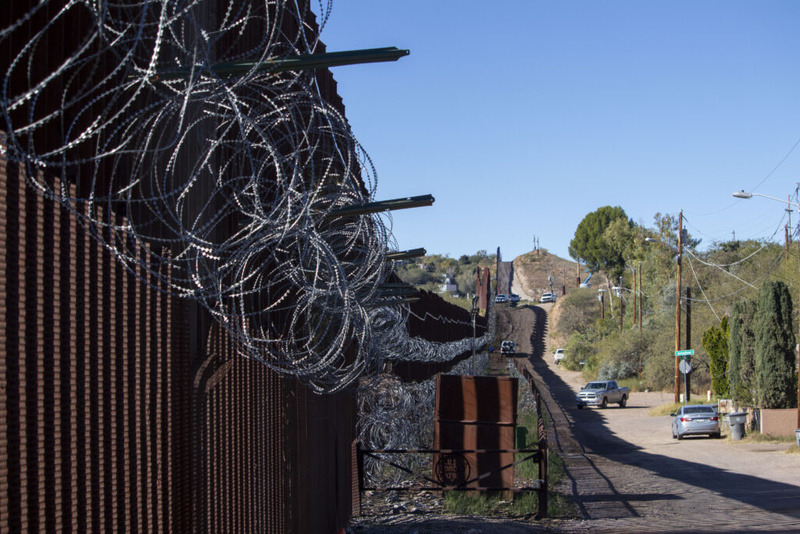
The border wall between the United States and Mexico in Nogales, Ariz. (Photo by Jerod MacDonald-Evoy/Arizona Mirror)
The Arizona Court of Appeals on Thursday upheld a 2024 law that punishes immigrants who cross the state’s southern border with jail time, rejecting a lawsuit that argued it violates the Arizona Constitution because it failed to take into account how much it would cost the state.
Living United for Change in Arizona, the immigrant rights group that sought to block the law from ever being implemented, decried the ruling as out of touch and said it’s looking into whether to ask the Arizona Supreme Court to take up the matter.
“We are appalled that the Court of Appeals has allowed Proposition 314 to stand at a moment when immigrant communities are already being terrorized by an increasingly aggressive federal immigration enforcement apparatus,” said Alejandra Gomez, LUCHA’s executive director.
Two years ago, 63% of Arizona voters cast their ballots in favor of Prop. 314, known as the “Secure the Border Act.” The sweeping new law lets state officials, including local police officers and state judges, exercise federal immigration enforcement authority. Its most controversial provision, which only went into effect this summer, makes it a misdemeanor for immigrants to cross Arizona’s border anywhere but at an official port of entry, which is punishable with up to 6 months in jail.
In April 2025, LUCHA filed a lawsuit that argued the law should be thrown out because it’s unconstitutional, conflicting with rules in the Arizona Constitution around how ballot measures are written and what the judicial branch’s role is. The main argument advanced by attorneys for the group is that Prop. 314 fails to set aside a funding source despite the likelihood that its requirements will cost the state money. The Arizona Constitution expressly mandates that ballot measures identify a revenue source for proposals that incur costs, and forbids that source from being the state’s general fund.
Provisions in Prop. 314 that attorneys said would likely result in a cost to the state require the Arizona Department of Corrections, Rehabilitation and Reentry to house people convicted of crossing the state’s border without permission if local law enforcement agencies don’t have the ability to do so; mandate state agencies to use a federal database to verify the immigration status of people applying for public benefits; and direct law enforcement officials to transport immigrants to a port of entry or into federal custody.
But the three-judge appellate panel disagreed with that assessment, saying that much of the costs might not end up being paid by the state, but be shouldered instead by local officials. Prop. 314 merely designates state officials as a contingency plan in case local agencies can’t house or transport immigrants, the judges wrote. And that means Prop. 314 doesn’t outright require the state to spend money.
“The Transport Provision authorizes ‘state or local law enforcement’ to transport a defendant, meaning a local agency may perform that function and incur the cost, not the State,” Vice Chief Judge David Weinzweig wrote in the unanimous ruling. “The Custody Provision likewise provides that the Corrections Department acts only when ‘a county or local law enforcement agency does not have the capacity to hold a person.’”
The law also requires that state agencies consult the Systematic Alien Verification for Entitlements program, a federal database, before approving public benefit applications.
Attorneys for LUCHA argued that, because the program charged monthly fees and fees per inquiry, Prop. 314 necessarily costs the state money. But that’s changed since President Donald Trump took office: In April, those fees were waived for state, local and tribal agencies in an effort to encourage the database’s use.
The appellate panel noted that, even if those fees are reinstated in the future, it doesn’t mean that Prop. 314 mandates that the state spend money, just that the federal government is at fault for any costs incurred.
“The vacillating price itself confirms the cost is not ‘inherent’ in the Act’s mandate, but instead stems from (the federal government’s) own, independently revisable policy,” the three-judge panel concluded.
Another argument that failed to convince the appellate court was that a provision in Prop. 314 outlining what evidence could lead to the arrest of immigrants crossing the border infringes on the judicial branch’s authority.
The ballot measure lists three scenarios under which probable cause could be established: a law enforcement officer witnesses a person crossing the border anywhere but at an official port of entry, there is a recording of that happening, or there is “other constitutionally sufficient indicia of probable cause.”
Attorneys for LUCHA argued that writing that standard into Prop. 314 overrides the judicial power to interpret if probable cause was obtained. But the Court of Appeals ruled that the provision in Prop. 314 serves to reiterate that probable cause is a requirement, preserving the due process mandates enshrined in the Arizona Constitution, and said that the scenarios are meant to ensure that threshold of evidence is met.
And while LUCHA attorneys added that the third option under the probable cause provision is too vague and could open the door to racial profiling, the appellate panel was skeptical.
“We are not persuaded,” Weinzweig wrote. “For starters, the Organizational Plaintiffs allege no facts describing how the Probable Cause Provision might be misapplied, only the possibility that some future enforcement in some undescribed circumstances might be wrongly applied to someone who shares a member’s background.”
This is the second time that a legal challenge against Prop. 314 has been defeated. Last month, the Arizona chapter of the American Civil Liberties Union dropped a lawsuit against the ballot measure because it lacked evidence that immigrants or citizens are being arrested or mistreated as a result of the law’s enactment.
Phoenix, AZ