Federal judge strikes down Kansas law offering in-state tuition rate to qualified immigrants
Sep 10, 2026 | 4:07 pm ET
Description
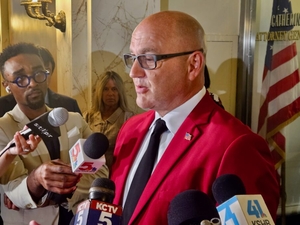
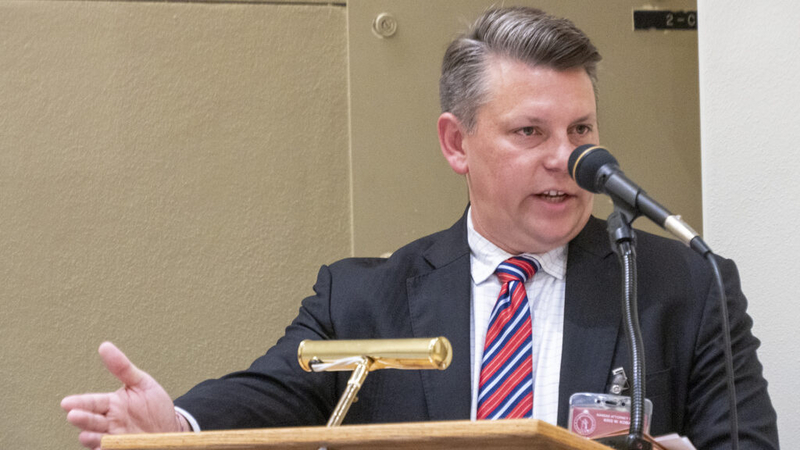
Ryan Kriegshauser, the U.S. Attorney for the District of Kansas, lauded the federal court decision blocking enforcement of a state law granting immigrant students the right to enroll at public colleges and universities at the in-state tuition rate. In this image from June 21, 2024, Kriegshauser addresses the State Objections Board. (Photo by Sherman Smith/Kansas Reflector)
TOPEKA — A U.S. District Court judge issued an order forbidding enforcement of a bipartisan Kansas law adopted in 2004 that allowed certain immigrant students at public colleges and universities to pay in-state tuition rates rather than higher out-of-state rates.
Beneficiaries of the controversial state statute have been community college or university students who were brought to the United States as children, completed a high school education in Kansas and agreed to seek citizenship while pursing a degree in higher education.
The judge’s injunction takes effect immediately, but it was unclear how it would be implemented on individual campuses across Kansas.
The state law was challenged by the U.S. Department of Justice based on a premise the program violated federal immigration law, incentivized illegal immigration and unconstitutionally discriminated against U.S. citizens.
U.S. District Judge Holly Teeter, a nominee of President Donald Trump, issued a permanent injunction Wednesday night that relied on the Justice Department’s arguments to justify invalidation of the Kansas tuition program.
“The central problem here is that there are United States citizens and nationals who pay full nonresident tuition when an unlawfully present alien is eligible to pay a lower rate on the basis of residence,” the judge said in the decision.
Teeter said state statute was preempted by federal law “because it confers a postsecondary education benefit on an unlawfully present alien based on a state-defined residency conclusion without making that same benefit generally available to United States citizens and nationals regardless of their residence.”
Republican Attorney General Kris Kobach, a longstanding opponent of the tuition statute, collaborated with the DOJ on the legal challenge and jointly proposed a consent judgment blocking the law.
In defense of the state’s tuition statute, Democratic Gov. Laura Kelly sought to intervene and seek dismissal of the lawsuit.
Ryan Kriegshauser, the U.S. Attorney for the District of Kansas, said during a news conference Thursday that the court ruling meant Kansas couldn’t extend in-state tuition benefits to immigrant students without providing the same benefit to U.S. citizens.
“No longer will illegal aliens enjoy the benefit of lower in-state tuition in Kansas,” Kriegshauser said. “This decision has been a long time coming. In fact, I looked at this statute 20 years ago as a law student and a law clerk. It violated the supremacy clause then as it does now.”
Jessica Swonger, staff attorney with the ACLU of Kansas, said the Mexican American Legal Defense and Educational Fund and the ACLU of Kansas filed a motion in July to intervene on behalf of students impacted by U.S. v. Kansas.
“This is a disappointing denial of the rights of those most impacted by the current administration’s cruel crusade against students in Kansas to participate in a lawsuit that will directly impact their future,” Swonger said. “The court has allowed the Department of Justice, in collusion with Attorney General Kobach, to slam the door on hardworking Kansas students, even though Kansans have long supported providing all children in our state the opportunity to learn.”
In June, the DOJ filed its complaint against Kansas and endorsed a proposed consent decree to permanently forbid future use of the tuition law.
“Kansas’ unconstitutional and un-American laws should never have been passed in the first place and are prohibited by federal law,” said Brett Shumate, an assistant attorney general in the DOJ’s civil rights division. “The Department of Justice has won on this exact issue in Texas, Oklahoma, Kentucky and Nebraska, and we will take this fight to any states that fail to put American citizens first.”
During the 2026 session of the Kansas Legislature, the House and Senate passed Senate Bill 254 to prohibit people without authorization to be in the United States from receiving state and local public benefits, including in-state tuition at public colleges and universities.
Kelly vetoed the measure and denounced the bill as damaging to the state’s economy and to workforce development. The Republican-controlled Legislature failed to produce two-thirds majorities necessary to override the governor.
“There are many ways that we could, and should, work together to fix this country’s broken immigration system,” Kelly said when she filed the motion to intervene in the lawsuit. “In pursuing higher education, these young Kansans are a net-benefit to our entire state, gaining the education and training needed to be valuable members of our workforce and contribute to our economy.”
In February, Kobach issued a nonbinding legal opinion that concluded the tuition law known as KSA 76-731a conflicted with federal law.
“For years, Kansas universities have been violating federal law by giving in-state tuition rates to illegal aliens, while nonresident U.S. citizens have to pay much more in tuition,” Kobach said. “The governor tried to intervene in this case, because she wanted to continue giving in-state tuition benefits to illegal aliens. With this decision, the court rejected her illogical arguments, and once again, U.S. citizens will be treated better than illegal aliens by Kansas universities.”
Topeka, KS