Schools, libraries sound alarm over potential changes to federal internet program
Sep 10, 2026 | 2:16 pm ET
Description
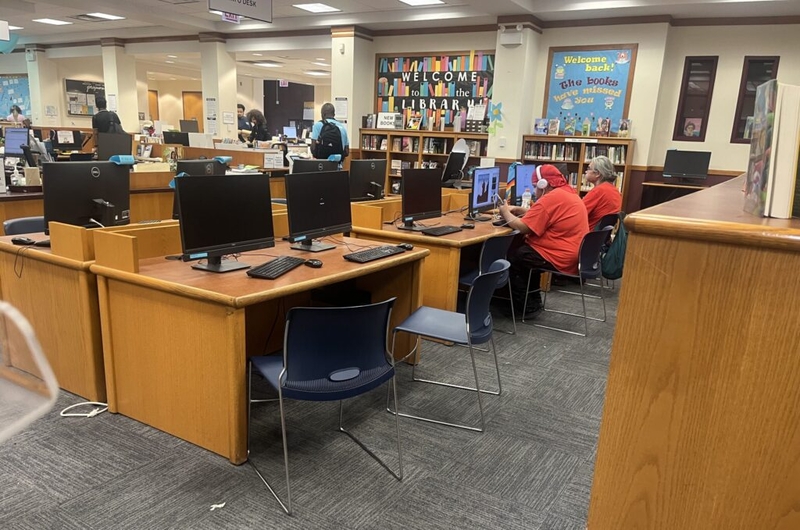
Patrons use free Wi-Fi at a public library in Chicago. For nearly 30 years, the E-Rate program has helped connect schools and libraries to the internet, but the Trump administration is reviewing the program. (Photo Robbie Sequeira/Stateline)
A multi-billion-dollar federal program that helps schools and libraries afford broadband internet is under review by the Trump administration, leaving education officials and advocates worried about potentially significant cuts.
The E-Rate program provides about $3 billion annually for internet access and telecommunications to more than 100,000 schools and 11,000 libraries across the country. It is the fifth-largest stream of federal funding for schools nationwide, according to the Schools Superintendents Association (AASA).
The Federal Communications Commission said it is reviewing “whether the program should be narrowed or otherwise reoriented to reflect the extent to which its connectivity objectives have been achieved.” The agency is accepting public comments until Oct. 13, which it will take into account when it crafts a proposal.
Amid a landscape of scaled back federal funding for education under the Trump administration and of tightening state and district budgets, some school officials and advocates are wary of what changes to the E-Rate program could spell for how schools and libraries operate.
In June, the FCC announced it would be exploring changes to the E-Rate program. FCC Chairman Brendan Carr said the proposal would be “aimed at empowering parents and ensuring that our E-Rate program produces the great educational outcomes stakeholders have intended.”
The E-Rate program has provided schools and libraries discounts on the cost of eligible services ranging from 20% to 90%, with higher discounts provided to the most disadvantaged schools and libraries. The FCC is asking whether adjustments should be made to the discount rate system.
The FCC also is asking for comment on whether E-rate support should be limited to rural areas or to areas served by a single provider; whether some services remain necessary; and whether concerns about students’ screen time should be addressed.
Education Department hands more states flexibility with federal dollars
At a virtual town hall hosted Wednesday by the Schools Superintendents Association, concerns over the FCC’s inquiry ranged from whether the FCC had the jurisdictional authority to change the program to how schools would be able to maintain broadband and internet connectivity without shifting funds away from staffing and other budgetary needs.
Without the same level of funding, schools and libraries could be subject to higher internet costs, less support for rural and high-cost communities and greater difficulties in upgrading needed building infrastructure, the AASA said.
E-Rate dollars impact every corner of the country, with nearly 102,000 schools and nearly 12,000 libraries receiving commitments in funding year 2024, according to the latest publicly available data. California had more than 12,000 E-Rate recipients, Texas nearly 9,800 and New York more than 6,200.
LaTonya M. Goffney, superintendent of the Aldine Independent School District in Texas, said her district received $11 million in E-Rate support over five years.
“Internet connectivity is not a one-time purchase,” she said during the superintendents group call. “If E-Rate were reduced or eliminated, Aldine ISD would face an immediate and significant budget shortfall and that means millions of dollars would have to be redirected from somewhere else in our budget…there’s no way to absorb a loss of this magnitude without affecting people.”
According to Shawnda Hines, deputy director of communications for the American Library Association, 73% of U.S. public libraries rely on the E-Rate program to pay their internet bill or to keep their networks updated.
When Congress established the program in 1996, only 14% of the nation’s K-12 classrooms had access to the Internet, according to the agency. The FCC has some authority to change how E-Rate is administered without congressional approval, but whether the agency can eliminate a congressionally authorized program altogether is an unsettled legal question.
Access to the internet in modern schools extends far beyond classroom instruction, Stacy Hawthorne, executive director of EdTech Leaders Alliance, explained.
It also powers bus routing, security systems and building ventilation, and helps digitize attendance records, school meals and student health information. Districts rely on internet-connected systems to operate buildings, comply with state and federal requirements and manage basic administrative functions.
“It’s not just email and Google Docs. Imagine it’s 5:30 a.m., the buses start coming to life. They use GPS routing, and they have parent-facing tracking apps,” Hawthorne said. “Cameras come to life, the security systems start running at full speed. Visitor management scans driver’s licenses against offender registries before a single visitor gets access to any of our school buildings.”
Stateline reporter Robbie Sequeira can be reached at [email protected].