Community, scientist disputes Oklahoma water agency finding that dams not to blame
Sep 09, 2026 | 1:56 pm ET
Description
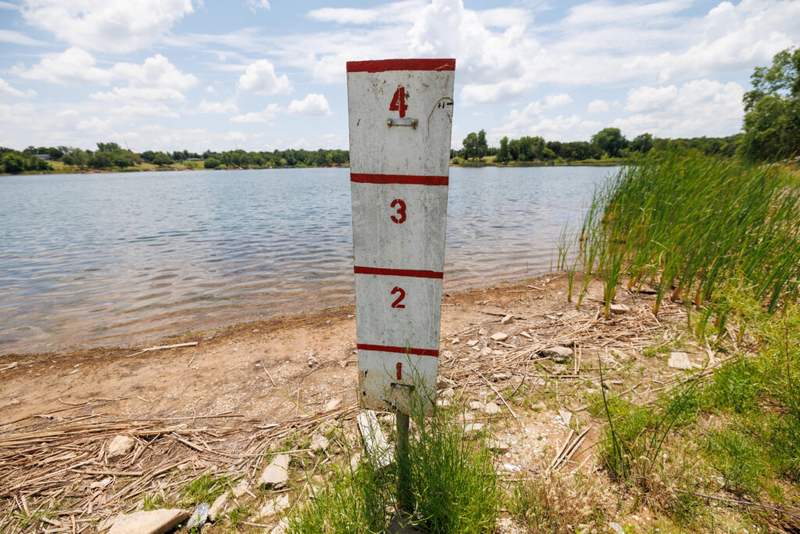
A water level marker at Cedar Lake near Hinton, Okla., Wednesday, July 15, 2026. (Photo by Nate Billings/For Oklahoma Voice)
OKLAHOMA CITY – There is no link between the construction of two dams and declining water levels at a lake west of Oklahoma City, according to the findings of a report released by a state agency tasked with managing water.
The reduction in water levels at Cedar Lake is more likely caused by a drop in aquifer levels related to homeowners’ domestic wells, according to the Oklahoma Water Resources Board’s 69-page report, which was distributed to some lawmakers and others.
But residents of the lakefront community located about 45 miles west of Oklahoma City and an independent hydrologist dispute the Water Resource Board’s findings. They said the agency’s report is riddled with inaccuracies and not based on science.
The agency, which is tasked with policing Oklahoma’s water resources, released the report to lawmakers amid heightened scrutiny over how it has handled a yearlong fight over two unpermitted dams erected upstream of the nearly 400-person Cedar Lake community.
Residents blame a dam erected in 2019 on a tributary feeding Cedar Lake for slowly causing water levels to drop and drying up their wells. They said that the agency has slow played their complaint because the dams are tied to a politically connected family.
Some residents believe the water board’s reluctance to force the dams to be removed or to release water is because the property is connected to V. Glenn Coffee, a former powerful state senator and former Oklahoma Secretary of State, who serves as a legal consultant to the State Senate Republican Caucus.
The Water Resources Board did not respond to a request to make the author of the report or someone familiar with it available for an interview. The report does not say who authored it.
The agency’s report states that evaporation losses will outpace streamflow and runoff during drought.
Low lake levels will continue with or without the smaller dams upstream, the report said.
Carol Becker, an independent hydrologist who reviewed the agency’s report, said she questions some of the conclusions.
Becker, who has about 35 years experience in water quality and resource management, said the Water Resources Board appeared to use wells in a different watershed to reach some of its conclusions.
While the report says water flowing into Cedar Lake can be estimated using nearby stream gauges, Becker said there are no nearby gauges.
Becker evaluated the Cedar Lake water level earlier this year after residents asked for an independent expert opinion.
She found that two of the upstream dams are capturing almost 40% of the watershed runoff, which would normally recharge Cedar Lake. Cedar Lake then recharges the aquifer located below it. That aquifer feeds the water wells that residents rely on, she said.
While Becker found that several factors can influence water levels at Cedar Lake, including household water use, land-cover changes, and climate, Becker said the two dams are the primary cause of the lake’s water drop.
“The evidence shows that they have little to no measurable effect compared with the dam impoundments, which remain the primary cause of declining water levels in the watershed,” according to Becker’s report.
Don Machacek has had property at the lake for about four years. He said there were no problems with Cedar Lake water levels and wells until the dams were built. He said the Oklahoma Water Resources Board report is “laughable” and not based on facts or science.
He said while Cedar Lake is going down, water being held behind the dams and in other lakes has not dropped.
“If it was anyone else… just the common man off the streets, rancher, farmer, what not, those dams would have been taken down,” Machacek said.
Cedar Lake residents are getting the “good old boy” treatment from the agency, he said.
Mark Sullivan, who owns property at Cedar Lake, said he believes the Oklahoma Water Resources Board governing body, composed of nine gubernatorial appointees, has gotten bad advice from agency staff.
In July, Cedar Lake residents went to an Oklahoma Water Resources Board meeting where the governing board was being asked to consider an agreement to allow the dams to remain in place while Coffee seeks a permit.
The governing board postponed consideration of the consent order until its Sept. 15 meeting after angry residents voiced their opposition.
Oklahoma City, OK