Hoping customers would return after Operation Metro Surge, immigrant businesses are still waiting
Sep 09, 2026 | 9:00 am ET

Description
Riverside Mall in Minneapolis, with no customers coming and going Tuesday, Aug. 25, 2026. (Photo by Nicole Neri/Minnesota Reformer)
When the federal immigration crackdown began in December, El Chuchi Market on Lake Street in Minneapolis was among the hardest-hit businesses, leading to a two-week closure in February.
But Luis Tamay, the owner, said the problems began well before Operation Metro Surge brought 3,000 immigration agents to Minnesota last winter.
Latino communities were feeling the immigration crackdown well before Operation Metro Surge, upon the second inauguration of President Donald Trump. Tariff-driven inflation also affected the local immigrant economy.
The surge, however, was a full-blown crisis, with customers too afraid to leave their homes.
El Chuchi adapted, focusing on home delivery.
“It wasn’t much, but it was a way to help our customers and to make sales to catch up on rent,” said Letitia Ponce, a worker there.
Tamay said business has improved since those dark winter days, but there’s been no full bounce-back: “It’s nothing like what it used to be,” he said.
El Chuchi’s story is not unique among immigrant businesses.
Once hopeful that the drawdown of Operation Metro Surge would bring shoppers and eaters back to stores and restaurants, businesses are finding that customers have not always returned.
Ahmed Said, a shop owner at Riverside Mall, said since the ICE raids began in December, he has not seen more than three or four customers a day.
“That is less than what I used to see in an hour. It is very hard to continue at this pace, and I do not want to walk away from the business I have been building for 14 years,” Said said.
Said said he has been paying his shop rent out of pocket because the business has not been able to support itself.
These anecdotal reports match preliminary data from government and other researchers.
Operation Metro Surge cost Minnesota’s leisure and hospitality sector an estimated 4,600 jobs and $71 million in wages, according to a study conducted by Aaron Rosenthal at North Star Policy Action and Aaron Sojourner at the W.E. Upjohn Institute for Policy Research.
The city of Minneapolis released a preliminary estimate for the economic impact of the surge on Feb. 13: $203.1 million. And, Rosenthal and Sojourner estimated more than $100 million in lost wages in the Twin Cities metro statistical area.
The data underscores a sobering reality: If Operation Metro Surge was a political failure for the Trump administration — which was forced to retreat upon public revulsion of the killing of two Americans and routine civil rights violations — it was a success if the measure was making life harder for immigrants and their businesses and communities.
Feds making it harder for immigrants to send money to family
$20 in sales
Hawo Hirsi, an owner of a women’s clothing store at Riverside Mall, said her business has been at a complete standstill since December.
“On the day before Eid, which is usually the festival’s busiest day of the year as everyone rushes to do last-minute shopping, I only made $20 in sales,” Hirsi said.
In the weeks after Operation Metro Surge wound down, Muslim-owned businesses struggled through Eid al-Fitr, which was in March, and Eid al-Adha on May 27 — without the usual bump in sales.
Hirsi said she received $2,500 in small-business aid from the city to pay her rent for three months, providing temporary relief while the business lagged.
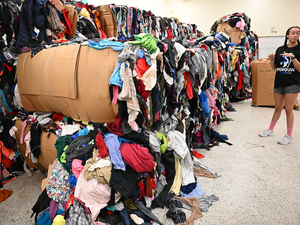
During a recent visit, she pointed around her shop, where heaps of women’s clothing were piled up. “This is the stock that came from overseas, which I planned to sell during the last two Eids, but there was no business,” she said.
Abdirizak Bihi, a community activist and job consultant for more than a decade, said the Somali community’s business downturn and financial challenges are at an all-time high.
“It is a chain reaction. When businesses fail, people’s livelihoods will fall with them,” Bihi said.
The city grant program requires evidence of lost business, but many people may not have kept sales records due to language barriers, Bihi said.
Somali government contractors have also faced increased scrutiny from state and federal authorities responding to widespread allegations of social service program fraud. That’s led to payment stoppages — even for some contractors not caught up in fraud allegations.
Bihi said he remains optimistic that businesses will recover as ICE activity has decreased, while Somali government contractors will have a better grasp on the government’s regulatory expectations.
“Many business owners lack the necessary training, and many of the mistakes are accidental rather than intentional,” Bihi said.
For struggling business owners, however, optimism about the future doesn’t pay the bills.
Some business owners have taken to closing their shops for half a day to pursue a side hustle elsewhere.
Yusuf Ibrahim, an owner of a men’s clothing store at 24 Mall, said his business is struggling to stay afloat. To cover the rent, he drives an Uber in the morning and opens the shop after 2 p.m. He said the rent is $1,200, and sales over the past few months have not reached $500 per month.
He also laid off two of his employees because he could not afford their wages.

Saint Paul, MN