More immigrants choosing to self-deport, leaving family behind
Sep 09, 2026 | 6:45 am ET

Description
Julie Moreno, a volunteer with American Families United, with her dog Topo Chico in her Newark home on April 9, 2026. Moreno's husband, Nef Juarez, self-deported to Mexico last year in October. (Photo by Anne-Marie Caruso/New Jersey Monitor)

This is the second in a three-part series examining President Donald Trump’s mass deportation effort and its effect on New Jersey.
Julie Moreno knew the night Donald Trump won the 2024 election that her husband would have to leave the country.
“I almost quite literally had a nervous breakdown,” she said. “All this rhetoric, all of the clear organization they put in place for more detention, more deportation. It was obvious this was going to be a totally hyper-charged administration 2.0.”
Ten months after the inauguration, her husband, Nef Juarez, boarded a plane to Mexico, a country he hadn’t been to since he moved to the U.S. more than two decades prior.
Their story has become an increasingly common one across New Jersey and the nation, as families agonize over whether to wait out the Trump administration’s enforcement surge, hide in the shadows, or leave on their own terms before U.S. Immigration and Customs Enforcement decides to come for them.
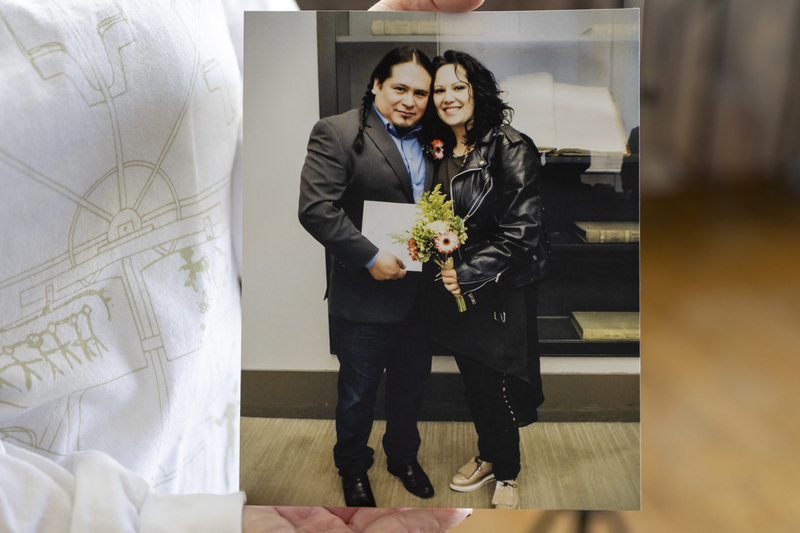
Juarez arrived from Puebla, Mexico, in 2000, while in his 20s. By 2008, he met Moreno and fell in love. Moreno, a Newark resident and advocate working with mixed-status families, married Juarez in City Hall in Manhattan in 2017, during Trump’s first term.
Juarez had no criminal record, no encounters with ICE during his time in America, and no deportation order, Moreno said during an interview in her Newark apartment. But under immigration laws dating back to 1996, his path to legal status was effectively blocked, having entered the country illegally without authorization. That triggers what’s referred to as an inadmissibility bar, which prevented him from applying for a marriage-based visa.
The couple had tried three separate times to obtain status for Juarez before learning he was ineligible for a consular appointment. They lived in a legal limbo they learned to navigate, Moreno said. They worked and resided in New Jersey, largely without fear, and his status was just a reality of their lives, she added.
But Moreno, 47, stressed that Trump’s second term felt different from his first. She pointed to Project 2025 and the shift in aggressive language surrounding enforcement, detention, and deportation.
“It became obvious that they had the structure to actually do what they talked about the first time,” she said. “Families like ours, we became scared.”
What accelerated the decision for Juarez to leave was the news that federal officials weighed repurposing Fort Dix as an immigration detention center. That hasn’t happened, but the plan would add 3,000 beds to the enforcement infrastructure in New Jersey. And Delaney Hall in Newark had just opened its doors as a migrant jail after years of being shuttered.
“That was a huge red flag,” she said. “We saw exactly what this was going to be. It was a nightmare, really.”
In October, Juarez boarded a plane to Mexico, leaving his life — and his wife — behind.
Moreno works with American Families United, a national nonprofit organization representing U.S. citizens in mixed-status marriages, an estimated 1.5 million households across the country. The organization is pushing for the passage of the American Families United Act, a bill in Congress that would create a waiver process allowing couples like Moreno and Juarez to petition for relief from inadmissibility bars on a case-by-case basis. It has not moved forward.
Experts and advocates note that people who opt for voluntary departure are not necessarily doing so because they want to leave. Some have legal avenues to remain in the U.S., but dismal detention conditions and the steep uphill battle of finding legal representation for court proceedings have pushed them toward departure.
The Vera Institute of Justice found that monthly voluntary departures surged from a few hundred at the end of the Biden administration to over 9,000 in a single month by March 2026. In all, immigration judges issued over 80,000 voluntary departure orders between January 2025 and March 2026 — a 600% jump from the final 15 months of the Biden administration, according to Vera Institute data reviewed by the Washington Post. And that doesn’t include people like Juarez who decided to leave before getting involved in the judicial system.
More than 70% of people granted voluntary departure under Trump’s second term were being held in immigration detention when they requested to leave, the data showed, and Vera researchers have said the rise is happening alongside, not instead of, formal removal orders, meaning people facing deportation orders have even slimmer chances that they’ll stay in the U.S.
New Jersey-specific figures are not publicly available, and ICE did not provide those numbers.
According to the U.S. Department of Homeland Security, more than 2 million immigrants without legal status have voluntarily self-deported since Trump took office in January 2025.
Trump administration officials claim over 100,000 have used a federal app on the DHS website to do so, although the department has not released data to substantiate that figure, and outside researchers have repeatedly challenged it. A Brookings Institution report said the department’s numbers “should not be considered a serious source,” and separate reporting by The Atlantic and ProPublica found the verifiable count of app-assisted departures was far lower, in the tens of thousands.
Homeland Security officials have repeatedly responded to questions about its detention and deportation effort by saying “being in detention is a choice.”
“We encourage all illegal aliens to take control of their departure with the CBP Home App. The United States is offering illegal aliens $2,600 and a free flight to self-deport now,” a Homeland Security spokesperson said. “We encourage every person here illegally to take advantage of this offer and reserve the chance to come back to the U.S. the right legal way to live the American dream. If not, you will be arrested and deported without a chance to return.”
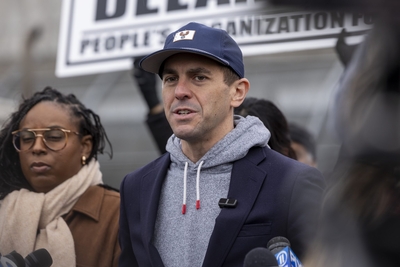
Rep. Rob Menendez (D-08) makes regular visits, both announced and unannounced, to Delaney Hall and meets with detainees inside. Menendez, a co-sponsor of the American Families United Act, said some of them are forced into signing self-deportation orders without understanding what they’re reading.
He said it’s all part of the Trump administration’s tactics: Scare people who are woven into the fabric of New Jersey’s communities into self-deporting or put them in a jail that “breaks them.”
“What they are doing in there is trying to create conditions where people are so demoralized, they sign voluntary departure papers to not have to be in there anymore,” he said in May. “I think what they’re trying to do inside is they’re trying to break people, so people give up.”
ICE did not respond to questions about how many people detained at Delaney Hall have self-deported, or to Menendez’s characterization that people are being coerced into signing these forms.
Moreno explained that her husband made his choice knowingly, without being put into detention. It was one of the hardest choices they ever had to make, she said, and it weighs on her constantly as she walks through the empty apartment she shares now with two dogs and a cat.
“That life of ours is dead and gone,” she said with pain in her voice. “We know there’s no going back on that decision.”
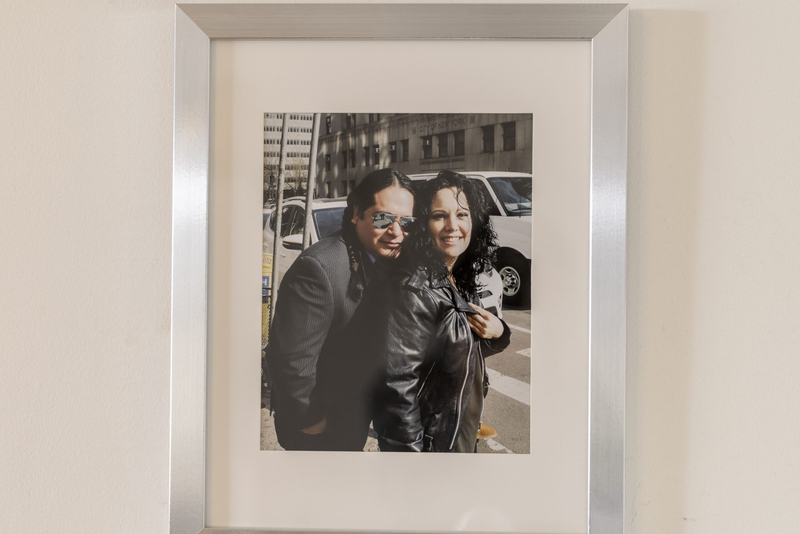
The transition has been difficult in ways she couldn’t anticipate. He shouldered much of the daily tasks in their life: running errands, picking up prescriptions, carrying the load of the small business of packaging and importing boxing gloves that they built together. He also did construction work. And now, with him thousands of miles away, she said, depression made ordinary tasks feel heavy, and she described the months after his departure as drowning.
“Everything felt like it was dragging me down, stuff both small and big,” Moreno said. “The life we expected to have, the life that we were working towards, I’m holding on by my teeth trying to keep things together now.”
In March, she visited him in Mexico for a family wedding. Seeing him eased fears that time apart would erode what they had built, and she said she wants to relocate to Mexico after her nephew graduates high school.
She said Juarez’s family was relieved to have him home, and he’s shared months with his elderly mother they may not have otherwise spent together — a silver lining. But the distance between them remains, she stressed.
“I miss him, but it felt like not one single day had passed. We’re really tight still,” she said. They have plans for a road trip when she visits again in the summer to find a spot for their next home. She smiles at the thought of seeing him again.
But for now, she keeps advocating — even louder than when Juarez was here, she says, because there’s nothing left to protect by staying quiet. She talks to other families in American Families United who are making similar calculations, quietly researching what documents they may need and scoping out regions of Mexico for where they’ll land.
“People are not necessarily naming dates, but they really, seriously are making their plans to leave,” she said.
This story was produced as part of the Center for Cooperative Media at Montclair State University’s 2025 NJ News Commons Investigative Reporting Initiative, and supported with funding from the Robert Wood Johnson Foundation.
Trenton, NJ