Michigan rabbis push El-Sayed to change rhetoric on Israel, ensure safety of Jewish community
Sep 09, 2026 | 7:00 am ET
Description
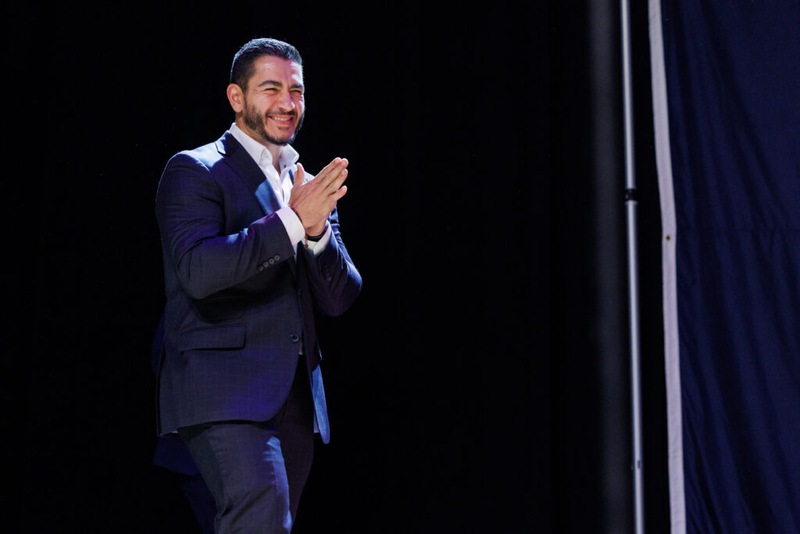
Former Wayne County Health Director Abdul El-Sayed at an election night watch party in Detroit, Mich., on Aug. 4, 2026. The Democratic primary for U.S. Senate was too close to call at the time he spoke. (Photo by Andrew Roth/Michigan Advance)
The road ahead for Democratic U.S. Senate nominee Abdul El-Sayed remains lined with speedbumps and fences to be mended, particularly with members of Michigan’s Jewish community who don’t like his rhetoric on Israel.
A new coalition of Jewish clergy and synagogue lay leaders in Michigan launched a new group Tuesday and called on El-Sayed to affirm “baseline community needs” — among them being a commitment to their safety, respect for their identities, political participation and self determination.
The coalition, Nonnegotiable Michigan, says it represents 40,000 Jewish voters in the state and characterized its demands of El-Sayed as “an invitation” to address urgent needs from Michigan’s Jewish community if he expects their votes in the Nov. 3. general election.
“Protecting the human dignity of every individual is a fundamental Jewish mandate,” the group said in a launch statement. “That is why American Jews helped build the movements at the forefront of the progressive coalition. Our community has been a relentless force standing up to the assaults on history, science, healthcare, inclusion, voting rights, abortion access, immigrant justice, climate action, LGBTQ equality and the rule of law itself.”
The group is asking Jews across Michigan to sign a petition calling on El-Sayed to commit to a list of principles, including:
- Jewish safety, including the safety of Zionist Jews, is nonnegotiable;
- The right of Jews to define their own identities is nonnegotiable;
- Jewish sovereignty in Israel is nonnegotiable;
- The full participation of Jews, including Zionist Jews, in American political life is nonnegotiable; and
- An affirmative vision for a better future for the Middle East is nonnegotiable.
El-Sayed is invested in making inroads, his campaign says
El-Sayed has been highly critical of the United States’ relationship with Israel — particularly the nation’s war against Hamas in Gaza. Groups including Amnesty International, Human Rights Watch, Doctors Without Borders and an independent United Nations body contend that Israel’s actions have amounted to a genocide against the Palestinian people.
El-Sayed also made the American Israel Public Affairs Committee a key target during his August primary race against U.S. Rep. Haley Stevens (D-Birmingham), which spent heavily on Stevens’ behalf due to her pro-Israel stance. AIPAC said it planned to spend big against El-Sayed again in the general election and in support of his opponent, former Republican U.S. Rep. Mike Rogers of White Lake, who is also pro-Israel. However, Republicans have asked AIPAC to back off of funding Rogers in the general election, citing their involvement as potentially politically toxic.
The Democratic nominee’s rhetoric about Israel has some Jews in Michigan feeling fearful and threatened as antisemitism rises across the nation, fueled in part by a growing opposition to Israel’s military actions, and have said they no longer feel safe or welcome in the Democratic Party. Michigan Attorney General Dana Nessel was among Jewish elected officials who said that she would be skipping the party’s summer nominating convention after its spring convention ended with many Jewish Democrats saying they were harassed by pro-Palestinian delegates and attendees.
Over the last few weeks, one of the sharpest voices in that movement has been Rabbi Asher Lopatin, leader of the Kehillat Etz Chayim congregation in Huntington Woods. Lopatin is also the Jewish Federation of Greater Ann Arbor’s director of community relations.
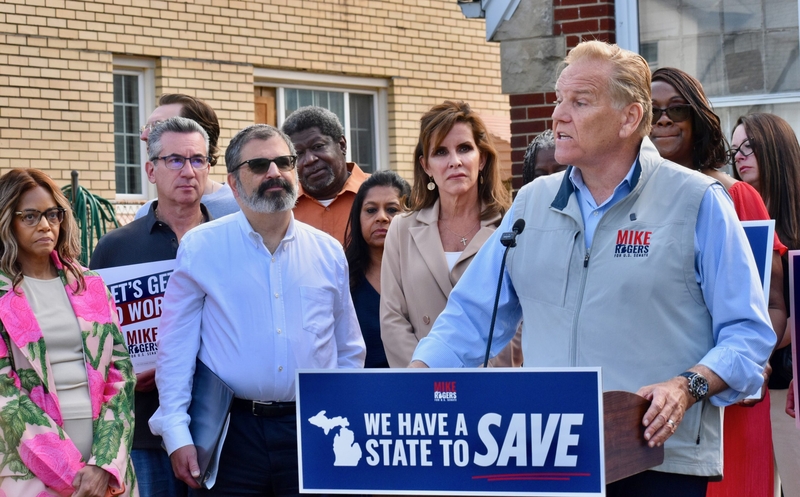
In late August, Lopatin joined Rogers’ effort to court disaffected Democrats to support his campaign. By proxy, that also included a push to attract Jewish voters to join his Democrats for Rogers coalition.
It has been incumbent on El-Sayed to mend those broken ties with the Democratic Jewish community, El-Sayed’s campaign said Tuesday. Over the past few weeks, El-Sayed has been in regular communication with Jewish leaders across Michigan, focusing on party unity and building a strong coalition to beat Rogers in the fall.
Some of that work has included closed-door meetings with prominent Jewish organizations, at both the state and national level, and conversations directly with rabbis.
In one of his earliest press conferences as the Democratic nominee, El-Sayed reaffirmed his commitment to protecting Jewish Michiganders as the state’s next senator.
“To all of my sisters and brothers of the Jewish faith … I want you to know that my commitment to Jewish safety is the same as the commitment I have to the safety of my own daughters,” El-Sayed said then. “I stand in solidarity with my sisters and brothers, and we can condemn antisemitism and at the same time we can be talking about how to bring people together.”
Concerns over El-Sayed still linger with the Jewish community
Nonnegotiable Michigan’s founding leaders include Rabbi Aaron Starr, spiritual leader of Congregation Shaarey Zedek in Southfield and president of the Michigan Board of Rabbis, and Rabbi Josh Whinston, a leading progressive Reform rabbi at Temple Beth Emeth in Ann Arbor. The list also includes nine other rabbis and congregation leaders.
In a press conference Tuesday afternoon, Whinston, who defined himself as leaning left politically, said that he has had multiple conversations with El-Sayed and has valued those talks.
“I’m somebody who cares deeply about the future of the Palestinian people and their their ability for self-determination, and I also care deeply about about Israeli Jews, Israelis in general, their ability to continue to have self determination and to defend themselves, and as well Jewish safety primarily here in Michigan,” Whinston said. “That is of the utmost importance to me, as one might imagine, the safety of my community and making sure that the kind of rhetoric that we hear from our elected officials, and from those seeking our vote, do not put the Jewish community in harm’s way. That is a primary concern of mine, as it should be for everyone.”
I want to help him figure out a way to continue to move the needle in ways that will be meaningful for the Jewish community and would have real effect on any potential policy that he’s a part of when he’s elected to the Senate. I think he’s trying to figure it out, but he hasn’t figured it out yet.
Whinston said he appreciated and accepted El-Sayed’s apology over his remarks on the Temple Israel attack, in which El-Sayed condemned the violent attack on a West Bloomfield temple, but also said that “hurt people hurt people,” referring to the attacker, whose brother was identified by the Israeli government as a Hezbollah leader killed in an Israeli airstrike.
The concern was that El-Sayed had suggested that the violence at the temple “could be understood through the lens of Israeli actions,” said Temple Israel Rabbi Jen Lader in an op-ed published by The Free Press. Ladder also called El-Sayed’s remark offensive.
During an annual, pre-Michigan Democratic Convention meeting of the Michigan Jewish Democratic Caucus, known as their Summer Simcha and held in the weeks following the August primary,, El-Sayed formally apologized for those remarks.
In his conversations with Whinston, specifically, the rabbi said it was apparent that El-Sayed was trying to figure out a way forward.
“I want to help him figure out a way to continue to move the needle in ways that will be meaningful for the Jewish community and would have real effect on any potential policy that he’s a part of when he’s elected to the Senate,” Whinston said. “I think he’s trying to figure it out, but he hasn’t figured it out yet.”
Still, Whinston said that apology hadn’t gone far enough, and much more work needed to be done by El-Sayed and his campaign.
Starr said El-Sayed is trying to bridge a gap with the Jewish community, but his previous rhetoric cut deeply.
“We hope that there will be another bridge between where he is now and where he can go in the future,” Starr said. “Frankly, I hope that Dr. El-Sayed, if he is elected to be our senator, or if Congressman Rogers is elected to be our senator, that they will stand up and that they will condemn violent rhetoric against the Jewish people, violent rhetoric against Israel and its right to exist. That’s what we’re asking for. We’re asking for someone to step up and be an ally, to work toward safety and security and a better life for all Michiganders, including Jewish Michiganders.”
In response to Tuesday’s news conference, Rogers campaign spokesperson Alyssa Brouillet said that El-Sayed, who Rogers’ campaign has taken to calling a “conman,” was attempting to “flip flop his past crazy town comments,” and that the attempt was falling on deaf ears with some Democrats.
“Try all he wants to run from his extreme stances on everything from Israel/Gaza, to abolishing prisons and putting boys in girls’ sports, he’s not fooling anyone,” Brouillet told Michigan Advance.
El-Sayed’s campaign, in turn, said it will continue the work it has been doing, which has also included joining Congregation T’chiyah in Ferndale on multiple occasions for Shabbat services and Passover Seder to sitting down with Jewish Democratic leaders and interfaith clergy for candid roundtable conversations.
Lansing, MI