Families lost weeks of food they couldn’t afford to replace. Then their SNAP claims were denied.
Sep 08, 2026 | 1:31 pm ET
Description
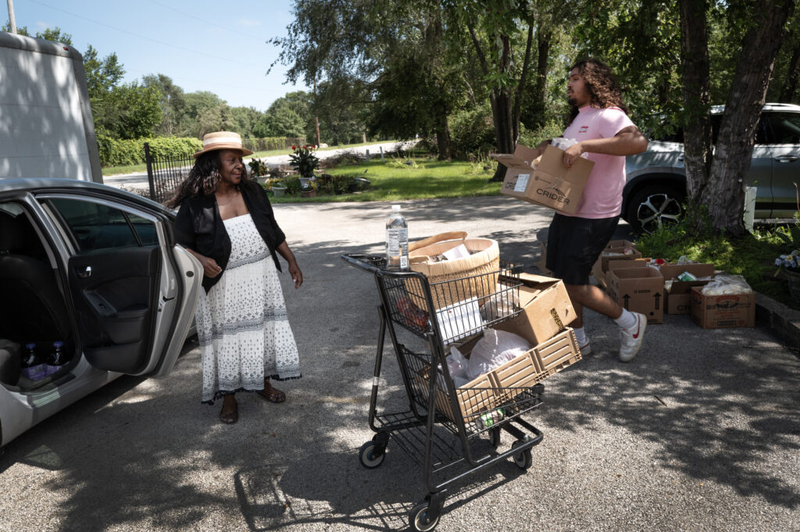
Pastor Valerie Clarke, left, and Connor Taylor of the Gospel Truth Apostolic Ministry distribute food to residents outside of their church on August 20, 2026 in Gary, Indiana. (Photo by Scott Olson/Getty Images)
When a powerful storm tore through Gary, Indiana, knocking out the power for two weeks, Tiffany Harrison, a mother of three, had to throw out all of the food that had spoiled in her fridge and deep freezer.
It was a big hit to her family in this majority-Black city where roughly 2 in 5 people rely on the federal Supplemental Nutrition Assistance Program, known as SNAP, to feed themselves, according to an analysis by the nonprofit news organization Capital B. At the time the power went out, Harrison’s deep freezer had been stocked with discount meat, like family packs of chicken, which she buys in bulk and breaks down into smaller packages so they can last throughout the month, she said. “We learn to be frugal to make the food last,” she said.
But the storm turned that planning upside down and added additional expenses for thousands of parents like Harrison, who were not only without power, but were also advised to boil their drinking water. Suddenly, she needed to buy cases of bottled water and quickly restock her pantry with nonperishables to last throughout the outage — all while dealing with price hikes at the grocery store and on the money she makes working at McDonald’s. And as a single mother, she had to carry the burden on her own.
Harrison had heard she could apply to replace her federal food benefits, an option that would ease the sting of the loss and loosen the pressure on her.
At the local Family and Social Services Administration office, she joined a line that stretched down the street. When Harrison finally made it inside, she said she was asked to fill out a form listing every single item that was inside her fridge, “all the way down to the jelly.”
Harrison, who is also going to school to become a social worker, didn’t make money the two weeks the power was out because the McDonald’s also shut down. She needed these replacement benefits to get her through the month and feed her children.
A caseworker told Harrison they would give her a call a few days after reviewing her application. “It gave me a little bit of hope,” she said. “Like at least I’m going to get something.”
Instead, Harrison said, her application was denied. And she’s not the only one. She’s made contact with dozens of Gary residents who all said they’ve had their replacement SNAP benefits denied.
The agency told The 19th in an email that only people who received their monthly benefits before the power outage hit on August 11 were eligible for replacement. Those whose benefits arrived after the outage started were not eligible for replacement because they would have used their benefits to buy food after the blackout had begun.
That could impact a lot of people in need of food in Gary, which has the highest share of SNAP recipients in Northwest Indiana, according to the analysis by Capital B. A disproportionate number of people who rely on SNAP are single moms, elderly people and people with disabilities.
SNAP benefits are distributed based on people’s last names. Starting on the fifth day of every month, people whose last names begin with A or B get their benefits; on the seventh day, it’s those whose surnames begin with C or D. The pattern goes on until the 23rd day of each month. Because of the timing of the outages, many SNAP recipients who lost power were not eligible to have their benefits replaced — and had to figure out how to absorb a significant expense.
Food and policy experts told The 19th that it doesn’t have to be this way.
Federal guidance allows SNAP recipients to receive replacement benefits if they lost food during flooding, power outages or other household misfortunes. Gina Plata-Nino, director of SNAP Policy and Advocacy at Food Research and Action Center, said the loss doesn’t have to be related to a disaster: It could be as simple as someone’s refrigerator breaking. What differs is how easy each state makes to report the need for a replacement benefit.
“The federal policy is the floor, not the ceiling,” she said, meaning that there is a federal obligation to provide replacement benefits if a recipient loses food. Plata-Nino added that while states can’t necessarily expand the amount of benefits offered, they can and should make it more accessible by removing onerous requirements, especially in times of a disaster like the one that occurred in Gary.
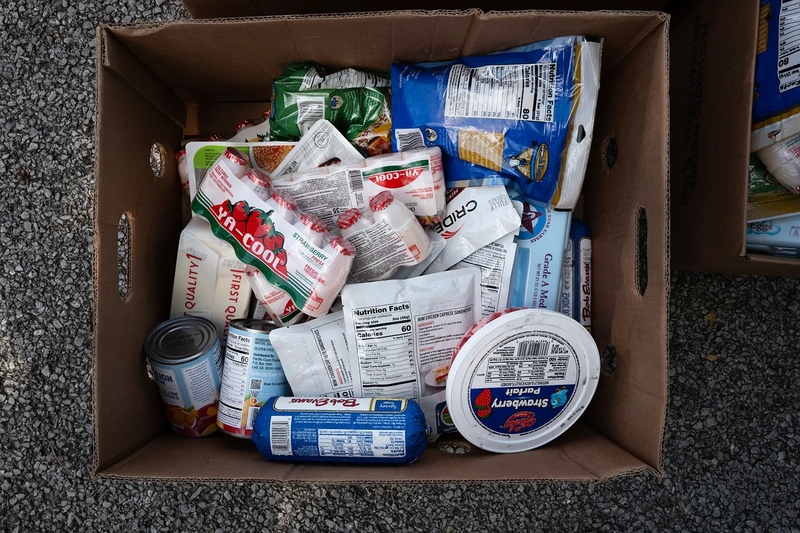
(Scott Olson/Getty Images)
In Indiana, the question is whether state policy on replacing SNAP benefits is legally more restrictive than it should be, according to Jennifer Terry, a staff attorney with Indiana Legal Services. “We have concerns about any policy that automatically denies replacement SNAP benefits based only on when a household received its benefits,” she said in an email. “The federal law appears to focus on the food that was actually lost, not the date the benefits were issued.
“Families may have lost food they bought weeks earlier, including refrigerated and frozen staples. We think those losses should be considered on their individual facts rather than through a blanket cutoff,” she said.
Brianna Jackson said the date a family received their benefits shouldn’t matter in situations like the one she and other residents have endured in Gary, even after power was restored. She has a hungry 7-year-old boy at home, as well as a newborn. She needs to take care of her own health after her pregnancy. She needs to eat.
The agency denied her application for SNAP replacement because her benefits arrived two days after the outage. Since then, she’s had to spend time driving around town looking for food distribution sites or stopping at churches that are giving away hot food.
“It’s difficult because I’m dealing with a 3-month-old,” she said. “On top of that, I’m trying to make sure I make it on time to go back and pick up my 7-year-old from school because if I don’t do that, I’ll get in trouble.” To complicate things, Jackson and her kids have been sleeping on different family members’ couches because the sump pump in her house failed during the blackout, causing her basement to flood.
Jackson said it’s been chaotic — everyone around her is also trying to figure out how to survive. Some people have family members who are sick or disabled and can’t get the things they need, she said. “On top of that, they don’t have any money because they use all their money to get generators or get other resources such as candles and gas and different things. It was basically like we were out here like we’re going through an apocalypse.”
Alexxis Evans received her benefits on August 9, before the power went out. Because she had not used all her food assistance by the time the outage hit, when she applied for a replacement, she was denied. She couldn’t even get reimbursed for the $50 in benefits that she had spent.
The denial didn’t make sense to Evans: Like everyone else without power, she lost all her food. Evans is on disability, has a young daughter at home and helps take care of her 87-year-old mother. Without the federal food benefits, she cannot feed her family, she said.
Like Harrison, Evans has a deep freezer — “I don’t always use all of my food every month,” she said. It’s about being strategic with the money so that it lasts; the denial felt like she was being penalized for not spending her benefits as soon as she got them. “It has to last the whole month. How does that make any sense?”
The denial stung even more because, she said, residents were urged by the agency to apply for the replacement benefits in the first place. “They gave everybody hope and then let us down when we were already down,” Evans said. “I was already dealing with depression, being in the dark for two and a half weeks, thinking about my animals and my daughter and my mother. The last thing I need to worry about is food,” she said.
All three of the single mothers said they’ve absorbed extra expenses like more money for gas, which is already sky-high, to look for food, and that they have had to deal with price gouging at local grocery stores on items like ice, bottled water and tissues.
For Emily Bryant, executive director of Feeding Indiana’s Hungry, the state should be pursuing a much simpler option that would immediately get benefits into the hands of Gary residents and clear up any confusion around denials like what parents like Evans experienced.
“Quite frankly, there is a really easy way to get past all of the paperwork and the administrative burden here,” she said. “The state has the ability, with or without a disaster SNAP declaration, to do mass benefit replacement by looking at the households in the zip codes that we know were impacted.”
Bryant said the state has done that in previous years for other disasters, like tornadoes, and it saves recipients like these women in Gary the stress over where to find food when they have so many other concerns. “We would strongly encourage the state to do that simply because it enables these families to move on,” she said.
It would also free up the state’s resources to focus on its application for Disaster SNAP, known as D-SNAP, a separate program that can make money available for residents impacted by a disaster who aren’t currently enrolled in the program, she said.
Providing a mass benefit replacement would make sense in Gary; Bryant said, one of her organization’s food bank directors told her that pretty much everyone in his two-county service areas, which include Gary, was experiencing food insecurity right now. For that reason, she said both public and private dollars need to come into play. “Food banks in the charitable sector don’t have the capacity to even begin to address the loss of food in these communities because that’s not the purpose,” she said. “It’s not to replace the entire contents of everyone’s freezer.”
In the meantime, Harrison isn’t giving up. She filed an appeal on the decision to deny her benefit and started a petition online, which has already garnered over 100 signatures, demanding that state and federal officials look into what is going on with the SNAP denials impacting her community. “I’ve reached out to everyone and their mama at this point,” she said.
“It’s like, look, this is what’s happening, and the community is hurting right now,” she added. “We need help.”
Indianapolis, IN