College athletics lawsuit sheds light on Louisiana DAs with private law practices
Sep 08, 2026 | 5:30 am ET
Description
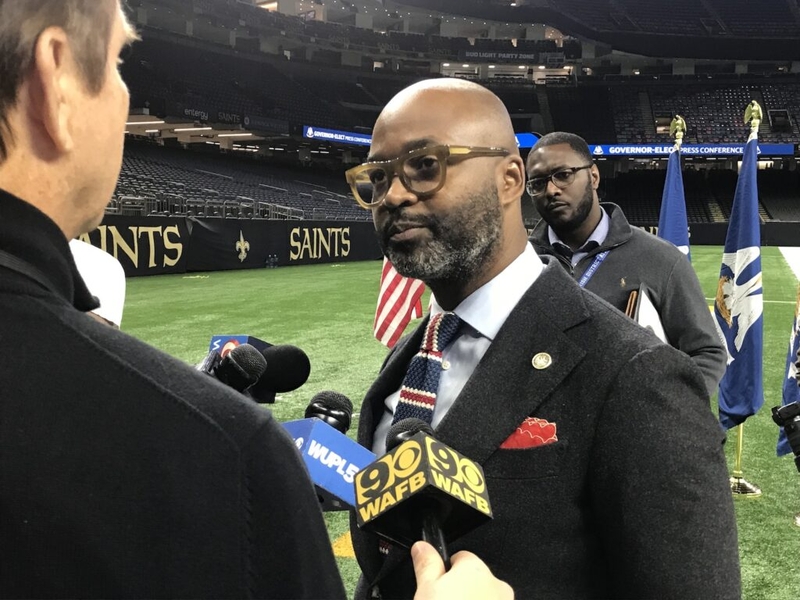
Orleans Parish District Attorney Jason Williams does outside legal work on top of his government job. Most other district attorneys in Louisiana have a similar arrangement. (Photo by Greg LaRose/Louisiana Illuminator)
A high-profile lawsuit over who can participate in college athletics led to an unusual showdown Thursday between two of Louisiana’s best-known prosecutors: Orleans Parish District Attorney Jason Williams and Tony Clayton, who leads criminal cases in Iberville, Pointe Coupee and West Baton Rouge parishes.
It also shed light on a fact not often talked about outside of legal circles. Most Louisiana district attorneys practice law on a private basis on top of public jobs holding criminals accountable.
At the Baton Rouge court hearing that drew national attention, Clayton represented a group of athletes hoping to play in college again after running out of eligibility, after some attempted to go professional. Williams was on the other side, working with the Southeastern Conference, to block the athletes from rejoining college squads.
Clayton and Williams are among 30 of Louisiana’s 42 district attorneys who maintain a private practice on top of their government job, according to a review of disclosure documents they have submitted to the state over the past two years.
“They are litigating because they are both exceptional trial attorneys. What they are doing is not illegal or unethical,” said Rafael Goyeneche, president of the Metropolitan Crime Commission, a New Orleans-area group focused on exposing government corruption.
Louisiana law allows district attorneys to maintain a private law practice outside of their public sector job as long as they don’t do any criminal defense work. Assistant DAs are also allowed to take on private law clients as long as the district attorney who leads their office allows them to do so.
“It is just sort of traditional. It’s historically been done that way,” Attorney General Liz Murrill said Thursday.
Wiliams’ decision to continue working as a private attorney has been scrutinized since he first took office in 2021. His job as New Orleans’ top prosecutor is considered more complex and demanding than most, if not all, other positions around the state.
Clayton, whose rural judicial district has about a fifth of New Orleans’ population, is known for taking on prominent and sometimes controversial cases at his private law firm. He didn’t change that approach after becoming district attorney in 2020.
For example, Clayton was part of the legal team who won $411 million, the largest personal injury jury award for an individual plaintiff in Louisiana’s history, last year. More recently, he represented Louisiana Supreme Court Justice Jefferson Hughes in a defamation lawsuit against The Times-Picayune and Advocate newspapers.
“The ability to maintain a civil practice can supplement the comparatively low salaries provided by the state to prosecutors in Louisiana,” Zach Daniels, executive director of the Louisiana District Attorneys Association, said in a written statement Thursday.
At least 13 Louisiana district attorneys make over more than $200,000 per year from their public offices, and at least 34 are paid more than $150,000, according to a review of their personal financial disclosure forms.
Williams and Clayton earn $192,000 and $183,000, respectively, as district attorneys, according to their records.
But they are among a group of just seven DAs who garner more than $100,000 per year from their private law practices, according to the disclosure forms. Others in that category include Joel Chaisson (St. Charles), Paul Connick (Jefferson), Chris Nevils (Winn), James Paxton (Tensas, Madison and East Carroll) and Joseph Waitz (Terrebonne).
Whether a district attorney decides to take on private clients in addition to their public work doesn’t necessarily correspond to the size or complexity of their district.
East Baton Rouge DA Hillar Moore and Collin Sims, who prosecutes cases in St. Tammany and Washington parishes, run two of the largest offices in the state and don’t maintain private law practices on the side.
Dane Ciolino, an ethics law expert and professor at Loyola University New Orleans, said the college athletes’ lawsuit is unlikely to create conflicts of interest for Williams or Clayton at their day jobs.
“There’s no potential criminal prosecution in this SEC suit,” Ciolino said.
However, district attorneys can run into problems if one of their private clients becomes a suspect in a crime.
That scenario played out when former St. Tammany District Attorney Walter Reed recused his office in 2011 from the criminal prosecution of a truck driver who was charged with killing two women. Reed, who was later sent to prison for political corruption, was representing the family of the victims in a wrongful death claim as a private attorney.
Williams has been accused of having a similar conflict of interest this year. He is on the legal team representing John McQueen, a wealthy New Orleans resident who has been sued by his former wife, Anne McQueen. As part of an ongoing legal battle, the McQueens have each accused each other of engaging in criminal activity, which Anne McQueen’s legal team alleges creates a conflict of interest for Williams.
“Prosecutorial action or inaction involving either side will affect Mr. Williams’ private clients as well as his ability to continue his representation,” attorney Mark Montiel, who is representing Anne McQueen, wrote in a legal brief on the matter in July. “The conflict cannot be ignored merely because no charges have been filed at this time.”
The issue of whether Williams should have to step away from that case is now pending before the Louisiana Supreme Court, though lower courts have ruled in Williams’ favor and said he can stay on the case.
Baton Rouge, LA