Decades of August roadside surveys in Iowa show wildlife and habitat changes
Sep 07, 2026 | 12:00 pm ET
Description
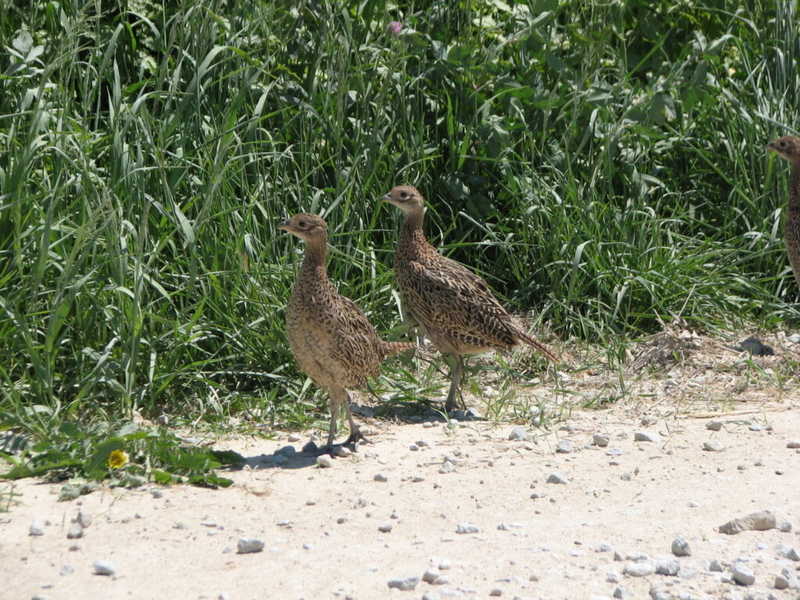
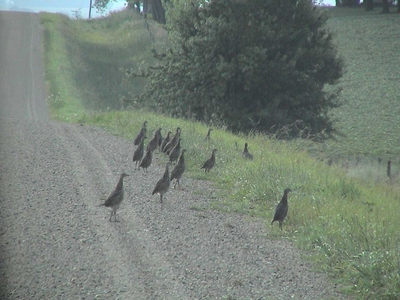
Young pheasants like to dry off along gravel roads on mornings with heavy dew. Iowa Department of Natural Resources staff use these mornings to count wildlife populations. (Photo courtesy of DNR)
Every August, for over half a century, Iowa Department of Natural Resource staff have set out along gravel roads at dawn, armed with a set of binoculars and, now, an interactive logging application, to survey the landscape for pheasants and other wildlife.
Todd Bogenschutz, an upland wildlife biologist with DNR, has driven the same 30-mile stretch of farm roads in Boone County for the past 30 years.
On a cloudy, early August morning, he jumped out of his truck, clapping his hands loudly, in an attempt to “flush” a family of pheasants out of the brush they ducked into as the truck inched up.
With a rustling of feathers, a group of pheasants shot up and rushed to take cover in a nearby cornfield. Bogenschutz used the movement of the birds to count and note the size of the birds to estimate their age.
“Three pigeon-sized birds, no hen,” Bogenschutz said as he stepped back into the truck and grabbed his phone to record the sighting.
Over the past three decades with DNR, Bogenschutz has seen the landscape — and with it the wildlife — change in tune with weather patterns and federal policies.
The results from Iowa’s 2026 August roadside survey indicates the second-highest pheasant population Iowa has seen since 2015. Even so, that pheasant population size is less than half of what it was when Bogenschutz started with Iowa DNR in the mid 1990s. The main difference, he said, is habitat availability.
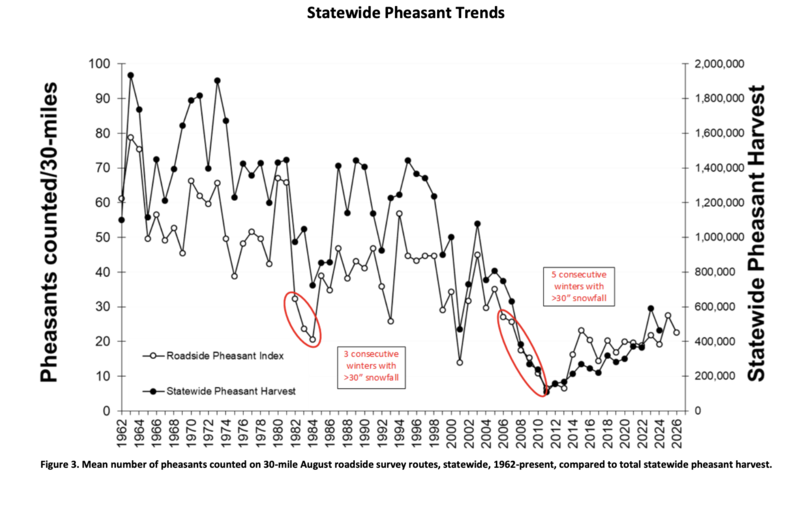
While the 2026 survey showed some of the highest pheasant populations in more than decade, the count was about 17% lower than the count in 2025.
This year the survey results show an average of 22.6 pheasants per 30-mile route, while last year’s report found an average of 27.5 pheasants per route. Before the turn of the century, averages were commonly above 40 pheasants per route, though in the 2010s, averages dipped below 10 for a stint.
Bogenshutz said winter precipitation is a good indicator of how big the pheasant population will be, as the birds sometimes have difficulty over-wintering in heavy amounts of snow. Last year, he said, was a mild winter, while this most recent year he considered “average.”
“A lot of hens die when we have the tougher winters, and so it doesn’t really matter what happens during nesting if we’ve got fewer hens,” Bogenshutz said. “Even if it’s a great nesting year, their count’s probably going down.”
Cold and wet conditions in the spring, when the birds nest, can also cause a dip in population sizes, but weather reports for spring 2026 showed fairly normal conditions.
Bogenschutz said based on the weather conditions for the year, staff anticipated no change in pheasant populations from 2025, yet the population decreased “significantly” with decreasing trends in 4 of the 9 survey regions.
Even if a pheasant hen loses her nest, they can often nest a second and sometimes even a third time in a season. Bogenschutz and other DNR staff who conduct the surveys make note of the size of the young birds. If a bird is smaller when staff survey in August, it suggests it came from a second roost, while a pigeon-sized young pheasant indicates a successful first nest.
Less habitat, fewer birds
While winter weather directly impacts the birds in a season, habitat loss affects bird populations more gradually.
As Bogenschutz drove along the route, he pointed to fields with rows of corn that he said used to be planted with native grasses, presumably through the U.S. Department of Agriculture’s Conservation Reserve Program, or CRP. Along these plots, Bogenschutz said he used to find pheasants or other upland game – but now it’s unlikely they’d be there.
“If we want to have critters, we’ve got to have habitat, and that’s basically some type of grass,” Bogenschutz said.
According to the roadside survey report, Iowa has more than 500,000 fewer acres enrolled in CRP than it did in 1995. When looking at total habitat – CRP, hay and small grains habitat – Iowa has lost more than 1.4 million acres of habitat since 1995, according to the survey.
In his report, Bogenschutz writes that while the 2018 farm bill expanded CRP to 27 million acres nationally, it reduced CRP rental rates which historically tracked closely with agricultural land values.
Bogenschutz said that since CRP contracts expire after a number of years, if a farmer can get more by planting a cash crop on it – even if the land is subject to flooding or drought – or renting it to another farmer, it’s not uncommon to see the grassland get tilled to make way for corn or soybeans.
“I think landowners in Iowa generally are willing to be good stewards and they would participate more in CRP,” Bogenschutz said.
He also sees more strips of CRP or other incentive programs that promote grassland areas. These strips, he said, are good for water quality and allow for some bird habitat, but generally are not as protective as a larger grassed area. When the habitat is just a strip, it leaves nesting birds more vulnerable to attacks from predators.
While a new farm bill has not materialized in the past several years, current drafts in the House and Senate keep the same 27 million acre cap set in the 2018 law. Several efforts in both chambers were proposed to bolster CRP, however progress on passing a farm bill has stalled as lawmakers disagree over federal nutrition program policies.
Conservation groups like Pheasants Forever also advocate for access to habitat through programs like CRP and by purchasing land that can become permanent habitat and public hunting grounds.
Roadside surveys
While the landscape around the routes has changed, the routes themselves have been consistent through the years.
The survey started in the 1930s as just a handful of randomly selected, 15-mile routes that staff drove up and back. Now, Bogenschutz said, each county has two, 30-mile routes that stay the same from year to year unless the route gets paved.
Bogenshutz said testing from Iowa State University in the 1950s “standardized” the roadside survey so that staff would run the routes on mornings with heavy dew and low wind. Those conditions, the study found, were most likely to draw the roosts to the edges of the roadsides as the birds tend to seek dry ground.
The survey ultimately helps to inform the DNR about bird populations ahead of the hunting season.
As Iowa heads into its 101st pheasant hunting season, Bogenschutz’s report said it should be a “good” hunting season as overall pheasant populations are 12% above the 10-year trend. Pheasant counts were above the 10-year averages in all regions of the state, except the south-central region, Bogenschutz reported.
The report estimates pheasant harvest numbers between 350,000 to 450,000 roosters this fall. Last year, hunters harvested around 500,000 ring-necked pheasant roosters.
DNR staff also survey for other wildlife on the dewy August mornings. According to the report, bobwhite quail populations declined from an average of 1.1 birds per route in 2025, to less than one bird per route in 2026.
Gray partridge populations appeared to have increased by 6% from 2025 to 2026 and cottontail rabbit populations this year were “identical” to those observed in 2025. No jackrabbits were observed in 2026.
Cottontail rabbit seasons opened at the end of August. Pheasant, gray partridge and bobwhite quail seasons will open at various dates in October. Official dates and hunting information can be found online with DNR.
Des Moines, IA