The race for governor: Low stakes in New Hampshire’s gubernatorial primary on Tuesday
Sep 07, 2026 | 9:26 am ET
Description
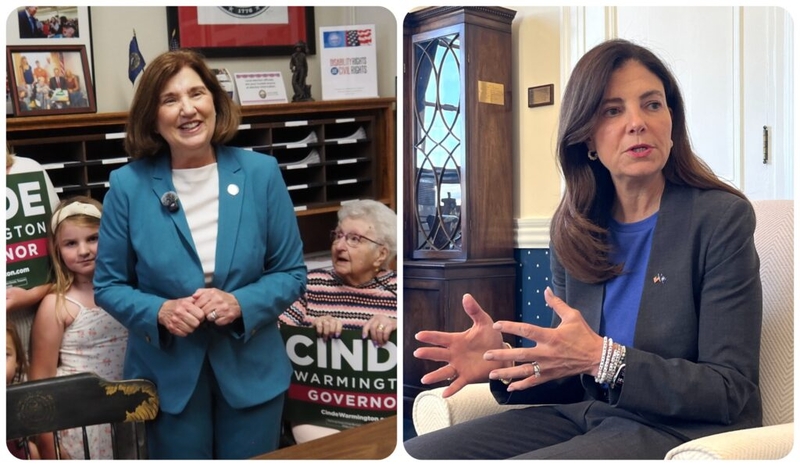
Cinde Warmington (left) and Gov. Kelly Ayotte (right) are already looking ahead to the November general election. (Left: Photo by William Skipworth/New Hampshire Bulletin; Right: Photo by Ethan DeWitt/New Hampshire Bulletin)
On Tuesday, Granite Staters will cast their votes in one of two gubernatorial primaries, but those votes are unlikely to have much impact.
Former Executive Councilor Cinde Warmington is the only name on the Democratic ballot. And incumbent Gov. Kelly Ayotte does not face a serious primary challenge. Shaun Fife, of Gilmanton, and Bob Wayne McClory, of Goffstown, have filed to challenge Ayotte in the Republican primary, but neither has mounted a campaign likely to make a dent in Ayotte’s chances.
This is Ayotte’s first reelection bid. She won election in 2024 over Manchester Mayor Joyce Craig with the endorsement of her predecessor, Gov. Chris Sununu, whom she has sought to emulate in many ways. Before becoming governor, she represented New Hampshire in the U.S. Senate from 2011 to 2017 and was the state’s attorney general.
Warmington served on the Executive Council, an elected body unique to New Hampshire that approves contracts and vets the governor’s appointments, from 2021 to 2025. She was the lone Democrat on the council. This is her second time running for governor. In 2024, she lost the gubernatorial primary to Craig.
Ayotte’s approval rating in UNH’s August Granite State Poll was 49%. In her first term as governor, she successfully pushed the Legislature to roll back a bail reform law that she believed was too lenient on pre-trial crime suspects. She signed a bell-to-bell public school cell phone ban into law. She harshened penalties for drivers who refuse a Breathalyzer test. She implemented premiums to some Medicaid enrollees and increased their copays. And she enacted a budget that made major cuts to agencies like the Office of the Child Advocate and the Department of Health and Human Services.
Warmington trailed Ayotte in an August UNH poll, 49%-39%. As an executive councilor she opposed canceling and denying contracts with Planned Parenthood of Northern New England, a measure her Republican colleagues on the council successfully pushed for. She was sometimes the only vote opposing Sununu’s nominees for governmental posts. She was regularly the most scrutinizing councilor of state agency commissioners during her tenure on the council.
Ayotte has sought to make the campaign entirely about Warmington’s work lobbying for the opioid industry. Before becoming executive councilor, Warmington worked as a healthcare attorney for Purdue Pharma and a clinic that was criticized for over-prescribing opioids. The incumbent governor’s campaign has spammed advertising spaces with commercials, billboards, and other ads labeling Warmington an “opioid lobbyist.” In terms of policy, she’s promising voters that in a second term a slate of housing legislation she signed into law will ease skyrocketing prices and that she’ll continue the tough-on-crime style policymaking she’s become known for.
Warmington has criticized Ayotte for her Medicaid premium plan and the cuts in the budget she signed into law. She’s also blamed Ayotte for an ongoing abuse and neglect scandal at the Sununu Youth Services Center, a juvenile justice facility in Manchester. Warmington and her Democratic allies have tried to tie Ayotte to President Donald Trump, who has historically low approval ratings and who lost New Hampshire in three consecutive presidential elections. Warmington argues Ayotte is not willing to “stand up to” Trump by speaking out or participating in lawsuits against the administration over federal funding being revoked from New Hampshire or other matters.
The general election is Nov. 3.
Getting to the polls and voting
The polls will open at varying times on Tuesday morning depending on the municipality. Voters can find out where their polling location is and which races will be on their ballot on the Secretary of State’s website at https://app.sos.nh.gov/pollingplacesampleballot. New Hampshire allows same-day voter registration. To register to vote on Election Day, voters will need to provide proof of their identity (driver’s license, government-issued photo ID, or passport), age (also driver’s license, government-issued photo ID, or passport), U.S. citizenship (birth certificate, passport, naturalization papers, or other proof), and domicile (government-issued ID or documentation with an address on it).
Concord, NH