U.S. Senate: Here’s what separates Manzur and Pappas, Brown and Sununu
Sep 07, 2026 | 4:50 am ET
Description
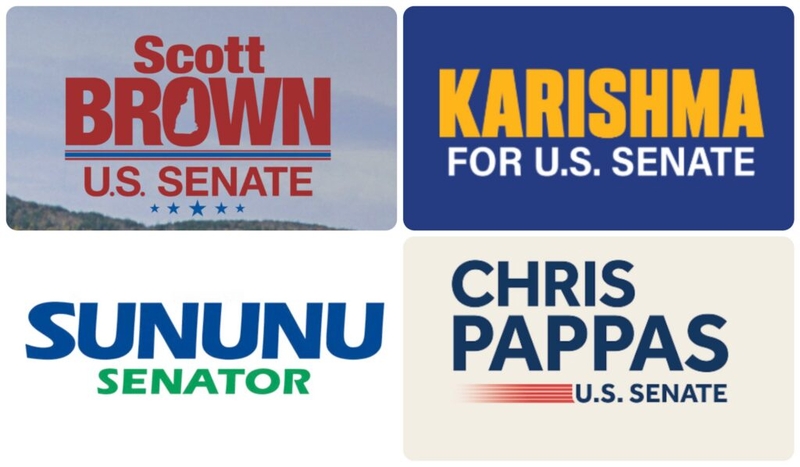
While John Sununu is facing off against Scott Brown in the U.S. Senate Republican primary and Chris Pappas faces Karishma Manzur on the Democratic side, Sununu and Pappas have sought to make the race about each other. (Screenshots from the four campaign sites)
After U.S. Sen. Jeanne Shaheen announced her retirement early last year, the race for a New Hampshire U.S. Senate seat became wide open.
On the Democratic side, U.S. Rep. Chris Pappas and Karishma Manzur are vying for the nomination in Tuesday’s primary elections.
Pappas, who has led in the polls throughout the race, represents the more moderate establishment choice while Manzur has attempted to offer a progressive alternative.
When they arrive at the polls Tuesday, voters will also find David Jarvis, Maxwell Saal, and John Vail on their ballots, but Pappas and Manzur have led the most active campaigns by far.
On the GOP side, two former U.S. senators are trying to convince voters to send them back to Washington, D.C.
John Sununu served in the U.S. Senate from 2002 until 2008 when Shaheen defeated him in his first reelection bid. Now that Shaheen is retiring almost two decades later, he’s asking Granite Staters to give him back the seat.
Scott Brown was first elected to the U.S. Senate in a special election in Massachusetts. After he lost reelection in 2012, he moved to New Hampshire and unsuccessfully ran for U.S. Senate in 2014. President Donald Trump appointed Brown ambassador to New Zealand and Samoa in his first term. Now, Brown is running for U.S. Senate again.
Rounding out the Republican ballot are Tom Alciere, Sky Danley, Andy Martin, Mary Maxwell, Richard A. McMenamon II, and Sabrina Ann Smith.
On the Democratic side, a centrist vs. a progressive
Pappas, a Manchester Democrat who has represented the eastern half of New Hampshire in the House since 2019, was the first to jump into the race. A center-left Democrat, Pappas was named the most bipartisan Democrat in Congress by the Lugar Center in 2023.
Indeed, some of his most significant votes have been ones in which he crossed the aisle.

Last year, he voted for the Laken Riley Act, an immigration and law enforcement bill pushed by Republicans in the wake of the death of a Georgia nursing student at the hands of an immigrant. That bill was widely criticized by progressives and immigration advocates who argued it disregards due process, gives too much power to state attorneys general, and strengthened ICE ahead of a series of aggressive crackdowns in Minneapolis, Chicago, and other cities. Opponents also argue crimes by immigrants who lack permanent legal status are rare and that Riley’s tragic death was an outlier.
In 2020, he was one of just six Democrats voting against the Marijuana Opportunity Reinvestment and Expungement Act — which sought to legalize cannabis federally — over his concern about a provision that would’ve expunged federal convictions.
He’s recently been touting his support for the DISCLOSE Act, which aims to curb “dark money” in politics. The legislation, which he sponsored this year, would require groups like super PACs to disclose political donors who give over $10,000. It also seeks to prevent money transfers between organizations meant to hide the identity of the original contributor and expand disclosure requirements for the funders of political ads, among other things.
In a purple state like New Hampshire, Pappas argued that he’s “shown through four tough campaigns for the House that I can attract Republicans and independents” and “truly build a coalition.”
Pappas faces a progressive challenge on Tuesday in the form of Karishma Manzur. An activist and a scientist from Exeter, Manzur counters Pappas’ campaign finance push by pointing to her own campaign finances.
“I’m not taking a single cent from corporate PACs, super PACs, AIPAC, foreign-aligned lobbies,” she said. “Nothing. I’m only taking money from regular folks here in New Hampshire and across the country. That is it. Therefore, nobody owns my vote.”
If elected, she wants to attempt to overturn Citizens United v. FEC, a 2010 Supreme Court decision that opened the door to dark money in politics. To do that, Congress would need 67 senators and two-thirds of the House to vote in favor of a constitutional amendment.
She’s made Pappas’ support for Israel and the financial backing he’s received from pro-Israel groups a cornerstone of her campaign.
Pappas’ campaigns since 2018 have received over $600,000 in direct and earmarked contributions from the American Israel Public Affairs Committee, or AIPAC, as well as more money from other pro-Israel funders.
Pappas has long supported U.S. aid to Israel. In February, at AIPAC’s 2026 Congressional Summit, he called himself “a strong supporter of the bipartisan U.S.-Israel relationship, which is a cornerstone of our national security policy.”
Recently though, bipartisan U.S. support for Israel has eroded among Democrats, and public opinion is souring on Israel. This comes as its multi-front wars drag on and more and more independent experts are concluding the country’s military is committing genocide against the Palestinian people.
In recent months, Pappas has moderated his stance. In July, he voted “present” — neither in favor nor against — on a measure to restrict weapons sales to Israel. He called that a “tough vote” when asked about it at the Manchester event last month, explaining that “what (Israeli President Benjamin) Netanyahu has done over the last few years is indefensible and unsupportable, and I think this is an important moment for a reset with respect to the U.S. policy toward Israel.” He said that Israeli security is “important to our national security and so is the plight of the Palestinian people.” He said he hopes Palestinians receive aid soon, that Hamas lays down its arms, and that Netanyahu loses reelection in October.
She supports a single-payer Medicare for All system.
“A single-payer universal healthcare system will be cheaper than the current system and cover all Americans,” Manzur said. “In addition to that, if anyone wanted to have some supplemental private health insurance, that’s fine. But every single person should be covered. Healthcare should not be a for-profit enterprise that it has become.”

Manzur also supported the Road to Housing Act, bipartisan legislation that was just enacted in an effort to address skyrocketing housing costs nationwide. Pappas voted for that bill as a representative.
In an August poll from St. Anselm College, Pappas held a strong lead over Manzur at 59% to 28%; 13% of respondents were unsure. The most recent UNH Granite State Poll, also from August, pointed to a slightly closer race: a 47%-34% advantage for Pappas, with 18% undecided.
Manzur has never held public office before. Asked why voters believe she could be effective in the Senate without any experience, she said: “I’m the only one who actually has a vision. When I launched, Pappas and Sununu, they didn’t even have a policy platform on their website. They were just going to run on their millions of dollars because it didn’t matter. All they need is money. What I’m bringing to the people is, as a scientist, I’m very evidence-based. I’m showing them how we can bring the money back home from being wasted on endless wars, how we can bring the money home by making sure we have a fair tax code, where … all these billionaires or the mega corporations are paying, paying their fair share of taxes, we can bring those trillions of dollars right here in New Hampshire and across this country.”
Pappas’ message to potential Manzur supporters: “I’m proud of the support I have, which comes from organized labor across the board in New Hampshire, which comes from small-dollar donors, and … but again, this is a campaign of ideas that’s really focused on how we beat John Sununu and MAGA Republicans and flip the majority in the U.S. Senate.”
Two former U.S. senators trying to make their comeback
Sununu did not respond to the Bulletin’s requests for an interview for this story. He held a commanding 54%-24% lead over Brown in the St. Anselm Poll and 60%-20% in the UNH poll.
Similar to Pappas’ positioning toward Manzur, Sununu has sought to shift attention away from Brown and toward the general election. He skipped a televised WMUR debate with Brown last week and has focused his television ads and campaign statements on Pappas.
Sununu comes from a politically connected family in New Hampshire politics. His father is a former governor who also served as White House chief of staff under President George H.W. Bush, and his brother was governor until early last year.

Elected at age 38 in 2002, he was the youngest person in the Senate. He was a supporter of the war in Iraq and of ending the 1984 Federal Assault Weapons Ban, which expired during his term. Some notable actions included voting against a constitutional ban on same-sex marriage and filibustering the PATRIOT Act, which expanded the government’s surveillance abilities and has been criticized by privacy advocates. He was also sponsor of legislation to privatize Social Security, which he’s been attacked for by Democrats during this campaign. An analysis from The Washington Post found Sununu voted with the Republican Party’s position 84% of the time.
Brown, meanwhile, was a centrist Republican during his brief tenure in the Senate. For example, in 2011, Brown voted with President Barack Obama’s legislative positions 69.6% of the time, according to Congressional Quarterly. He sponsored the STOCK Act, which was signed into law by Obama and required members of Congress to disclose stock transactions and sought to ban insider trading. However, he was a strong opponent of Obama’s signature legislative feat, the Affordable Care Act.
Asked during a phone interview if he would vote to repeal the ACA and what he envisioned to replace it should he be elected, Brown said: “I can’t fix health care in a 30-second phone call, nor would I even do it. But what I would say is that I will absolutely volunteer to be on the task force to find solutions because I am a problem solver.”

In 2026, Brown has sought to position himself in the minds of primary voters as more right wing and as the pro-Trump candidate.
For example, he’s touting Trump’s One Big Beautiful Bill Act, an omnibus bill that touched nearly every segment of the federal government. He has been vocal about his support for the provisions in that bill that eliminated some taxes on tips and overtime. Asked what he would say to voters’ concerns about the Medicaid and SNAP cuts included in that bill, Brown said SNAP shouldn’t be run by the federal government anyway (the program is currently jointly run by states and the federal government). He wishes the federal government gave states block grant funding to run it by themselves.
“We can do it better than the federal government,” Brown said. “I believe in block granting the SNAP money to us directly, and the same with education funds. I believe we should take those education funds and block grant them to our states because we can do it better.”
Asked about his level of concern over the massive increase to the federal government’s debt that the One Big Beautiful Bill brought via tax cuts, Brown said: “The hope was that we would actually create jobs and actually add to the job base and the tax base that would offset that.”
Still, Trump has endorsed his opponent Sununu in the race, likely a calculation by a president paying attention to polling numbers.
Like Sununu, Brown has been trying to focus on criticizing Pappas.
“Chris Pappas, all he does is complain,” Brown said. “You know, blame, blame, blame, and he doesn’t actually come up with solutions.”
Getting to the polls and voting
The polls will open at varying times on Tuesday morning depending on the municipality. Voters can find out where their polling location is and which races will be on their ballot on the Secretary of State’s website at https://app.sos.nh.gov/pollingplacesampleballot. New Hampshire allows same-day voter registration. To register to vote on Election Day, voters will need to provide proof of their identity (driver’s license, government-issued photo ID, or passport), age (also driver’s license, government-issued photo ID, or passport), U.S. citizenship (birth certificate, passport, naturalization papers, or other proof), and domicile (government-issued ID or documentation with an address on it).
Concord, NH