A Maryland military mystery: Museum tries to identify soldiers in Civil War tintypes
Sep 06, 2026 | 6:00 pm ET
Description
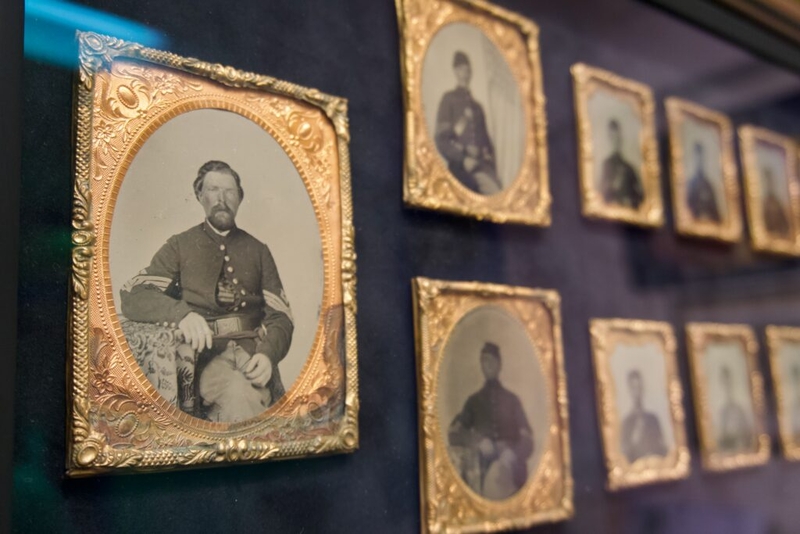
The Maryland Museum of Military History is asking for help from the public to identify soldiers from the Eastern Shore in a set of Civil War-era photographs. (Photo by Christine Condon/Maryland Matters)
Nestled in the oldest armory in Maryland is a set of Civil War-era photographs vexing a small team of military historians.
So they’re asking for help.
The historians at the Maryland Museum of Military History hope that genealogy whizzes or military history buffs might be able to identify the 45 Union soldiers pictured in a set of individual tintypes, each ensconced in its own intricate metal frame.
The museum’s curators say that the framed collection is rare, in that it depicts an entire Civil War regiment.
“Every museum I’ve been to, while they have individual photographs of people, they don’t have a whole unit,” said Alexandra Reed, a curator at the Maryland Museum of Military History.
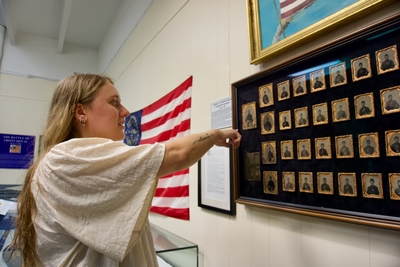
The curators know who was in the regiment — Company B, 2nd Regiment of the Maryland Eastern Shore Volunteers — based on military records. But they have no idea who’s who in the pictures.
They range in age from 16 to 44 years old, and historians believe they all enlisted in Chestertown within the same two-week period. They would go on to fight in battles at Falling Waters in Maryland, along with Lynchburg and Snicker’s Gap in Virginia.
Reed, a curator at the museum for the past four years, said the large frame has been hanging on the wall in the museum’s Civil War exhibit throughout her tenure. But another project, focused on the Iraq War, inspired her to seek more information about the roughly 165-year-old photographs.
Reed and her team were interviewing a Maryland veteran — Guard Capt. Joseph D. Shaffer of the 115th Military Police Battalion — about a series of photographs he donated to the museum documenting his time in Iraq.
In April 2003, Shaffer, who was born in Oakland, Maryland, became the first member of the Maryland National Guard to lead a convoy into Baghdad, according to a display at the museum. He was also in charge of collecting materials to construct Camp Cropper, a detention camp for “high-value detainees” inside Baghdad International Airport.
But Shaffer was unable to remember many of the individuals pictured, forcing the team to seek out others who could help, Reed said. Efforts to enlarge and sharpen blurry name tags often failed.
“It kind of made me realize that there are a crap ton of photos that we’ve got that are just unidentified individuals,” Reed said.
The hardest ones of all, she realized, would be the tintypes from more than a century ago.
So far, Reed said, a few members of the public — along with the nonprofit Baltimore Heritage — have volunteered to help with the identification effort. But there haven’t been any breakthroughs yet.
At one point, the historians believed they were close to making an identification, Reed said, using public photos on an ancestry website.
“I thought I had the right person because they had the right name, the birthdays kind of matched up,” Reed said.
But as the team looked through online photos of the individual, they started to question whether the person’s face looked the same as the tintype. And when Reed started scrutinizing newspaper clippings from the era, she discovered that the individual in the online pictures could not have been fighting in the Eastern Shore regiment during the Civil War.
Reed said her team is wondering if any descendants of the soldiers would have photos that could be used to confirm a soldier’s identity, or whether additional military history enthusiasts could comb digital archives and ancestry websites for evidence, helping the small team of only a few historians who work at the museum.
Tintypes, also known as ferrotypes or melainotypes, were invented in the 1850s and continued to be produced into the 20th century, according to the Library of Congress. To create the image, the photographer would apply the photographic emulsion to a thin sheet of iron coated with a dark lacquer or enamel.
Civil War soldiers were popular subjects of tintypes, which were frequently taken indoors in studios, because they were durable, meaning they could easily be sent home to relatives.
The 125-year-old armory building, located near the Joseph Meyerhoff Symphony Hall in Baltimore, is historic in its own right: It hosted the Democratic National Convention in 1912, when the party selected eventual President Woodrow Wilson, and hosted a televised speech delivered by President Dwight D. Eisenhower.
The museum also displays a Jeep with a German helmet welded to its front as a trophy of war. Called the Vixen Tor, the Jeep was owned by Maj. Gen. Charles H. Gerhardt, who commanded the 29th Infantry Division on D-Day. Images show that Eisenhower rode in the Jeep in Germany.
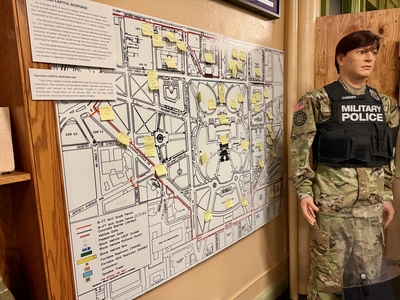
But its exhibits also cover present-day topics, including the Maryland National Guard’s deployments to the Jan. 6 insurrection in Washington, D.C., and its deployments during the coronavirus pandemic.
In one glass case sits a face shield, a vaccine vial and a large bottle of hand sanitizer — already considered relics of another time. And beside it, a large map of the U.S. Capitol complex, which the Maryland National Guard, the first outside unit to arrive in Washington that day, used during its response to the rioting.
“We start with colonial [times],” Reed said of the museum. “We’re still trying to develop into today.”
Annapolis, MD