Iowa labor experts speak on UnityPoint unionization efforts, worker challenges
Sep 04, 2026 | 5:24 pm ET
Description
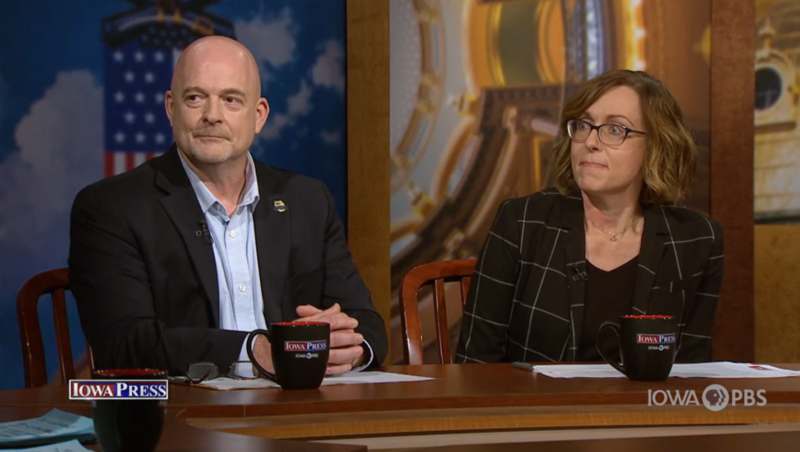
Teamsters Local 238 Secretary-Treasurer Jesse Case, left, and Jennifer Sherer, deputy director of Economic Policy Institute Economic Analysis and Research Network, speak on Iowa Press on Sept. 4, 2026. (Screenshot taken from Iowa Press video)
As the United States honors the efforts of its labor movement and workers this Labor Day Weekend, Iowa labor experts say workers are “making the labor movement every day,” amidst weaker bargaining laws, attacks from corporations and other challenges everyone is facing, whether they hold a union card or not.
Jesse Case, secretary-treasurer of Teamsters Local 238, and Jennifer Sherer, deputy director of the Economic Policy Institute’s Economic Analysis and Research Network and director of the institute’s Worker Power Project, spoke on “Iowa Press” Sept. 4 about efforts of some Iowans to unionize and the issues impacting unionized workers in the state and across the country.
Sherer told “Iowa Press” moderator Kay Henderson and Gazette Des Moines Bureau Chief Erin Murphy that this is a difficult period for Iowa workers, and that in the 30 years she’s lived in Iowa, the state’s union representation density has fallen from above to below the national average.
In 2025, the U.S. union membership rate was 10%, according to the U.S. Bureau of Labor Statistics, and Henderson said currently just over 100,000 Iowans are union members, or around 6.8% of the population.
“But that’s not the end of this history,” Sherer said. “Workers are still rewriting it today, and this Labor Day and the next election cycle and everything that comes after will probably write the next chapter.”
UnityPoint nurses still in fight for unionization
Nurses working in four Des Moines area UnityPoint Health locations are still waiting to hear a ruling from the National Labor Relations Board on their vote to unionize, as 251 of the 1,537 votes cast have been challenged. According to the National Labor Relations Board, 871 votes were cast to organize and 666 voted against the motion.
Case said he believes the workers won the election and that the challenges are a tactic by UnityPoint to stop them from organizing, something he said isn’t uncommon in healthcare. He called UnityPoint’s efforts to halt the union’s creation “one of the most expensive union busting campaigns in the history of labor.”
According to a May Economic Policy Institute report cited by Sherer in the discussion, UnityPoint Health spent more than $2.1 million on “union avoidance consultants” in 2025. The healthcare company came in second to Amazon, which spent more than $26.6 million, and the total spent on union avoidance topped $1.5 billion in the U.S.
“We think that the union and the workers are going to prevail with those labor board decisions, and then it’s going to, you know, take all hands on deck to get the employer to get to the table and negotiate a fair agreement because we expect them to stall on that too,” Case said. “And they really just need to step to the plate and do the right thing and negotiate in good faith with those workers who voted to organize under their federal rights.”
In response to a question from Murphy about UnityPoint’s claim that a union contract for its healthcare workers would be “too rigid” and reward seniority rather than performance, Case said all employers say that in these situations. Employers and workers need to have a partnership with negotiated terms and a voice for the workers, he said, as it makes the workforce more consistent, makes recruitment easier and can improve the work’s quality.
Union election filings in the healthcare industry have been increasing over the past few years, Sherer said, alongside general support nationwide for unions. However, even with more than 70% of U.S. citizens across age demographics and party lines supporting unions, she said federal and state labor laws “have gotten so weak” that the path to a union contract is murky, even without efforts from employers to quell calls to organize.
“I do absolutely think the UnityPoint example here in Iowa is a leading example of a trend we’re seeing everywhere,” Sherer said.
State, national challenges for workers
Despite U.S. employers adding 162,000 jobs to the labor market in August, according to the Associated Press, Sherer said the job market is “weak in certain important ways.” Beyond AI data center investment and a couple of other sectors, she said most industries are seeing either status-quo or declining numbers, and there is debate over whether the data center push will “turn out to be a temporary bubble.”
“Not a crisis, I don’t hear a lot of people yet predicting that we’re on the brink of a recession around the corner, but it’s not a healthy labor market, and particularly in states like Iowa, where we’re seeing pretty weak numbers,” Sherer said.
Artificial intelligence is becoming a threat to workers in many different fields, Case and Sherer said, from healthcare to white-collar industries. Case said he and others in unions are also worried about autonomous vehicles and investments from Silicon Valley in AI to “put driverless trucks on our roads.”
What may work in places like San Francisco and Austin, Texas, would not work in Iowa, Case said, and the idea of driverless vehicles brings up questions of accountability if there’s an accident and someone is hurt or killed.
An industry that historically could be found throughout Iowa, food processing plants, has been shrinking as well, Murphy said, leading to closures that impact hundreds of workers. Case said he sees the closures as “a product of consolidation of big (agriculture)” and monopolies created by Tyson’s, Cargill and JBS, and there are 11 packing plants across the country responsible for processing half of all of the beef here.
What makes it harder for Iowa workers when they are laid off due to consolidation, or other reasons, is the weakening of the state unemployment system, Sherer said. It’s harder now than it was a decade ago to predict household stability in the future with unemployment because benefits have been shortened in their length, Sherer said, making the market overall less healthy.
“If you pick an industry in this country, it’s generally run by four or five companies, and sometimes on a global scale. So there are monopolies that are controlling business in this country. It’s not good for our communities, it’s not good for workers,” Case said, “We need to really beef up the antitrust laws in this country and get some U.S. attorneys who are interested in fixing those monopolies, or at least holding them accountable.”
In response to a question about the impact of past comments by the Teamsters president about unions not being beholden to either the Republican or Democratic party, Case said “organized labor is not an extension of either political party, nor should we be.”
His local union has “represented” presidential campaigns in the past, Case said, including for former President Joe Biden and former Vice President Kamala Harris, but the union’s membership is split by thirds among Democrats, Republicans and independents.
Many independent voters are sick of both of the major parties, but what’s worse is a one-party system, which Case said has been the state in Iowa for years. With Republican control over state government, Case said collective bargaining rights were lost for 180,000 public sector employees, the state has the second-highest cancer rates and the worst water quality in the U.S. and “big money from New York and D.C.” has impacted policy-making to the “detriment of workers.”
“The reality is, we have to have a relationship with people on both sides of the aisle when we can and when they’re reasonable,” Case said. “Sometimes you can’t have a relationship with people because they’re just nut jobs, but where we can establish relationships, we have to have bipartisan relationships in some states and on the national level.”
“Iowa Press” airs on Iowa PBS. Here’s the broadcast schedule.
Des Moines, IA