Stadium’s blingy entrance will be new, but making the public pay for it is the same old
Sep 04, 2026 | 9:25 am ET
Description
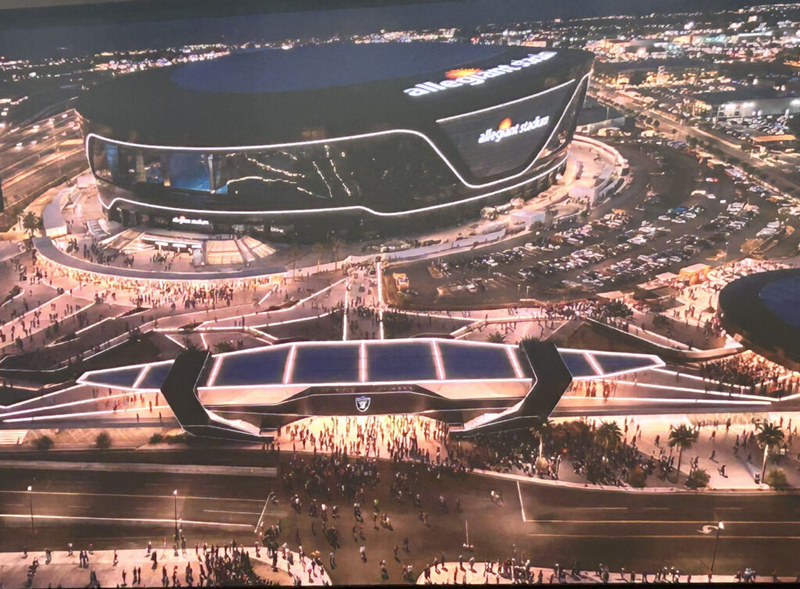
A rendering of the proposed portico at Allegiant Stadium shown as part of a presentation at the Las Vegas Stadium Authority meeting Sept. 2, 2026. (Photo: Dana Gentry/Nevada Current)
The movers and shakers and elbow-rubbers on the Las Vegas Stadium Authority this week perfunctorily rubber-stamped another $75 million of public funding to build a new entrance to the Las Vegas NFL stadium that will include, among other things, a station for Elon Musk’s preposterous tunnels (though perhaps surprisingly, not a ballroom).
Discussion from authority members was confined to gushing about how glorious the stadium — and Southern Nevada’s spectacle-based economy in general — has been for one and all. (So pay no attention to the missing Canadians and the $5 gas, I guess.)
The Las Vegas bread-and-circuses economic model does make a lot of money. The conventional narrative, happily chirped by the aforementioned mover-shakers and the nine out of ten Nevada politicians of both parties who’ve long been mainlining the Kool-Aid about publicly provided “incentives” for stadiums and companies and such, is that the money ripples throughout the community and lifts all boats.
And yet Nevada has sported the highest or nearly highest unemployment rate in the nation almost perpetually throughout the first quarter of the 21st century.
The Las Vegas metro area household median income (often the product of two or more earners), at just over $80,000 in 2024, is about $1,600 less than the national median. And in the city providing the spectacle economy’s its brand name, i.e., Las Vegas, the median household income falls more than $2,100 shy of the nation’s.
Neither the NFL nor Formula 1 nor data centers nor MrBeast, nor any of the other countless private sector entities the people of Nevada give cash and prizes to, need those government handouts.
That’s especially true given Nevada is one of only five states without a personal or corporate income tax. How much more economic “incentive” do businesses need to bring their enterprises to Nevada?
But a cult-like dogma pervades the practice of “economic development” in Nevada (and most of the rest of the nation). According to the profession’s gospel, corporations, companies, and other for-profit entities (such as pro sports teams) won’t locate or relocate somewhere unless they get generous publicly funded support in the form of tax breaks, tax credits, and maybe some roadwork or other infrastructure tossed in if the entity is big and/or showy enough, like Tesla, F1, or the NFL.
Most elected officials who enable the economic development giveaways seem to feel spending public money to help private business is more fun and exciting and splashy, and hence politically preferable, to focusing public spending on what those politicians evidently view as more mundane concerns such as public education, public transit, or public health.
If the Raiders and the NFL’s stadium authority cheerleaders are hot for a new $158 million entrance to the football field, that’s fine. Making the public pay for half of it isn’t. Let the Raiders and Musk and Allegiant and the resort industry — and any other private entities who want to put their money where their team spirit is — pay for it.
And if the authority’s got $75 million in tax revenue burning a hole in its pocket, spend it on, oh, affordable child care for the working families who make Las Vegas spectacle-based economy go. As an example.
Making the public pay for a stadium remodeling job is another in a long line of cases where very rich private interests play the Nevada public for a bunch of suckers and chumps, with the full and obsequious support of Nevada “leaders.”
But this week’s exercise in groveling before special interests in the name of the Nevada public notwithstanding, there are signs of growing doubts in Nevada about the wisdom of government giveaways.
Last last year, Nevada’s Republican governor, Joe Lombardo, and the Democratic attorney general who is running against him, Aaron Ford, were both supporting a scheme to give billions of dollars of transferable, which means sellable, tax credits to California film corporations and one of the nation’s largest master planned community developers. But a sufficient number of state legislators stood up against what would have been the largest public subsidy in the state’s history, and the tax credit scheme failed.
In what might be another long-overdue indication Nevada elected officials are, if not wising up to the government giveaway racket, at least becoming more sensitive to public opinion against it, Lombardo and Ford are both scurrying to backpedal from their support for data center tax breaks.
Lombardo’s running an ad that says data center tax breaks “took money from our schools, and gave it to data centers.”
Ford’s running an ad that says tax breaks for data centers “have handed them over 200 million of your tax dollars.”
Such characterizations of Nevada economic development programs — took money from our schools, handed over your tax dollars — might have been leveled by the occasional critic over the years (raises hand). But hostile descriptions of the state’s principal economic development policies are nearly unprecedented among state politicians, and astounding to see from general election candidates for governor. (And all it took was the rise of a technology that makes a good deal of the human race wonder how or even if they will coexist with it.)
But no concern about the wisdom, fairness, and virtue of public giveaways to private interests was on display when the stadium authority blithely approved $75 million in tax revenue for stadium bling.
It’s hard to be disappointed in the authority itself. It was created to serve the Raiders and the stadium, not the public. It seems similarly pointless to blame the staff at the Governor’s Office of Economic Development, which routinely approves Nevada government giveaways. Rubber-stamping public goodies for the private sector is what they were hired to do.
A line of Nevada governors, legislators, county commissioners — and of course the industries and their executives those elected officials cater and answer to — are the ones who created and empowered all this government giveaway nonsense. The decisions of those purported leaders reflect a profound lack of, well, leadership, but an unseemly amount of comfort with narratives crafted over decades by corporate America.
We’re likely stuck with that caliber of leadership. There’s very little daylight between Lombardo and Ford on economic policy, and for each of them, data centers are a one-off in which they’re scrambling to catch up to strong bipartisan public opinion. As politicians often do, they’re following, not leading. Whichever one of them wins, don’t expect to hear them say Tesla, the NFL, or any other of the many non-data center recipients of Nevada tax breaks and subsidies are, to borrow the phrase in Lombardo’s ad, “taking money from our schools.” Even though they are.
Bits and pieces of this column were originally published in the Daily Current newsletter, which is free and which you can subscribe to here.
Las Vegas, NV