‘The knives are out’ as candidates make final sprint to the primary
Sep 03, 2026 | 5:33 pm ET
Description
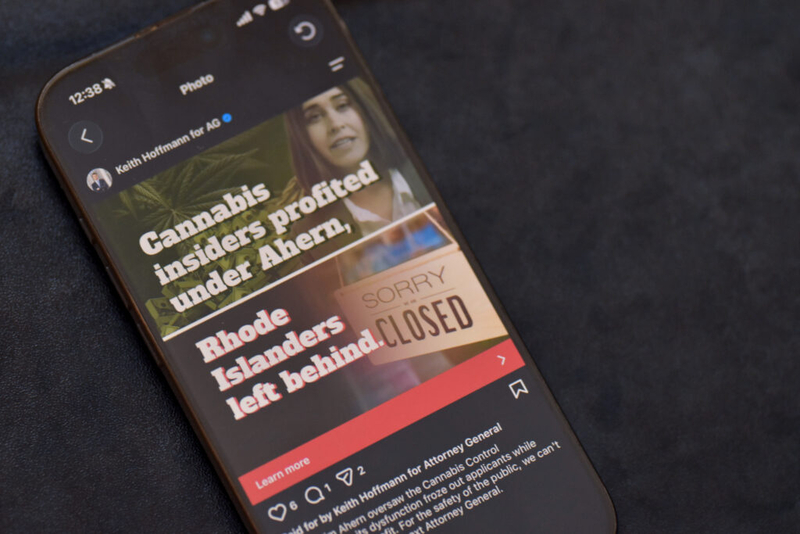
An Instagram ad by Keith Hoffmann, a Democrat running for Rhode Island attorney general, criticizes rival Kim Ahern’s tenure leading the state Cannabis Control Commission (Photo by Christopher Shea/Rhode Island Current)
A quiet summer overall in the Democratic primary races for attorney general and lieutenant governor has turned increasingly combative in the closing days of the campaigns.
Lieutenant governor candidate Xay Khamsyvoravong on Thursday accused incumbent Sabina Matos of relying on a dark-money super PAC to keep her reelection bid afloat. Matos’ campaign has denied the allegation.
Attorney General hopeful Keith Hoffmann on Wednesday had to correct his campaign’s closing ad after Barrington Rep. Jason Knight claimed it misled voters by including the endorsement of a gun safety group that actually backed Knight’s campaign. Hoffmann was also accused on Friday by Kim Ahern’s campaign of failing to disclose stock holdings in companies he prosecuted while part of the AG’s office.
“The knives are out,” observed Matt Ulricksen, an associate professor of political science at the Community College of Rhode Island.
Multiple polls show a large swatch of voters remain undecided in both races just days before the Sept. 9 primary. A survey released Aug. 27 by the University of New Hampshire found 46% of likely voters surveyed on the AG’s race were undecided. More than a third of voters were undecided in a WPRI-Emerson College survey published two days prior.
In the five-way race for lieutenant governor, the WPRI-Emerson poll also found that more than 4 in 10 voters were still undecided in the primary, which also includes former state Sen. Cindy Coyne of Barrington, Providence City Councilor Sue AnderBois and Ponaganset High School science teacher Ross McCurdy.
“Negativism moves votes,” Ulricksen said. “As much as we decry negative campaigning, the research is solid.”
So many ads, so little time left
The AG campaigns have spent heavily trying to break through to voters over the summer, primarily through television commercials highlighting their credentials to be Rhode Island’s top lawyer.
Hoffmann was the first out with an ad, landing a spot in July as part of a $1 million media campaign. A review of order forms filed with the Federal Communications Commission show Hoffmann’s campaign has spent $784,441 on more than 5,900 ad spots across Rhode Island’s broadcast and cable TV networks.
FCC filings show Ahern’s campaign has spent over $418,000 on television with 1,694 commercial spots since joining the airwaves the week after Hoffmann. Knight’s campaign has spent over $319,000 on 1,948 ad spots across Rhode Island’s broadcast and cable networks. Warwick Rep. Joe Solomon has expended nearly $280,000 on 800 broadcast TV spots.
“When you look at those airwaves, it is constantly Keith,” Ulricksen said.
Hoffmann’s campaign has also called Ahern a “sloppy prosecutor” on social media, referencing a high-profile murder trial in 2017 in which a Superior Court judge declared a mistrial, faulting Ahern and another prosecutor over failures to disclose evidence to the defense.
Ahern defended her conduct during a WPRI debate on Aug. 12 stating “no personal or professional violations were found on the state.”
Another post promoted by Hoffmann criticized Ahern’s tenure leading the state’s Cannabis Control Commission, which has yet to license any new retail stores nearly four years after recreational sales were legalized by the General Assembly. Josh Block, a spokesperson for Aherns’ campaign called the attacks “a desperate effort by Keith Hoffmann to spread lies.”
Hoffmann said in an interview with Rhode Island Current he only went negative against Ahern because she attacked him first, including in the WPRI debate where she criticized his heavy self-funding and lack of prosecutorial experience.
“We responded. Period,” Hoffmann told Rhode Island Current.
Negativism moves votes. As much as we decry negative campaigning, the research is solid.
Hoffmann has loaned himself $760,000 since he launched his campaign last year. That includes $210,000 infusion made Aug. 28, according to disclosure forms filed Wednesday with the Rhode Island Board of Elections.
Knight has loaned himself $138,000 this election cycle, and Solomon loaned his campaign $100,000.
Ahern in a past statement boasted about being fueled entirely by donations and that the “attorney general is not a job to be bought by the highest bidder.” But Ahern’s latest disclosure forms show she loaned her campaign $295,000 between Aug. 25 and 31.
Block said the money was needed to respond to Hoffmann’s paid attacks.
“It was important to put in what they can in order to create a more level playing field for voters,” he wrote in an email to Rhode Island Current.
Ahern sought to level the playing field Aug. 28 by accusing Hoffmann and his wife of holding stock in companies involved in cases he handled at the attorney general’s office, including Daimler Truck and pharmaceutical companies.
“For a senior leader in the Attorney General’s Office to fail to disclose a personal financial stake in the outcome of their own case is a major red flag, and for that same person to now be seeking the Attorney General’s Office for himself should be concerning to all Rhode Islanders,” Ahern said in a statement.
Hoffmann maintains he did nothing wrong.
“I’ve filed and disclosed everything as required and have always followed all office policies,” he said.
State law requires all state-appointed officials and employees “who hold a major decision-making position in a state agency” to file financial disclosure forms with the Rhode Island Ethics Commission.
Jason Gramitt, the Ethics Commission’s executive director, said the state’s annual financial disclosure requirement generally applies to agency heads and other top-level officials. He said a director of policy at the AG’s office would generally not be required to file.
“Most state employees don’t file and are not required to file financial disclosure statements,” Gramitt said in a recent interview.
The lieutenant governor’s race has been a much quieter affair financially.
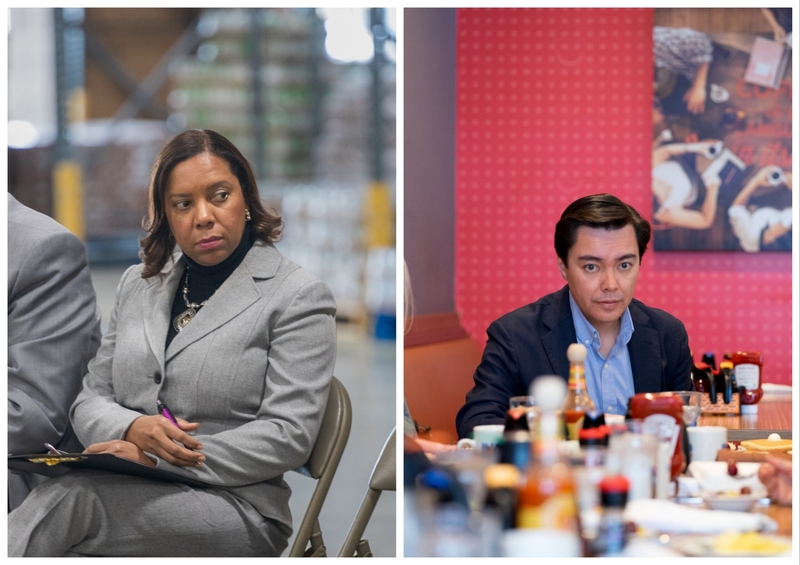
FCC filings show Khamsyvoravong’s campaign spent nearly $122,000 for 381 ad spots across broadcast and cable between the start of early voting and the Sept. 9 primary. Coyne committed more than $96,000 for 349 commercial spots across Rhode Island’s broadcast networks. AnderBois spent a little over $63,000 on 502 ad spots.
Matos and McCurdy have remained off television.
But Matos has not escaped scrutiny over campaign spending, with Khamsyvoravong now making one of the organizations supporting her a central issue in the final days of the primary.
Khamsyvoravong cited donations to the Democratic Lieutenant Governors Association from “pharmaceutical companies, a private-prison company involved in President Donald Trump’s ICE detention infrastructure and Big Tech.” Forms show the association then transferred $100,000 to the DLP PAC, which has used the money for radio ads and mailers supporting Matos.
“Rhode Islanders should never have to wonder whether their elected officials are willing to mislead voters to advance their own political careers,” Khamsyvoravong said in a statement.
Christa Thompson, Matos’ campaign manager, said in an emailed statement to Rhode Island Current that the lieutenant governor has not accepted corporate PAC donations in her own fundraising.
“Sabina Matos’s anti-corporate and bona fides are clear,” Thompson said in an emailed statement. “When she’s reelected as Lieutenant Governor, she’ll keep leading that fight to lower grocery costs, and that’s where her focus is in the next four days.”
Early voting remains underway through 4 p.m. on Tuesday, Sept. 8. The winner of the next day’s Democratic lieutenant governor primary will face Republican John Loughlin in November. The victor of the four-way AG’s race will face Alan Gordon in the general election.
Providence, RI