Billings area legislative race draws two write-in candidates
Sep 03, 2026 | 5:37 pm ET
Description
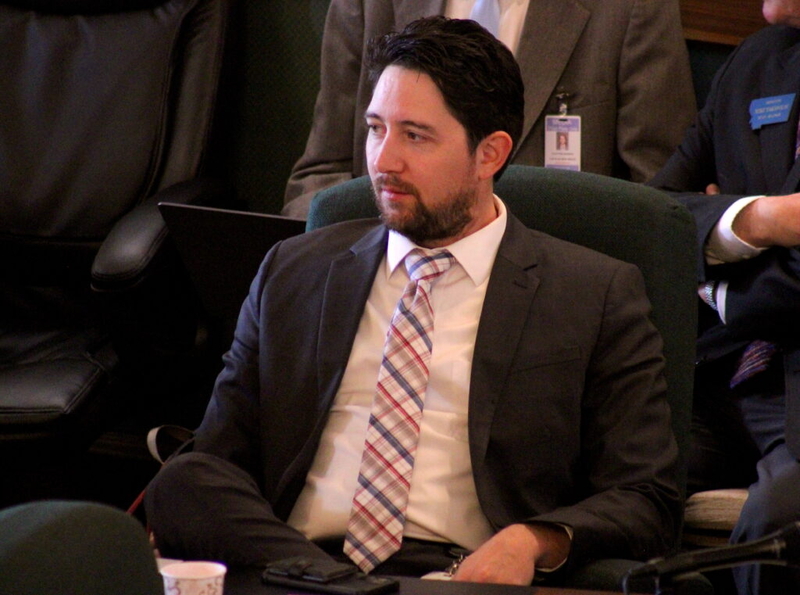
Sen. Daniel Zolnikov, R-Billings, sits prior to a Montana Senate floor session on Wednesday, April 30, 2025. (Jordan Hansen/Daily Montanan)
The path back to Helena appeared smooth for State Sen. Daniel Zolnikov, up until about three weeks ago.
Zolnikov has been a lawmaker since 2013 and filed to run for re-election to Senate District 22, representing part of Billings, this year. He ran unopposed in the Republican primary in June, and the Democratic candidate was not certified after paperwork errors, leaving Zolnikov unopposed again.
But when the Secretary of State’s Office finalized candidates for November’s ballot in recent weeks, two individuals filed as write-in options, challenging Zolnikov.
“It makes the odds twice as hard for two people to be trying to get on a ballot line,” Zolnikov told the Daily Montanan. “If you really wanted to take me out, you would support one write-in candidate.”
The two candidates working to convince voters to take the extra steps of remembering, and then writing their names on a ballot are Elijah Tidswell, a Republican, and Cari Olson, a Democrat — though write-in candidates are officially “nonpartisan.”
“Write-ins are rarely successful, and I think more often than not they’re just a protest vote,” said Elijah Tidswell, one of the write-ins. “But I don’t think of this as a protest. We’re getting signs, we’re knocking doors, we’re doing the work.”
Write-in candidates rarely win elections, though in Montana, some municipal and county precinct committee races — low-turnout elections — have seen some candidates prevail.
The blank line often included at the end of the list of qualified candidates is often used by voters wanting to have a little fun and avoid making a choice between candidates.
Maryland Matters, a States Newsroom affiliate, reported that in 2016 more than 45,000 people wrote in candidates for president, and each state governs the write-in process differently.
Last year, the Montana Legislature altered the state’s rules around write-in candidates in two ways: Candidates who lose a primary are no longer allowed to run a write-in campaign for the general election; and candidates must officially declare as write-in candidates 90 days before the general election.
The Secretary of State’s office exercised its discretion overseeing state elections to remove the write-in line from ballots that don’t have declared write-in candidates, which election officials say is efficient, as undeclared candidates aren’t officially tallied anyways.
That move is one of many issues Olson has with Montana politics, and if she were elected it’s a legislative change she would seek.
“There was not one bill that did this,” Olson told the Daily Montanan. “(Secretary of State) Christi Jacobsen on her own took that right away from us Montanans.”
Olson said that she supports more political power stemming from everyday Montanans. She would like to make it easier to vote for any candidate, and also easier to recall elected officials.
“If I win, I’m going to make it so easy to recall myself, I’m going to be hated by every other politician,” said Olson, who has worked in Democratic politics for years.
Tidswell, a real estate agent, has also been involved in his party’s political sphere for years, having previously run for the state Senate in 2022, losing by 12 points in the general election.
He was the chairman of the Montana Young Republicans until this year, and survived a vote of no confidence that sought to remove him from that role in 2025. He was re-elected to his position last fall, but resigned this spring after butting heads with the state GOP.
Tidswell said the issues he ran into are “emblematic of the larger Montana civil war,” which has seen more conservative Republicans who hold leadership positions clash with more moderate members in recent years.
“I’m definitely seen as more of an ‘old-school Republican,’ or I guess they’d label me a moderate, or a RINO,” Tidswell told the Daily Montanan.
His primary motivation for getting into the race at such a late stage was in response to the public pushback to a data center project planned just north of Billings.
“I know there’s a lot of people calling for full bans right now, I don’t know if that’s possible to get passed,” he said. “But there has to be at least some responses from our government and elected officials towards these concerns.”
Both Tidswell and Olson are making data center concerns a key part of their campaigns, in opposition to Zolnikov, whom Olson has nicknamed on her social media pages as “Data Center Danny.”
Zolnikov chairs the Energy and Technology Interim Committee and has passed numerous bills focused addressing privacy rights and technology regulation, including a “right to compute” bill last session which includes a framework for companies to build critical infrastructure, which can include data centers.
“I’m running because of data centers, data centers, data centers,” said Olson, who supports a full ban of data centers in the state. “At some point we need to wake up and understand that our politicians are putting corporations over us.”
Zolnikov told the Daily Montanan that data centers like the one Quantica is proposing near Billings will bring in millions of dollars of investment into the state, provide for much-needed infrastructure upgrades and allow Montana to export a new product — data.
“With these companies we’re not just selling megawatts of Montana power, we’re selling a product,” Zolnikov said. “In a capitalistic world, that’s a good thing.
Zolnikov told the Daily Montanan that there are no financial benefits for him, personally, if Quantica’s data center is built. He previously worked for Broad Reach Power — which formerly was a holding company for assets that became Quantica — but on other energy development projects.
He acknowledged many of the concerns people have about these large projects, including water and energy use, but said there are ways to address those through policy.
“We have some of the strongest water rights in Montana — an interim committee is working on that right now,” he said.
The interim committee he leads, meanwhile, is working to address energy concerns.
“We’ll ensure there will be a new rate class for large loads, and ensure they can’t shift that burden onto retail and residential customers,” he said. “If they build their own energy generation, that surplus goes into the grid to help customers and overall tax burdens in communities could decrease.
“I see a lot of benefits.”
Zolnikov says that drawing two opponents in the last month on the back of rising debates over data centers shows that the issue really “grew legs” since spring.
“I think it’s good that it’s become a big issue, it draws attention to the consumer protection bills we will have in the Legislature,” he said. “That’s a big benefit, as long I stay in office to pass them.”
Tidswell said that despite the odds, he’s fully invested in his campaign.
“At the end of the day, I’m running this campaign like I’m on the ballot but a little bit harder,” he said.
The race for state Senate District 9 has also drawn a write-in candidate, Nate White, who described himself as a philosopher to the Choteau Acantha.
That election includes Democrat Noy Holland of Choteau against longtime lawmaker Rep. Llew Jones, who won a tight primary and battled legal challenges to his candidacy for the senate seat.
Helena, MT