The Great Salt Lake — Utah’s silent health emergency
Sep 03, 2026 | 3:01 pm ET
Description
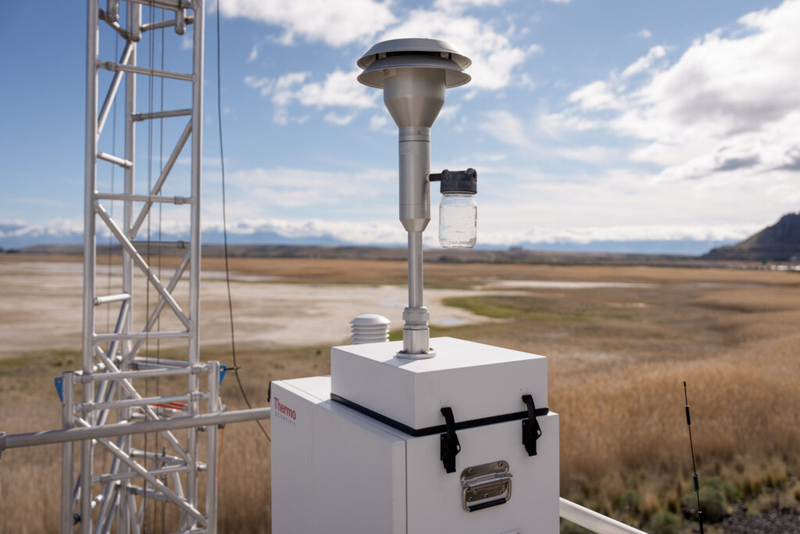
An air quality monitoring station at Great Salt Lake State Park in Magna is pictured on Tuesday, April 14, 2026. (Photo by Spenser Heaps for Utah News Dispatch)
In recent years, public discourse on air quality in Utah has rightly focused on the dangers of wildfire smoke. Wildfire events across the Western United States have degraded air quality for days and weeks at a time. Yet, while headlines chase each new plume of smoke, a slower and arguably more dangerous crisis has been allowed to develop with remarkably little urgency: the drying of the Great Salt Lake and the toxic dust it is now releasing into the air that Utahns breathe every single day.
As the Great Salt Lake shrinks, its exposed lake bed becomes a source of windblown dust laced with naturally occurring heavy metals and contaminants accumulated over decades of industrial activity. Among those contaminants are arsenic, lead, and uranium. Lead is the element that deserves particular attention here, and it should be noted that scientists have expressed concern about lake bed dust samples exceeding federal guidelines for lead exposure in surrounding communities. We obsess over chipped lead paint in old homes, and justifiably so, but an entire region facing repeated exposure to windborne dust containing lead and arsenic draws almost no comparable alarm. This is not conspiracy, it is documented environmental science, and it can cause severe respiratory illness, neurological harm, and worse.
The Great Salt Lake has lost a substantial portion of its historic volume, leaving thousands of square miles of dry lake bed exposed. When windstorms move across that playa, they lift fine particulate matter into the atmosphere and carry it into population centers along the Wasatch Front. Fine dust of this kind penetrates deep into lung tissue, beyond the defenses that stop larger particles. Chronic exposure is associated with asthma, chronic obstructive pulmonary disease, cardiovascular stress, and cancer risk. Arsenic is a known carcinogen. Uranium and radium, radioactive elements present in lake bed sediments, add a dimension of long-term hazard that conventional air pollution simply does not carry. Radium decay products inhaled as dust raise legitimate concerns about cumulative radiation exposure that no regulatory framework is currently designed to monitor or manage.
This is a hazardous materials situation that is not under control. There is no technology available that can cap the exposed lake bed, no practical way to treat thousands of acres of contaminated sediment, and no mechanism to prevent wind from mobilizing the dust. Rising regional temperatures compound the problem. Hotter summers accelerate evaporation, further shrinking the lake and expanding the dust source. Winters have grown shorter and thinner, reducing snowpack and stream flow that historically sustained the lake. Conditions next summer are projected to be even hotter, promising another season of accelerated evaporation, stressed ecosystems, and intensifying dust events. The brine shrimp industry, migratory bird habitat, and regional snowfall patterns all deteriorate in parallel, but the human health dimension remains the least discussed of the consequences.
The empirical outlook for habitability deserves honest treatment. Researchers modeling the lake’s decline have warned that a majority of the lake bed could eventually become exposed, placing millions of residents in proximity to recurring toxic dust events. Salt Lake City sits less than 20 miles from the lake, with millions of people downwind. Persistent heavy metal exposure has consequences that unfold across generations. Severe respiratory illness is the most immediate concern, but epidemiological literature also links heavy metal exposure to elevated risks of severe illness, developmental disorders, and birth defects. On current trajectories, the question facing Utah is not merely economic but existential: at what point does the region become (for practical purposes) inhospitable?
Into this already fraught situation comes a further development: proposals to site nuclear power facilities in the state. The optics and the risk calculus matter in a region whose drying lake bed already contains hot uranium and potentially radium, whose winds already mobilize that material, and whose regulatory attention has been consumed elsewhere. Adding nuclear infrastructure to a landscape already dealing with windblown radiological contamination raises questions of hazard management, emergency planning, and cumulative exposure that deserve rigorous public debate before ground is broken.
The pollution we see is not just smoke, it is lake bed dust. What we lack is urgency. Regulatory attention, media coverage, and political capital remain fixed on wildfire seasons and conventional smog, while the lake continues to recede. When the time inevitably comes when Utah is potentially uninhabitable, leaders need to not risk the public’s health by hiding the truth. It may not be in some people’s lifetime, but it could come at some point, that when the Great Salt Lake fully dries up, there will be nothing left but hazmat dust.
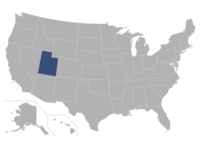
Salt Lake City, UT