Pennsylvania labor agency launches initiative targeting wage violations in home care industry
Sep 02, 2026 | 5:32 pm ET
Description
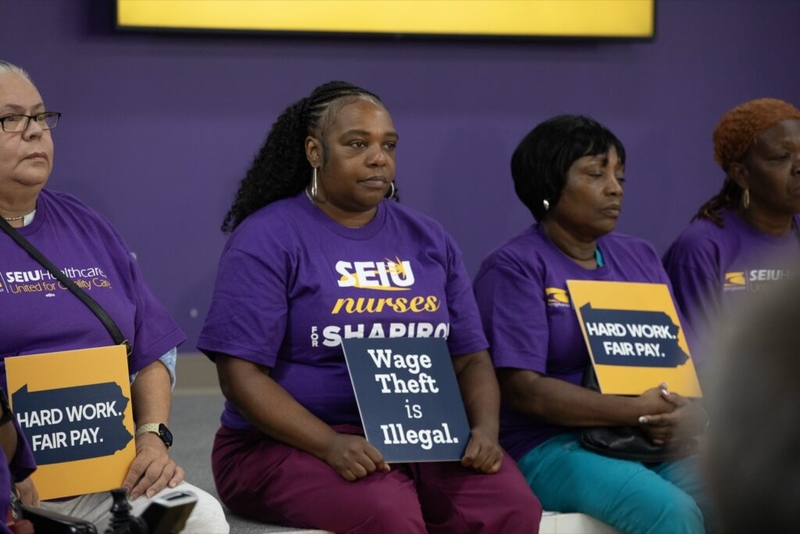
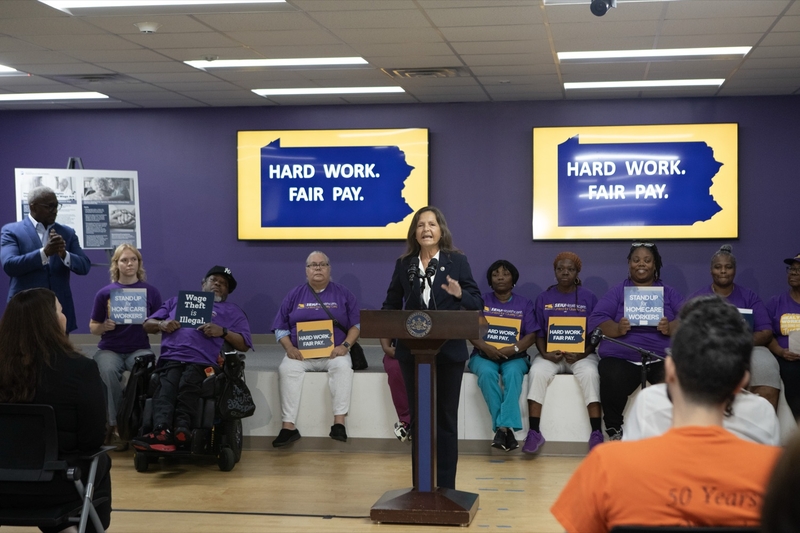
Union members with SEIU Healthcare Pennsylvania support a state initiative to preemptively investigate Minimum Wage Act violations in the home care industry. (PACast)
As a wheelchair user who’s relied on home care services since breaking his neck playing high school football decades ago, Theo Braddy knows the importance of getting good assistance.
“You’re hearing from someone who knows the difference attendant caregivers and direct care workers bring to the table,” he said. “Unfortunately, Pennsylvania’s home care system is already fragile. We lost a lot of small- and middle-sized providers during the (COVID-19) pandemic, and we have not been able to recover from that.”
As the executive director for the National Council on Independent Living, he helps advocate for others with disabilities, including two phone calls last week from people who couldn’t get out of bed or use the restroom without assistance. Neither could secure home healthcare.
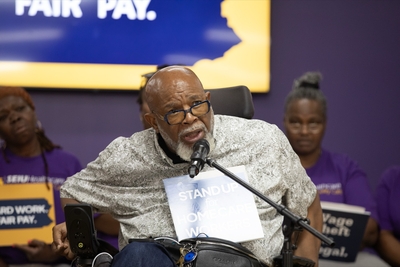
But the industry, already struggling with low wages, is also vulnerable to wage theft. According to state Secretary of Labor and Industry Nancy Walker, nearly 40% of the agency’s Minimum Wage Act complaints come from home care workers.
“Behind every single one of those complaints is someone who showed up to work, who cared for someone else’s parent or spouse or family member or child or loved one, but was not paid,” added Walker.
In response, Walker’s agency is establishing a new initiative to affirm pay across independent home agencies, sending legal demands for wage and hour information to businesses throughout the commonwealth.
In a Wednesday press conference, Walker didn’t specify how many agencies would be subject to review or if there was a timeline.
“We will not wait for new complaints, but we will be proactive and strategic within an industry where people are often isolated, where they’re often underpaid and where they fear if they speak up they’ll be retaliated against,” Walker continued.
Mia Haney, the CEO of the Pennsylvania Homecare Association, emphasized that the organization supported “holding bad actors accountable,” but added that “they should not define an industry overwhelmingly made up of providers committed to their workers and the people they serve.”
“Pennsylvania’s home care industry has been a focus of the Department of Labor & Industry for years, and responsible providers take seriously their obligation to follow wage and hour laws,” Haney told the Capital-Star.
Haney and others have long pushed for the state to increase reimbursement, saying it lags behind other states.
“Strong enforcement protects workers from employers who break the law. Adequate Medicaid funding gives responsible employers the resources to raise wages and strengthen the workforce. Pennsylvania needs both,” she added.
The National Institute for Worker’s Rights claims that employers violate minimum wage laws every day to the tune of $15 billion annually, a cost higher than losses from “all forms of property crime.”
“Wage theft should not be tolerated. And we cannot talk about addressing Pennsylvania’s home care worker shortage while allowing workers to go unpaid,” said Braddy. “Fair treatment and fair pay have to be a part of our workforce strategy.”
How will the initiative work?
An agency release described the initiative as “proactive” investigations in collaboration with partners like union leaders and advocates, rather than waiting for a worker to file a complaint. The state started sending notices to agencies, who collectively employ an estimated 100,000 home care workers, on Wednesday.
‘I hope you can live with your consciences’: Pa. minimum wage proposal blocked by Senate GOP
“Minimum Wage Act complaints often involve unpaid overtime, unpaid hours worked, improper overtime calculations, inaccurate records or other pay practices that prevent workers from receiving the wages they are owed,” read the release.
For example, an employee who worked 30 hours with one client and also spent 20 hours with another client is entitled to 10 hours of overtime, as described by the state’s Home Care Workers’ Rights. On-duty hours include times when the client is sleeping and employers cannot deduct “sleep time.”
Workers must also be paid for time spent traveling between clients.
“Employee status under the (Minimum Wage Act) is determined by the economic realities of the working relationship, not by labels, tax forms or employment contracts,” said another state website geared toward home care workers.
Employers aren’t allied to retaliate against employees who file complaints under the law.
Low wages stifle fast-growing industry
Roughly 200,000 Pennsylvanians, both aged or disabled, rely on Medicaid to cover the pay for home care workers, also known as direct care workers. This workforce assists with activities of daily living, such as bathing, eating or toileting.
“Home care workers make it possible for our fellow Pennsylvanians to live, to work, to love, to go to school and participate in the communities of their choice amongst their loved ones and friends,” said Juliet Marsala, the deputy secretary for the state Office of Long-Term Living. “They provide people with the dignity and independence they deserve, so they can live their lives and reach their goals.”
Most state payments filter through agencies, though a small number of enrollees pay their home care workers directly. But industry demand is growing.
Speakers added that approximately 25% of Pennsylvanians are age 60 or older, a number that is projected to increase to 33% by 2030. Receiving care at home, rather than in an institutional setting like a nursing home, is the preferred option for aging adults across the country.
“But making that possible depends on having a strong, stable and respected direct care workforce,” said Gabrielle Szymanski, a deputy secretary at the state Department of Aging.
Matt Yarnell, the union president of SEIU Healthcare Pennsylvania, noted that the average hourly wage for workers was $13.50 and turnover at agencies topped out at 104%.
“That is way too low. Nobody, doesn’t matter what corner of Pennsylvania you live in, $13.50 an hour does not cut it,” Yarnell said. “These are high stakes. We’re caring for humans. We’re not making cereal, we’re caring for humans in their homes and that’s a big deal.”
‘We can’t wait any longer’: Latest Pa. budget lacks home health nurse funding increase
Haney and others point to low state reimbursements for care, noting that all of Pennsylvania’s neighbors pay home care workers at a higher rate. According to the group, more than 112,500 home care shifts go unfilled each month.
“The reality is that (home care) agencies agree with the (Shapiro) Administration’s comments that we have to pay workers more,” Haney added. “Direct care workers deserve higher wages, but the (state) Department of Human Services Medicaid rates that largely fund those wages have not kept pace despite significant advocacy efforts to prioritize this workforce.”
In the last budget cycle, workers directly employed by their Medicaid enrollee got a boast, but Braddy said more steps are needed.
“We cannot continually demand that providers pay better wages, provide better benefits, recruit more workers and meet additional requirements without asking whether or not the system is adequately funding and accomplishing those things,” he continued. “Accountability and adequate funding have to go together.”
Other speakers emphasized the difficult work required to be a home care worker, adding that sometimes they’re the only face a client sees that day.
When Wanda Carroll-Russell first started as a home care worker in Philadelphia two decades ago, she didn’t have any training or union backing.
“This work isn’t simple, it’s complex. Isolating conditions inside someone’s private home, usually with no coworkers or anyone watching us, this isolation makes workers vulnerable,” said Carroll-Russell.
“So many” other workers don’t have the protections she says she has now as a union member with SEIU Healthcare Pennsylvania, she continued, specifically when it came to getting paid fair wages. She credited them with securing a raise last year from $15.49 to $17.21, an amount she said allowed her to keep her insurance.
“The demand is growing fast. The workforce isn’t keeping up because the pay and the support haven’t kept up either.”
Harrisburg, PA