Doug Jones calls for ethics reform, attacks Tuberville over AI, data center investments
Sep 02, 2026 | 4:33 pm ET
Description
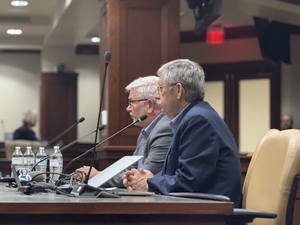
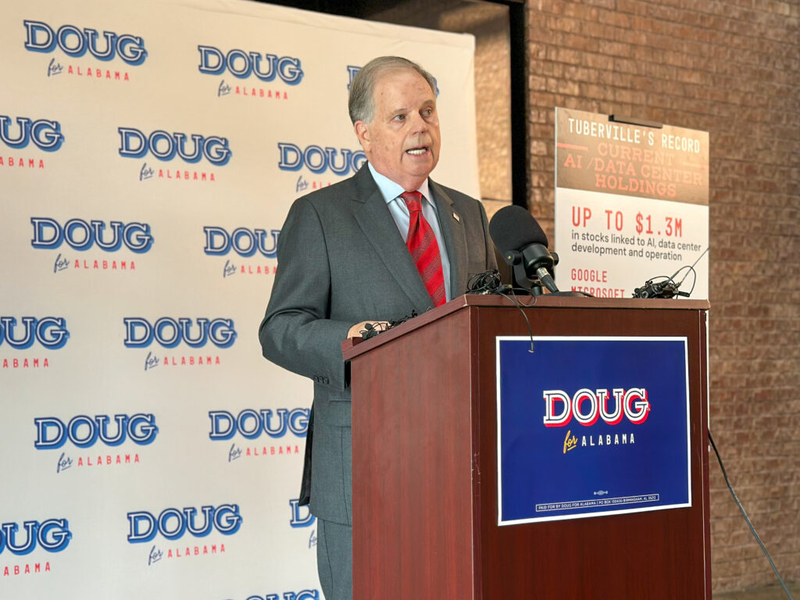
Democratic gubernatorial nominee Doug Jones speaking at a press conference in Birmingham, Alabama, on Sept. 2, 2026. Jones accused his Republican opponent of unethical financial practices with data center companies during the Wednesday morning press conference. (Anna Barrett/Alabama Reflector)
BIRMINGHAM — Democratic gubernatorial nominee Doug Jones on Wednesday called for a reform of Alabama’s ethics laws and accused his Republican opponent of unethical financial practices with data center companies.
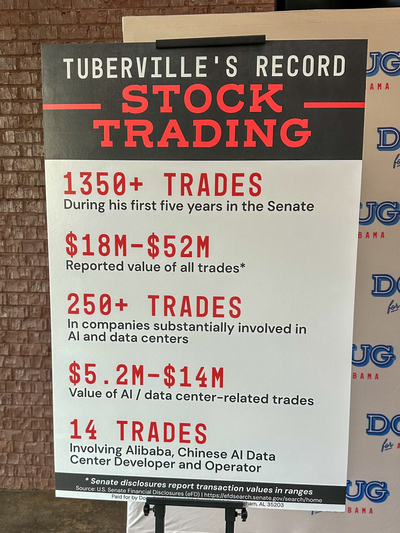
Referencing U.S. Sen. Tommy Tuberville’s publicly available financial disclosure statements from the first five years of his term, Jones alleged that Tuberville supports the development of hyperscale data centers because of his personal investment in the industry.
“It appears that Tommy Tuberville is such an AI proponent because he has kept right on investing his money,” Jones said. “While he asked Alabamians to trust his judgment about data centers, look at the stocks he holds: Google, Microsoft, Oracle, Apple, Qualcomm, Accenture, the big AI names. It’s okay to hold those stocks, but to not tell folks and not understand why he is talking about big tech the way he does is wrong.”
Jordan Doufexis, chair of the Tuberville campaign, said in a statement Wednesday afternoon that the senator has a broker that manages his investments and day-to-day financial decisions.
“Coach is not making those day-to-day trading decisions,” he said. “DC Doug is grasping for attention, but the real issue for Alabamians is this: who has a plan to protect Alabama families?”
Brokers can make portfolio adjustments based on the investor’s requests while maintaining a diverse portfolio. A follow-up question was sent to the campaign Wednesday if Tuberville would be open to adjusting his portfolio.
Data centers have emerged as a top election issue in Alabama, crossing ideological lines. Residents and experts are concerned about transparency with public officials, and public health and environmental impacts the 24/7 facilities could have. Jones has called for a one-year moratorium.
“It may be less than a year, if we put those guardrails in place beforehand, lift it,” he said. “Just pause it right now to get those guardrails in place.”
Tuberville previously said that Alabamians’ concerns were “bull crap” and the state is “going to do data centers.” In an op-ed published in Alabama Political Reporter on Tuesday, he shifted slightly by promising that data center developers and operators would pay for all infrastructure upgrades needed to operate.
He also promised to give communities more power and put the facilities in the state’s highest property tax bracket. Alabama’s Constitution significantly limits the powers of county governments, and giving them powers to reject or regulate data centers could require a constitutional amendment. The governor has no direct role in that process.
Jones said Wednesday that Tuberville’s “so-called plan” does not change anything because the senator’s plan is about “money, money, money.”
“This is about quality of life,” Jones said. “This is about ensuring and putting legislation and guardrails in place to make sure that the power company is not going to charge you for it. It means making sure that the water is not going to be polluted.”
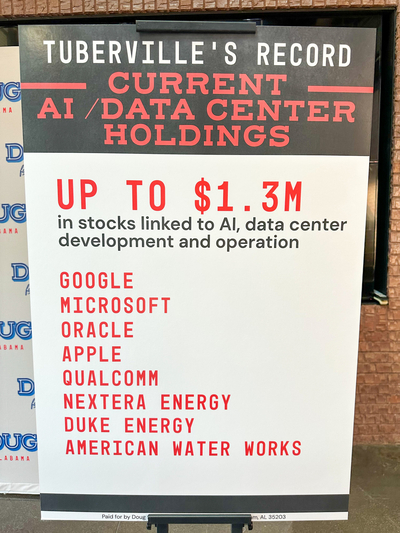
Tuberville has also said that data center and artificial intelligence concerns have been influenced by China. According to Tuberville’s financial disclosure for his first five years on Capitol Hill, he made 14 trades in China-based AI and data center developer Alibaba Cloud. The company owns 31 data centers across the world – two in the United States and 13 in China’s mainland – according to its website.
Jones compiled Tuberville’s financial disclosures into one document on his website. The Reflector independently verified each.
Tuberville does not currently hold any stocks in the company, but Jones said Tuberville failed to disclose about 130 trades in 2021.
“As a senator, he has personally invested in one of China’s leading AI and data center companies at a time when AI and the data center boom was taking off,” Jones said. “This is a man telling Alabamians that concerns about data centers is Chinese propaganda.”
Alabama ethics reform
Jones also added changing the state’s ethics law to his lengthy policy platform. Current law requires candidates and elected officials to file statements of economic interest, which includes combined household income and stocks and businesses where the person filing owns 5% or more.
Jones said he wants to strengthen the Alabama ethics law to require all state officeholders to fully disclose their financials and ban stock trading.
“This is not opposition research. These are not rumors. It’s just pure paperwork,” Jones said. “That’s important because, as governor, he will not be required to sign any similar financial documents.”
Tuberville filed a statement of economic interest with the state in 2025. The public view of the report does not reveal as much information as the public view of his financial disclosure for Congress for the same year.
Although Tuberville does not own 5% of any business, a Reflector analysis found he bought and sold stocks from 34 companies during 2025, according to the congressional report. He also earned between $188,000 and $471,000 from stocks in a mutual fund during 2025. The report lists income in ranges like $15,001 to $50,000 and $2,501 to $5,000, so the true income is unknown.
“If he wants to be the governor of Alabama, he cannot be a shareholder in the industry he is asking Alabama to bet its future on,” Jones said.
Tuberville opposed a ban on congressional stock trading, calling the initiative “ridiculous” in 2022. Doufexis did not address Jones’ call for ethics reform in his statement.
Jones wants the Legislature to pass these changes before a new governor is sworn in on Jan. 18, during its organizational session. The session, which begins on Jan. 12, is usually reserved for committee assignments and leadership elections, though then-Gov. Bob Riley called a special session in Dec. 2010, a month after sweeping Republican victories in the state Legislature that year, to pass a package of ethics bills.
Montgomery