Seizures, chest pain and long holds at a Phoenix ICE facility flying under the radar
Sep 02, 2026 | 1:28 pm ET
Description
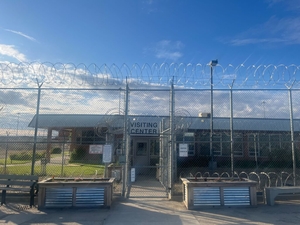
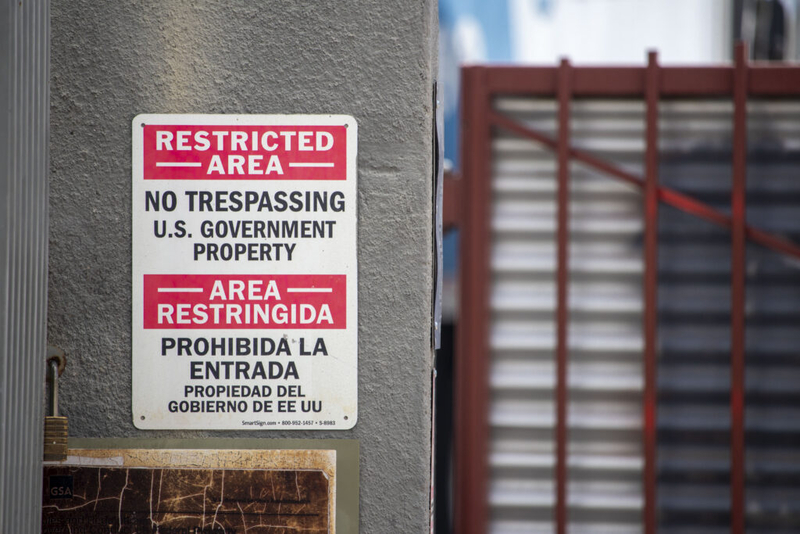
A sign at the front gate of the U.S. Immigration and Customs Enforcement Phoenix District Office, where upwards of 150 detainees can be held at a time. (Photo by Jerod MacDonald-Evoy/Arizona Mirror)
In midtown Phoenix, an ICE officer called 911 in mid-December 2025 as a pregnant woman who was being detained by immigration agents was having medical issues at a facility that has largely gone under the radar.
“We have a pregnant detainee complaining of severe abdominal pain,” the unidentified ICE agent says in a 911 recording exclusively obtained by the Arizona Mirror, adding that the 27-year-old woman had “white mucus” coming out of her. An ambulance was dispatched and she was transferred to the emergency department at St. Joseph’s Hospital, per Phoenix Fire Department records.
Between December 2025 and March 2026, ICE agents called 911 to request medical help for immigrant detainees at the midtown Phoenix facility on 11 separate occasions. That facility was also the subject of a shooting in July; the FBI is investigating.
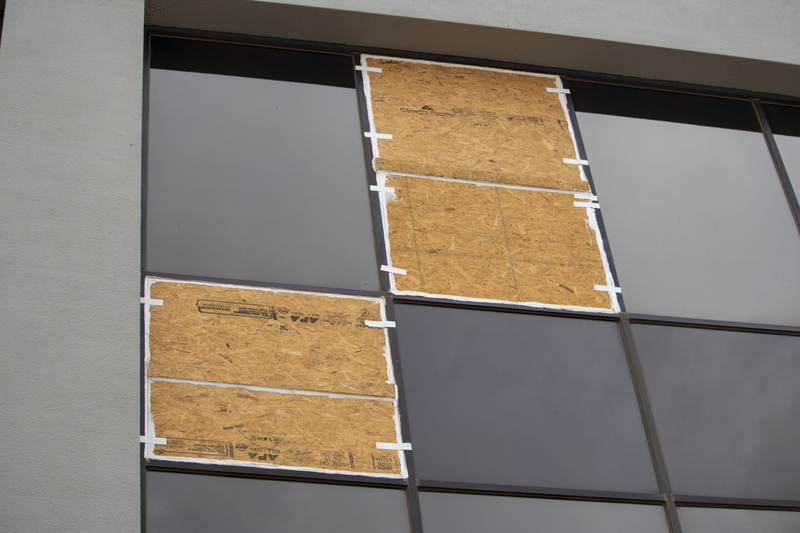
Many know the building as the Arizona headquarters for the U.S. Department of Homeland Security and U.S. Immigration and Customs Enforcement. It sits next door to the Arizona Attorney General’s Office and has been the subject of weekly protests that began last summer, some of which led to clashes between protesters and ICE officers.
The Phoenix ICE District Office, while being the primary base of operations for ICE in the Grand Canyon State, also houses a temporary hold facility. It features 10 holding cells that can hold upwards of 150 people. The facility has no beds, no on-site medical services, limited access to food and no shower that is accessible to detainees. According to ICE, it is meant to house people for no more than 12 hours.
But as ICE has implemented President Donald Trump’s mass deportation agenda and immigration agents have sought to meet high quotas for arresting immigrants, detention sites have become more crowded and short-term facilities are being used for longer than intended.
At the midtown Phoenix ICE office, that means detainees were being held an average of 25 hours during the first three months of this year, more than double the time immigrants are supposed to be in the facility’s holding cells, according to ICE data obtained by the Deportation Data Project and analyzed by the Arizona Mirror.
In 2025, the average stay at the facility was roughly 19 hours. In the three years before Trump began his second stint as president, between 2022 and 2024, the average stay ranged from between eight hours and 10 hours.
ICE called the Mirror’s analysis of its own publicly released data “FALSE.”
“ICE is not holding detainees for more than 12 hours at the facility in Phoenix, AZ. This is a processing facility not a detention facility,” an unnamed DHS spokesperson wrote in an email to the Mirror in response to questions. “Illegal aliens are quickly processed and transferred to permanent housing at a detention facility.”
One Democratic member of Arizona’s congressional delegation who has visited other ICE detention facilities, only for the agency to move detainees prior to one of those visits, told the Mirror that all ICE facilities need additional oversight.
“We need MAXIMUM congressional and agency oversight of ICE facilities across this country, especially in border states like Arizona,” U.S. Rep. Yassamin Ansari, D-Phoenix, said in a statement to the Mirror. “From overcrowding, to delayed medical attention for serious issues, Trump’s paramilitary force is treating innocent people — including American citizens — like caged animals.
“It’s disgusting and dystopian… More must be done across the board, and more people that have the power to do so need to speak up.”
And long-time watchers of these facilities are concerned about diminishing conditions as they relate to the administration’s changing policies and gutting of oversight.
“Under this administration, we have seen a major shift in detention standards,” American Civil Liberties Union of Arizona Executive Director Victoria Lopez said. “They’ve gone through various versions over the years, and under this current administration, we are seeing these major shifts under the detention standards to provide less assistance to those in detention.”
The lesser known temporary hold facility has gone largely unnoticed, with sparse reporting on conditions and its capacity until now.
‘Temporary’ hold
The Phoenix field office is one of several temporary hold facilities in the state.
Such facilities, both locally and in other states, have come under scrutiny for conditions such as lack of beds and food, leading to lawsuits against the Trump administration.
Facilities in New York, Los Angeles and Baltimore have all made national news for poor conditions, and another Arizona temporary hold facility made national headlines after a surprise visit from lawmakers found detainees crammed into small spaces like “sardines.”
That facility, the Arizona Removal Operations Coordination Center, was first reported on by the Mirror, which found ICE had shipped detainees to other facilities in the days before a congressional oversight visit. That facility has faced criticism from lawmakers and local authorities over the overcrowding that the Mirror uncovered.
ICE has historically classified its temporary hold facilities as separate from detention facilities due to the short stays, and has claimed they are exempt from congressional oversight. Additionally, under the Trump administration, ICE has insisted that Congress needs its approval to conduct oversight.The courts have ruled twice that ICE cannot limit or prevent congressional oversight of detention facilities, including temporary hold facilities.
ICE, however, still views temporary hold facilities as distinct from detention facilities when it comes to congressional oversight. That means for places like the Phoenix District Office, oversight likely has to be done internally by the Office of the Inspector General or internal DHS units that have all been gutted by the Trump administration.
“Trump's paramilitary force is treating innocent people — including American citizens — like caged animals. It's disgusting and dystopian… More must be done across the board, and more people that have the power to do so need to speak up.”
DHS’s Office of Detention Oversight has largely given glowing reviews to facilities that have seen deaths and more, according to reporting by the Project on Government Oversight.
Neither the Mesa facility nor the Phoenix District Office have ever had a visit from the ODO. But the midtown Phoenix office was visited by independent auditors in 2017 and 2022.
The Prison Rape and Elimination Act became federal law in 2003 and led federal and state officials to begin gathering statistics and data to address the problem of prison rape and sexual assault. In 2017, both AROCC and the Phoenix District Office had their first PREA audits.
The people chosen to conduct the 2017 audit came under fire two years later after a DHS Inspector General report claimed they had overlooked problems when conducting audits of detention facilities.
The midtown field office is operated by both ICE Enforcement and Removal Operations members and private security guards from the company G4S, according to the 2017 audit.
“PDO serves as a reception hub for the majority of the Arizona Field Office’s Area of Responsibility,” the audit report says. “Each eligible detainee is processed and bussed to a detention facility or other deportation area, two to three times a day.”
The facility also houses juvenile detainees, who the audit said are “moved within 12 hours of arriving at the facility.” The Phoenix District Office also has no on-site medical care and any detainee that requires it is sent to either Banner University Medical Center or St. Joseph’s Hospital, according to auditors.
The 2017 audit found no issues, but the audit in 2022 flagged some areas of concern to ICE.
That audit noted that the facility “is not a detention facility and has no cells or secure dormitories” and that detainees are held for “approximately 3.5 hours and are then either released from custody or remanded to the Florence Staging Facility located in Florence, Arizona, approximately 64 miles southeast of Phoenix.”
In 2022, auditors learned of a sexual assault involving two minors. They noted that “a forensic examination was conducted on the alleged minor victim,” though the case was ultimately closed as “unsubstantiated.”
The auditors found that there were no clear policies on ensuring that, when a case is referred to the Phoenix Police Department, the local police department adheres to the same evidence collection protocols that ICE requires.
Auditors also found that there was no “written institutional plan” to require that the agency notify any “non-DHS facility” that a detainee who may be a victim is alerted of their potential need for medical or mental health services. ICE contracts with private prison companies like GeoGroup and CoreCivic to run some of its detention centers.
Auditors also found “no evidence an incident review” was conducted on two investigations into sexual abuse at the facility.
They also discovered that the private security company hired to work at the facility was “not complying with the standard requirement” that staff submit confirmation that they have “not been involved in misconduct” such as sexual abuse.
A follow-up audit conducted four months later found the facility had addressed the issues and was in compliance.
Falls, seizures and chest pain
From October 2025 to December 2025 the number of overnight stays at the Phoenix facility began to increase.
ICE has told past auditors that detainees mainly stay between three and 12 hours, but the agency’s data shows those stays are increasing.
In 2023, the average length of stay was around nine hours. In 2024, that average remained roughly the same. The average length of stay increased in 2025, the first year of Trump’s second term, to roughly 19 hours.
For the first three months of 2026, the average length of stay increased by over 200% with the average stay being roughly 25 hours. Through July, the 2026 average hold time was more than 20 hours.
Much like at other detention centers, the Phoenix District Office has also seen the number of overnight stays and the daily population shoot upwards since Trump took office.
But as much as they’ve increased over figures in recent years, the increase in daily population was higher briefly in 2022, when Joe Biden was president. That year, the daily population reached 263 detainees for a facility that has a stated max capacity of 150 detainees.
During Biden’s administration, the agency also had its longest stays, with an individual staying 211 days in 2022, 973 days in 2023 and 97 days in 2024.
Since Trump resumed office in January 2025, the facility has reached over capacity, as well, with the daily population for Dec. 3, 2025, reaching 155 detainees. In recent months, the facility has also begun to reach levels for overnight populations that have not been seen since 2022.
As the facility’s population has increased, so did reports of detainees having medical issues that required trips to the hospital, according to records obtained by the Mirror.
On Dec. 18, data shows that 85 immigrants were booked into the facility and 110 people were held overnight.
That day, firefighters responded to a call of a woman who was reporting difficulty breathing and was taken to the hospital.
Two days later, a detainee that was picked up from the Scottsdale Police Department’s jail reported chest pains and was taken to the hospital. ICE booked 14 people that day and 83 stayed overnight.
The facility has also seen a number of fall injuries, including due to seizures.
“We had a detainee fall down,” an unnamed ICE agent told a dispatcher in one 911 call. Later, he asked a colleague if the man was breathing in response to a question from the dispatcher. “He’s breathing right? Yeah, he’s breathing.”
In one January recording, an ICE agent told dispatchers there was a male detainee “seizing on the floor.”
“He doesn’t know where he’s at, doesn’t know what day it is or who the president is,” the unnamed agent said on the 911 call, adding that the man had blood coming out of his mouth.
In another call, an agent named “Lance” said that a 60-year-old diabetic woman fell in the building’s underground parking garage, injuring her leg.
Another call detailed a 45-year-old man experiencing chest pain; he was later taken to the hospital.
“He’s got his hand on his left arm and heart,” the agent told the dispatcher. “He didn’t come into custody with any medication.”
The very next day, the same agent called 911 again because a detainee was seizing, noting that Phoenix Fire Department had been there the previous night.
“We have a detainee that just fell out, unresponsive,” another agent told dispatch. “He’s completely unresponsive. He has a lot of high blood pressure issues…He’s not responding at all. Kinda like having a seizure, shaking on the floor.”
In its statement to the Mirror, ICE said that the calls reflect its commitment to the health of detainees.
“As immigration detention populations increase, the likelihood of medical, safety, or other emergent situations requiring emergency services may also increase. Emergency services, including 911, are used as situations require when immediate assistance from local first responders is needed,” the unnamed ICE spokesperson said. “The use of 911 reflects the facility’s commitment to ensuring individuals receive timely and appropriate care when emergent needs arise.”
A number of the 911 calls required advanced life support and detainees were transported as “Code 3,” meaning the ambulance left with sirens and lights active, according to Phoenix Fire Department records obtained by the Mirror.
The Phoenix Fire Department also dispatched a law enforcement liaison and battalion chief when calls came in from the ICE field office. Phoenix Fire told the Mirror that certain addresses have “premise alerts” on them in case additional resources may be needed, though a spokesperson said that “premise alert” is no longer in place for the Phoenix District Office.
Lopez, the leader of the ACLU in Arizona, said poor conditions at ICE facilities are an expected outcome of Trump’s mass deportation campaign.
“At the end of the day, the issue that we are facing here is that the law allows for our government to detain far too many people for far too long under horrific conditions and until we have a solution to not detaining so many immigrants in this country, we will continue to have the same patter of longstanding systemic problems when it comes to immigration detention,” she said.
Lopez cited past and recent court victories on conditions at similar facilities, including a local case.
In Doe v. Wolf, several groups, including the American Immigration Council, filed a class action lawsuit challenging the conditions at detention centers run by U.S. Customs and Border Protection.
The suit focused primarily on two women and two men detained in the Tucson Border Patrol Station who described overcrowding, lack of beds, inadequate food and water, lack of medical care and freezing conditions.
The court eventually enjoined CBP from holding detainees longer than 48 hours unless they could provide adequate conditions that included a bed with a blanket, shower, food and more, deeming anything less than that unconstitutional.
More recent lawsuits have led to ICE shutting down some facilities temporarily, like in Baltimore.
“The government will use all sorts of different words to categorize and classify the spectrum of facilities they use for immigration detention, but what we have seen over and over again is they are unable to meet minimum standards so that people are safe in these facilities,” Lopez said of the Phoenix facility and others like it. “And we have seen the result of that, with people who have died in custody, people who have been detained for far too long.”
Lopez also said that ICE’s reliance on local emergency services is indicative of a greater problem with ICE detention facilities.
“When we take a look at these kinds of 911 emergency calls from a government detention facility … it is because they are unable to manage the health of the people in their custody,” Lopez said. “And that is a huge problem that needs to be meaningfully addressed.”
Phoenix, AZ