NJ students head back to school with new mandate: no phones from first bell to last
Sep 02, 2026 | 7:19 am ET
Description
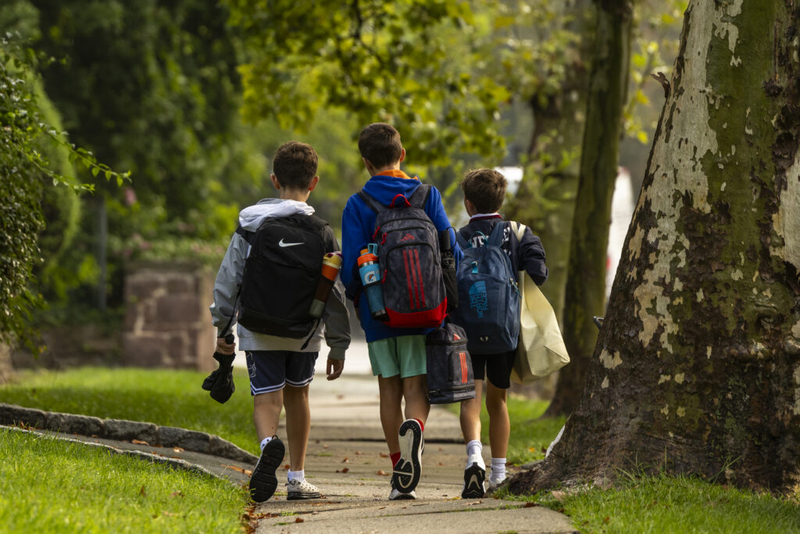
Students walk along Park Avenue on their way to school in Glen Ridge on Sept. 1, 2026. (Photo by Anne-Marie Caruso/New Jersey Monitor)
Students are returning to classes this week with new backpacks, new outfits, and a new rule: no phones out during the school day.
New Jersey children are starting their first school year under a statewide law aimed at banning students from using their cellphones during the school day — from the first to the last bell — a sweeping policy change that education officials are confident will have a positive impact on kids, though they say it’ll take months to know the full effect.
“The idea of the bell-to-bell ban is that phones are just separate from the school day. It’s not even coming out in the hallways or between classes. I think the spirit of the ban is to make a pretty global culture change around the relationship to the phone,” said Jeffrey Lane, a Rutgers University researcher and associate professor at the School of Communication and Information.
The law, signed by former Gov. Phil Murphy in January on his way out of office, requires every K-12 public school in New Jersey to bar students from using smartphones, tablets, smartwatches, and other internet-connected devices from the start of the school day until dismissal.
How the new ban plays out looks different from district to district. In some schools, students each morning will drop their phones into magnetic locking pouches that don’t open again until dismissal. Other schools will require their students to turn their phones off and keep them in their lockers or backpacks for the entire school day.
With Labor Day late this year, some New Jersey schools started the new year Tuesday, some start Wednesday, and some don’t go back until next week. Gov. Mikie Sherrill, a Democrat who took office in January, said the response to the cellphone ban so far has been largely positive, noting her team met with students and parents in the spring and summer.

She said students have mentioned “feeling a little freer when they’re not connected” to their phones, and they are realizing that rampant cellphone use is “impairing their ability to just socialize and relax a little bit.”
Sherrill, who has four kids, said it’s an ongoing issue in her household trying to find activities for her kids to keep them off the couch locked in on their phones. As a parent, she welcomes phone-free school days.
“The best way I can describe it is almost a sense of relief. Everybody needs a break,” she said.
The ban goes into effect weeks after Sherrill signed a three-bill package aimed at boosting online safety for minors. One of those bills was the New Jersey Kids Code Act, which restricts platform features designed to keep young users constantly engaged and requires companies to default to their highest privacy settings for young people. Some of those restrictions are mirrored in a new legal settlement between Facebook owner Meta and states including New Jersey that will impose similar restrictions on Facebook, Instagram, and Threads next year, including daily time limits and notification pauses.
The cellphone ban bill won near-unanimous approval from the Legislature last year, with just three no votes among the 120 members. One of the critics was Assemblyman Brian Bergen (R-Morris), who has mocked his colleagues as Luddites for supporting it.
“Fun fact: NJ ALSO still has a 1989 law making it a criminal offense for a student to carry a BEEPER. We never repealed it. We just banned the next device. In 30 years, kids will laugh at this law the way we laugh at the beeper ban,” he said on social media last week.
Nearly two dozen states across the country have adopted cellphone bans during the school day, including California, Florida, Ohio, South Carolina, and Virginia.
Under New Jersey’s law, students will be able to use their phones in case of an emergency, for translation services, and when a cellphone is part of a student’s educational curriculum.
The law leaves details of enforcement up to individual districts, and does not mandate a single statewide method. The Department of Education released an FAQ and guidance for school officials over the summer.
Betsy Ginsburg, executive director of the Garden State Coalition of Schools, said she’s hopeful the ban will cut down on classroom distractions and improve students’ mental health, particularly by reducing online bullying.
“Students will start relating to each other one-to-one instead of via their cellphones,” she said.
She noted that the culture around cellphones in schools shifted around the time COVID-19 restrictions led to school closures. When students were at home taking classes over Zoom in their pajamas, they had more freedom to use their phones and that carried over into schools when they reopened the following year, she said.
Not all parents are on board. Ginsburg said the most common complaint she’s heard is from parents worrying how they will reach their kids during emergencies, whether during extreme weather or school shootings. She stressed that districts are required to notify parents by phone or text about emergencies, and that school security experts advise against students being on their phones during lockdowns.
“The distraction of a cellphone sometimes interferes with a school official’s ability to make sure that the students are as safe as possible in an emergency,” she said.
Lane conducted a survey for the state Department of Education to help inform the law. He noted the research didn’t take a position on the ban itself; it studied how New Jersey minors are using their phones and social media.
Nearly 40% of teens use social media four hours a day, with sleep, attention span, and lack of physical activity emerging as top concerns for parents and teens, he said. Only a small fraction of parents thought cellphone use should be unrestricted in schools, while the majority “understands something has to be done to limit cellphone use,” he said.
“Some parents are accustomed to communicating with their kids during the school day, and it’s a pretty big culture shift to all of a sudden take cellphones out of the school day,” Lane said. “I think it’s an opportunity to redesign the whole day — not just the school day — and it’s kind of like an opportunity for households to change the relationship to the phone and social media.”

Trenton, NJ