Tommy Tuberville outlines new data center approach as opposition to facilities mounts
Sep 02, 2026 | 5:59 am ET

Description
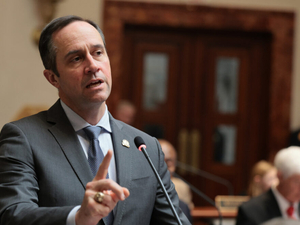
U.S. Sen. and Republican gubernatorial nominee Tommy Tuberville speaking at the Alabama Republican Party's Summer Dinner on July 31, 2026, at the Renaissance Hotel in Montgomery, Alabama. Tuberville Tuesday published an opinion column in Alabama Political Reporter detailing his plans for addressing data centers in the state after weeks of touting them and denouncing their critics. (Anna Barrett/Alabama Reflector)
Republican gubernatorial nominee Tommy Tuberville Tuesday laid out a new stance on data centers in Alabama after weeks of championing them and denouncing their critics.
In an opinion column published in Alabama Political Reporter, Tuberville said as governor he would work to give communities the power to reject data centers and put them in the state’s highest property tax bracket, though he was not clear on details.
“Here’s my message to data centers: If you want to use our resources, you pay full taxes, cover the total cost of your energy, and replace what you take,” the article said. “We’ll welcome you with open arms, but keep your hands out of our pockets.”
The announcement came as data center development around the state draws opposition over concerns about energy use and potential impacts on the environment and the communities where they reside, and differs slightly from previous statements Tuberville has made about data centers. In July, AL.com reported that Tuberville said people who are opposed to data centers and artificial intelligence are being influenced by China and called concerns about the environmental effects of data centers “bullcrap.”
Tuberville’s column did not directly address environmental concerns. He wrote that he wants to give local communities the option to determine if they want a data center.
“A project that works in one community may be wrong for another,” Tuberville wrote. “Local residents understand their roads, water, schools and neighborhoods better than bureaucrats or corporate executives. Private property rights matter, but so do the rights of neighboring property owners.”
Tuberville said in the column he would make data centers pay for the total cost of substations, transmission lines and water systems needed to run the facilities; “replace the power and water capacity they take” and impose higher taxes on data centers.
Tuberville also said he would want to put them in the highest property tax bracket in the state. Under a constitutional amendment passed in 1978, the highest taxed properties are utility properties providing utility services, taxed at 30% of fair market value. Owner-occupied homes and agricultural properties are taxed at 10% of fair market value.
Tuberville’s campaign team did not respond to questions Tuesday about how he would implement his ideas. Alabama’s constitution severely limits county governments’ powers, and giving them more could require a constitutional amendment, a potentially years-long process in which the governor has no direct role. The Association of County Commissions of Alabama has called for giving county governments more comprehensive use of land control.
During a policy speech in July, Democratic gubernatorial nominee Doug Jones called for a one-year data center moratorium to have “guardrails and policies in place to protect our people and our communities.” Messages seeking comment were left with the Jones campaign on Tuesday.
Ryan Anderson, a staff attorney with Southern Environmental Law Center, said in an interview Tuesday the recommendations in Tuberville’s column were a step in the right direction.
“We’ve seen a huge data center boom in the state of Alabama over the past year, and you know we really need our elected officials to start stepping up to the plate and doing something to protect communities,” Anderson said.
In Lowndes County, an 800-acre data center known as Project Red Clay, has received backlash from residents for lack of transparency from county officials.
Ann Burgwin Faulkner, a resident of Lowndes County who has opposed putting the center in the county, said in an interview Tuesday afternoon Tuberville’s current stance is “wonderful.”
“I don’t think that anyone is opposed to data centers,” Faulkner said. “The opposition is to the wrong developments coming to the wrong place with no transparency.”
Anderson said the one thing Tuberville’s recommendations lacked were clear guidelines on transparency.
“Another key piece that’s missing from this is required government transparency, whether that’s banning the use of NDAs (non-disclosure agreements), reforming the Open Records Act, something needs to be done to make sure that these decisions are made in a transparent manner,” she said.
Earlier this year, Bessemer City officials including Mayor Kenneth Gulley, signed a NDA for Project Marvel, an 18-building data center project.
Anderson said the difference between Jones’ moratorium and Tuberville’s proposal is that a moratorium could give communities more time to plan than Tuberville’s plan.
“I think about it like a temporary pause, less than you know a blanket prohibition on these things,” Anderson said. “And a big issue here is what are we going to do for the communities that are facing data center developments with none of these protections right now, like the people in Lowndes County. We don’t have time to spare before good policies, protective policies, get implemented here in Alabama.”
Montgomery