Mamdani Ends Adams’s Chromebook Spending Spree
Sep 02, 2026 | 4:00 am ET
Description
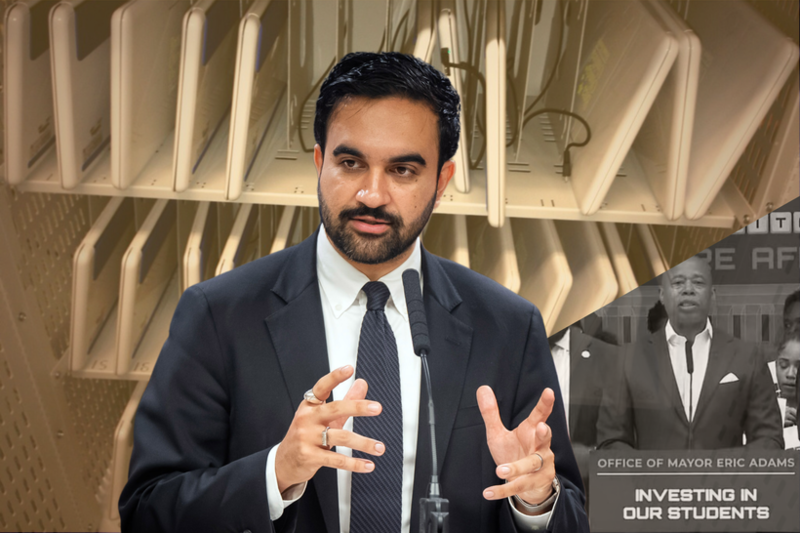
Photo courtesy of New York Focus
Mayor Zohran Mamdani is canceling a contract with T-Mobile to hook up New York City public school students’ laptops with cell service. The contract would have cost well over $100 million over the next three years, making the move one of the most significant single cost-cutting measures of Mamdani’s young mayoralty.
New York Focus spotlighted the questionable contract last year, after it was inked by then-Mayor Eric Adams’s administration in the final months of his tenure. The city agreed to pay more than $320 million for 350,000 Chromebook laptops equipped with T-Mobile LTE service, along with up to one million lines of cell service for those computers and other school-issued devices. The T-Mobile portion of the contract cost the city about $3.5 million per month and just under $200 million in total.
Adams signed the contract despite data indicating that the large majority of public school students already have internet at home. City officials had also raised internal concerns about the contract, complaining that it required the city to pay T-Mobile a flat fee regardless of how many lines of cell service were active. The city had approached T-Mobile without soliciting competing offers from fellow city vendors Verizon and AT&T, the critics noted, and it was unclear whether the Department of Education even wanted the internet-connected laptops.
Eight months into his tenure, Mamdani is now terminating the T-Mobile part of the contract, a move first reported by Chalkbeat. Department of Education spokesperson Nicole Brownstein said that the administration views the contract as unnecessary because it replicates an existing program that allows schools to pay $10 a month per child to provide LTE service through Verizon to any student who needs it.
“We know reliable technology access is critical for our students, and our schools are ready to support any family who needs help accessing LTE at home through established internet programs already available to every student through their school,” Brownstein said.
“We appreciate T-Mobile for their support of our students and educators. Ultimately this program, launched under the prior administration, duplicated existing resources at an unnecessary cost. By discontinuing this component of this contract, we are saving taxpayer dollars while continuing to deliver the internet connectivity we know our school communities rely on.”
Brownstein said last week that the administration had instructed school principals to identify families without internet access and give them LTE service before the first day of school on Sept. 10. Although the 350,000 laptops have already been distributed to schools, city officials also told principals that the T-Mobile student plans would end on Aug. 31, Chalkbeat reported.
The move comes amid a broader backlash against education technology, including a state bill introduced this month that would sharply limit the use of screens in classrooms and the distribution of school-issued devices. Mamdani is set to announce new technology rules including a ban on individual screens until third grade, the New York Times reported on Tuesday.
Naveed Hasan, an elected member of the city’s school board, commended Mamdani for canceling the T-Mobile contract and urged him to go further in curbing waste in school technology spending and in reviving plans for city-owned tech infrastructure. The school board had grown increasingly skeptical of tech vendors and recently rejected a contract for Oracle software.
The city did not provide an official estimate for how much money would be saved by cutting the contract, which has already been in effect for about a year. The savings may be partially offset by more students receiving LTE service through the Verizon program. But at nearly $50 million per year, the contract was costlier than many of the other programs that Mamdani decided to slash as part of cost-cutting efforts in his first budget earlier this year — like a $9.9 million Department of Social Services consulting contract with McKinsey.
That initial effort helped the city find $1.77 billion in savings over two years, which represents less than one percent of the city’s spending over that period. Mamdani wants to double down on that work, announcing in July that he will ask city agencies to find more savings worth 2.5 percent of their budgets.

Albany