Conservative group’s anti-redistricting measure makes Colorado’s 2026 ballot
Sep 01, 2026 | 4:54 pm ET
Description
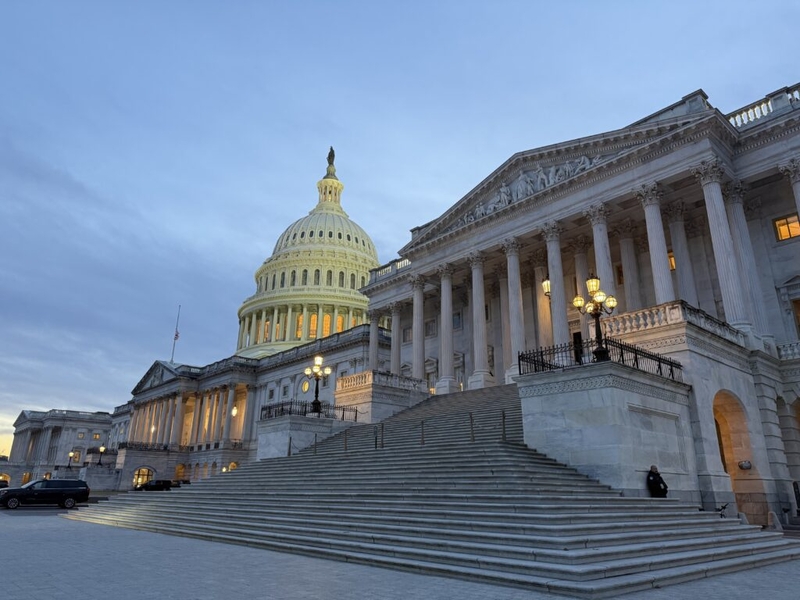
The U.S. Capitol building in Washington, D.C., on Tuesday, Jan. 13, 2026. (Photo by Jennifer Shutt/States Newsroom)
An effort by Democrats to pass a mid-decade redistricting plan was struck down by the Colorado Supreme Court earlier this year — but a conservative group’s countermeasure, which aims to prohibit any such partisan move in the future, is still set to go before voters in November.
Backers of Proposed Initiative 256 submitted a sufficient number of petition signatures to qualify for the 2026 ballot, the Colorado secretary of state’s office said Monday. As a constitutional measure, the initiative needed the support of at least 2% of the registered voters in each of Colorado’s 35 state Senate districts.
Colorado’s current eight-seat congressional map was drawn by its inaugural independent redistricting commission, established by a pair of anti-gerrymandering constitutional amendments passed by voters in 2018. The current congressional delegation is split 4-4 between Democrats and Republicans, with four seats rated as solidly Democratic, three leaning towards Republicans and one toss-up.
A Democratic group, in response to an unprecedented gerrymandering spree launched by Republicans at President Donald Trump’s urging, had backed a ballot measure this year that would have drawn a temporary map likely to give Colorado Democrats a 7-1 advantage in the 2028 and 2030 elections. But the state Supreme Court ruled in June that the effort violated the Colorado constitution’s single-subject requirement, which bars initiatives from appearing on the ballot if they contain multiple subjects.
The ruling also applied to several Republican counter-proposals that would have asked voters instead to tilt the congressional map in the GOP’s direction.
Separately, Initiative 256 was filed by Advance Colorado, a right-wing “dark money” group that does not disclose its donors, to block Democrats’ effort. The measure would require any mid-decade or “off-cycle” redistricting effort to be approved by both the state’s independent redistricting commission and the Colorado Supreme Court, and prohibit the approval of a map that “has been drawn purposefully to favor one political party.”
The initiative is one of up to 13 statewide measures that could appear on Colorado’s 2026 ballot. As a constitutional measure, it would need to receive 55% support from voters to pass.
Redistricting wars
Congressional maps are typically drawn once a decade after the decennial census. But Republicans launched a mid-decade gerrymandering war that began last year in Texas, where Trump had pressured the GOP into redistricting to give the party an advantage in the 2026 midterm elections. A month later, California Democrats moved forward with their own redistricting effort in response, and many other states around the country followed.
The ensuing tit-for-tat has heavily favored Republicans, who were able to push through new maps in seven other states, including Ohio and Florida, often solely through legislative action. In May, the conservative-dominated U.S. Supreme Court’s dismantling of a key provision in the Voting Rights Act kicked off another wave of redistricting in southern states, which rapidly redrew their maps to eliminate majority Black districts.
Meanwhile, Democrats’ efforts to respond have hit a variety of legal and procedural obstacles in blue states — many of which, like Colorado, already had independent redistricting commissions or other anti-gerrymandering measures in place. Voters in Virginia approved an aggressive Democratic gerrymander earlier this year, only for the state’s supreme court to block the plan weeks later.
California is the only state to have redrawn its map to advantage Democrats in 2026, though the party is also expected to gain a seat in Utah from a new map drawn as a result of a court battle that dates to 2022. Overall, the redistricting battles have given Republicans an advantage in about 10 additional districts as they look to hold on to their three-seat House majority.
Denver, CO