Possible hyperscale data center eyed for Bow
Sep 01, 2026 | 2:15 pm ET
Description
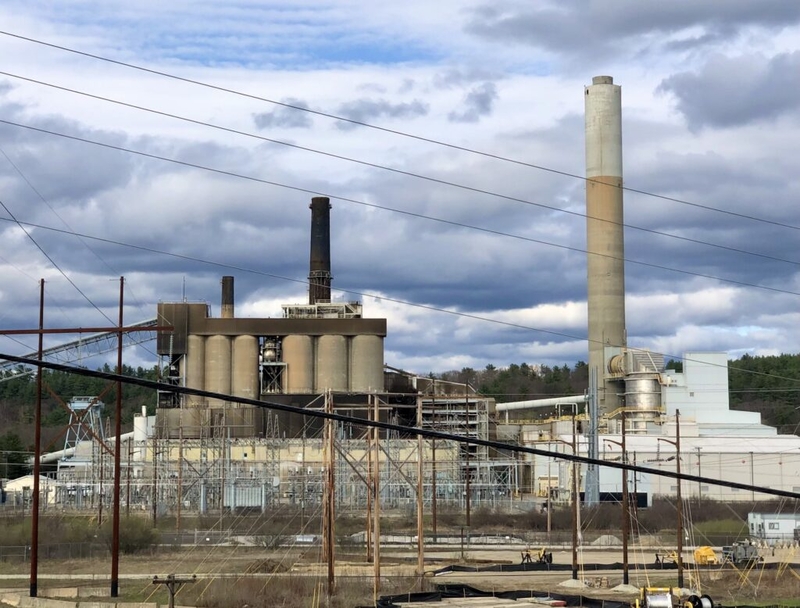
At the time of its closure last year, Bow's Merrimack Station was the last active coal plant remaining in New England. (File photo by Hadley Barndollar/New Hampshire Bulletin)
A massive data center could be headed to the town of Bow, according to Federal Energy Regulatory Commission filings and a social media post from New Hampshire’s consumer advocate.
The public filings describe an agreement for a preliminary, exploratory study on the “viability” of connecting a 350-megawatt project to the grid. The study, according to the filings, was to be conducted by Eversource Energy, which owns the region’s electric transmission system, at the request of Granite Shore Power, LLC, owner of Merrimack Station, a former coal-fired power plant in Bow.
New Hampshire Consumer Advocate Donald Kreis described the possible large-load facility as a data center in a tweet on Monday afternoon, describing a meeting among staff from his office, New Hampshire Department of Energy personnel, and Eversource Energy employees. During the meeting, an Eversource executive mentioned that a developer was considering a data center project of “up to 200 MW” for Bow, Kreis wrote in the post.
The study is an early-stage step in what could be a lengthy permitting process. New Hampshire Gov. Kelly Ayotte has spoken out against data centers, saying she supports a moratorium on their construction in New Hampshire.
“I will always advocate for our towns to decide what’s best for them, but with too many unknowns surrounding these facilities, I think it is best for us to institute a moratorium for the time being,” she said in a statement to the Bulletin on Tuesday.
In the post, Kreis did not identify the site, which is not listed in the documents. Officials from Eversource and Bow declined to identify the location of the proposed center, and Granite Shore Power, which requested the study, did not respond to a request for comment. But Granite Shore Power’s physical address in Bow is the site of Merrimack Station, which was the last coal power plant operating in New England until its closure in late 2025. At the time, Granite Shore Power executives said they would repurpose the approximately 400 acre parcel to host solar power and batteries.
Asked on Tuesday morning if he had knowledge of any data center discussions, Bow Select Board Chairman Kip McDaniel declined to comment. But he said Bow had long been positioning itself to welcome developers, and spoke about data centers as a potential source of tax revenue.
“Bow has spent the last 15 years trying to court appropriate development, and I think we’ve become a town that people want to work with,” McDaniel said. “… I’d also say that people who know about data centers know that they can be valued very highly, and in a town where, we are obviously (in) a property tax-based state, that can be hugely beneficial.”
The rapid expansion of artificial intelligence has driven a surge of data center development across the U.S., along with a tide of bipartisan concern about the centers’ large energy use and footprints, the environmental impact of the power plants used to run them, and impacts on electricity rates.
In response to a question about the Bow proposal, Ayotte identified concerns about impacts on electricity rates and other potential “unforeseen” harms from data centers.
Thus far, New Hampshire has largely been on the sidelines for the data center surge. One exception was a proposal in Nottingham earlier this year, which resulted in local backlash. The developer, a New Hampshire businessman, ultimately rescinded his proposal.
Yet it’s not a given that New England will continue to see relatively few data centers in the region, according to ISO-NE, which operates the regional power grid.
“New England has not experienced data center development on the same scale as other parts of the country, but this is an area that can change, and the ISO believes the region needs to be prepared in the event development accelerates,” said ISO-NE Senior Communications Specialist Mary Cate Colapietro in an email to the Bulletin.
The ISO creates load forecasts using information shared by transmission owners to anticipate future load growth in the region, Colapietro said. A recent version of that forecast notes a possible data center for the northeast Massachusetts and Boston area and does not identify any projects in New Hampshire.
Kreis’ description of the possible Bow center’s energy use at 200 megawatts is smaller than the federal filings indicated, but in either case, the facility would be considered a “hyperscale” center — a general category that encompasses facilities drawing more than 100 megawatts of power, according to technology company IBM. One hundred megawatts powers approximately 80,000 homes, according to a 2026 report from the Electric Power Research Institute.
Eversource spokesperson William Hinkle said the utility was engaged in the study because it is required to provide information about its transmission system to potential developers, regardless of the nature of the project in question. Meanwhile, the company is “concerned” about the possible effects of large load developments on the grid, he said.
“Eversource only delivers power and does not develop data centers,” he wrote. “We are obligated to respond to all proposals from developers.”
Granite Shore Power’s viability assessment agreement with Eversource was filed with the Federal Energy Regulatory Commission in April. The filings do not contain information about how the facility would be powered. The review process for the facility, if it proceeds, will involve more grid and power studies, and subsequent permitting steps at the local, state, and federal level.
McDaniel, who also sits on the Bow Planning Board as a select board representative, said the process would involve opportunities for public comment.
“This will go through, like any other development, it will go through a very robust planning process,” he said.

Concord, NH