Federal judge blocks new Virginia limits on existing local ICE agreements
Sep 01, 2026 | 1:23 pm ET

Description
A U.S. Immigration and Customs Enforcement officer is pictured during an enforcement operation. A federal judge has temporarily blocked key provisions of a Virginia law restricting cooperation between local law enforcement agencies and federal immigration authorities. (Photo by Nicole Neri/Minnesota Reformer)
A federal judge has temporarily blocked Virginia from enforcing key provisions of a new law restricting cooperation between local law enforcement and federal immigration authorities, allowing existing partnerships with U.S. Immigration and Customs enforcement to continue while the legal challenge plays out.
Senior U.S. District Court Judge Robert Payne in Richmond issued a preliminary injunction Monday, barring the commonwealth from applying the law against federal immigration officers, employees or agencies and from interfering with existing agreements under Section 287(g) of federal immigration law.
Those agreements allow ICE to authorize trained state and local officers to perform certain federal immigration enforcement duties.
Virginia’s law required existing agreements to be rewritten by Sept. 1 to include a dozen conditions governing how federal immigration operations could be conducted around the state. Agreements that were not modified would have been considered void and unenforceable.
However, Payne left one significant restriction in place, preventing localities and law enforcement agencies that have never participated in the 287(g) program from entering such agreements for the first time.
Attorney General Jay Jones said Tuesday that his office would immediately seek to keep the injunction from taking effect while appealing the court’s decision.
“My office strongly disagrees with the judge’s order and will urgently file a motion to stay this ruling and appeal the temporary injunction,” Jones said in an email.
Jones argued that the ruling misinterprets both contract law and the state’s authority over its local governments. Because the conditions apply to Virginia’s localities rather than ICE, they do not directly regulate federal immigration enforcement, he said.
Jones also cited Dillon’s Rule, arguing that Virginia’s legislature has the authority to modify or withdraw localities’ power to enter contracts.
“The General Assembly was well within its legal authority to pass this law and to put statutory requirements in place to ensure Virginia’s already resource-constrained localities and law enforcement agencies are not devoting critical resources toward carrying out responsibilities that rest solely with the federal government,” Jones said.
Judge finds federal government likely to prevail
The U.S. Justice Department sued Virginia in June, arguing that the law unconstitutionally interferes with federal immigration enforcement and impairs existing contracts between ICE and Virginia localities.
In granting the injunction, Payne found the federal government was likely to prevail on its claim that the law violates the U.S. Constitution’s Contract Clause.
He concluded that the new requirements created a “substantial impairment” of existing agreements and were not appropriately and reasonably tailored to advance a significant and legitimate public purpose.
The federal government was also likely to succeed on its Supremacy Clause claim, Payne found, writing that the Virginia law “directly regulates the conduct of federal law enforcement” in an area under federal authority.
Without an injunction, the judge concluded, the federal government would likely suffer irreparable harm from both the impairment of its contracts and interference with its immigration responsibilities. He also found that temporarily blocking the law was in the public interest.
However, the four-page order does not resolve the lawsuit or permanently strike down the statute. Payne wrote the court would lay out its reasoning in “a forthcoming memorandum opinion.”
The injunction will remain in place while the case proceeds or until the court orders otherwise.
Background of the new law
Virginia lawmakers adopted the restrictions this year through Senate Bill 783, sponsored by Sen. Saddam Azlan Salim, D-Fairfax, and identical House Bill 1441 by Del. Alfonso Lopez, D-Arlington. Gov. Abigail Spanberger signed both measures in April, and they became law July 1.
In addition to placing conditions on 287(g) agreements, the legislation generally prohibits state and local officers from assisting with federal civil immigration operations. Exceptions include assistance permitted or required by law, authorized by a judicial warrant or subpoena, or involving the transfer of an adult from a correctional facility after receipt of an immigration detainer.
For existing 287(g) agreements, the new law requires a dozen conditions, including advance identification of participating federal agents and restrictions on enforcement at schools, faith-based organizations, courthouses and polling places. It also imposes limits on surveillance technology and requires judicial warrants for entering homes and making certain information requests.
Legal advocates respond
The Legal Aid Justice Center, which filed a friend-of-the-court brief supporting Virginia, said the General Assembly acted within its constitutional authority by placing conditions on what the organization described as a voluntary federal program.
“We are very concerned that existing 287(g) agreements will be allowed to continue,” the organization said in a statement Tuesday. “These agreements entangle local law enforcement in federal immigration enforcement, which undermines the trust communities need to report crimes and cooperate with investigations.”
While welcoming the portion of the ruling that prevents new agreements, the center argued that Payne went further than the federal government requested by barring Virginia from interfering with existing agreements “in any way.”
The organization said that language could put related actions by local governments beyond the oversight of state lawmakers and Virginia voters, and it urged the state to appeal and seek a stay.
Monica Sarmiento, executive director of the Virginia Coalition for Immigrant Rights, said her group was “deeply disappointed” by Payne’s ruling.
She pointed to videos recorded by residents showing what she described as combative and aggressive ICE encounters in recent months.
“Virginia voters overwhelmingly support the initiative to restrict local law enforcement from collaborating with ICE,” Sarmiento said.
Immigration enforcement in Virginia accelerates
The legal dispute is unfolding as federal immigration authorities step up enforcement in Virginia and neighboring Maryland.
The U.S. Department of Homeland Security said a sweeping ICE operation resulted in 1,328 arrests across the two states between Aug. 1 and Aug. 14.
According to the agency, those arrested included people with convictions or prior arrests involving sexual battery, kidnapping, driving while intoxicated, identity theft, robbery, murder, attempted murder and rape.
DHS did not say how many of the detainees had been convicted of crimes.
DHS Secretary Markwayne Mullin said the operation targeted people he characterized as threats to public safety.
“Over the course of just two weeks in Virginia and Maryland, they arrested sexual assailants, kidnappers, drunk drivers, robbers, and gang members,” Mullin said in a statement.
Much of the operation focused on the Washington suburbs, according to ICE, although officers carried out targeted enforcement actions elsewhere in Virginia and Maryland.
Spanberger, meanwhile, has taken several steps since entering office in January to distance state agencies from federal civil immigration enforcement. In February, she directed state law enforcement agencies to terminate their 287(g) agreements, though the directive did not apply to agreements involving local agencies.
Her Executive Order 16, issued in May, directed state agencies and institutions to develop guidance for employees who encounter federal immigration officers at schools, hospitals, courthouses, polling places and commonwealth attorneys’ offices.
The order also prohibits nonpublic state property from being used as a staging area, processing location or operational base for federal civil immigration enforcement and requires agencies to verify that federal officers seeking access possess a valid warrant or order.
Spanberger cited data showing “approximately 70 percent of individuals booked in detention centers in Virginia have not been convicted of a crime” in the May directive.
Payne directed the state to distribute Monday’s ruling to commonwealth’s attorneys across the state and ordered the parties to to contact the court to schedule further proceedings.
Jones said his office would continue defending the new law as the case moves forward.
“Accordingly, my team will continue to vigorously defend this law to ensure that state and local law enforcement are focused on their core responsibilities of investigating and deterring criminal activity, staffing correctional facilities, and engaging with their communities, not forced to be foot soldiers of an overreaching federal government,” Jones said.
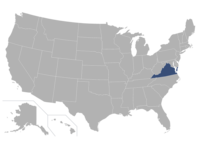
Richmond, VA