New Mexico data center water use could soar in coming years, researcher tells state lawmakers
Sep 01, 2026 | 12:49 pm ET
Description
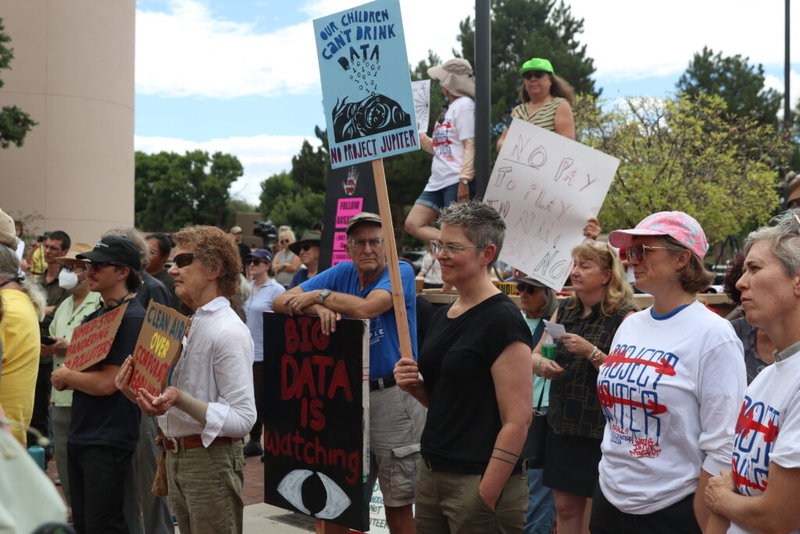
New Mexico residents on Aug. 21, 2026, protested a pending air quality permit application for the Project Jupiter data center. A new report found water usage could soar if every planned data center built out. (Danielle Prokop for Source NM)
Water use for data centers across New Mexico could soar in the coming years, an analyst told state lawmakers Monday.
Currently, data centers in the state use just more than 500 million gallons of water annually, accounting for one-half of 1% of the state’s total water use, Houston Advanced Research Center Vice President of Water and Community Resilience Margaret Cook told legislators on the interim Water and Natural Resources Committee. If every data center planned for the state was up and running, that figure would jump to 23.6 billion gallons per year, she said.
The lion’s share of that water would go toward “indirect use,” such as cooling the power plants that fuel the data centers, Cook said. A lack of transparency from data center developers makes it difficult to accurately predict future water use numbers, she added.
“There’s a lot of data uncertainty with data centers, which is a bit ironic,” Cook told lawmakers Monday. “The lack of transparency from data centers means that we don’t have enough information for planning. There aren’t a lot of studies available about water use, specifically water use actually occurring at data centers.”
Data centers’ water use has been a steady source of concern from advocates and lawmakers.
In a petition to the New Mexico Supreme Court filed in August, conservation group Center for Biological Diversity alleged that a well supporting the development has pumped more than 100 million gallons of fresh water since April, when public meter data for the well first published.
The Supreme Court gave the Office of the State Engineer a Wednesday deadline to respond to the Center for Biological Diversity’s claims.
On Aug. 24, U.S. Rep. Melanie Stansbury (D-N.M.) sent a letter to several New Mexico state agencies asking for a “clear public accounting” of the various water sources that will support the Project Jupiter data center under construction in southern New Mexico.
Nat Chakeres, general counsel for the New Mexico Office of the State Engineer, spoke alongside Cook and two representatives from Meta at the interim committee meeting. He said that he, too, has not “been super thrilled” with Project Jupiter’s shifting water needs.
“The total amount of water that Project Jupiter has stated that they need has changed over time…a big part of that has to do with how much water is needed for electric generation,” Chakeres said, referencing how developers pivoted away from their initial plans to build two natural gas plants on-site.
While data center opposition has become a bipartisan issue nationally, some Republicans on the interim Water and Natural Resources Committee Monday voiced support for them.
After two representatives from Meta shared details about the efficient cooling technology employed at its longstanding Los Lunas data center and spoke about Meta’s goal to restore more water than it consumes by 2030, two Republican state lawmakers — Sen. James Townsend (R-Artesia) and Sen. Larry Scott (R-Hobbs) — questioned why water-intensive developments such as golf courses aren’t subject to the same public scrutiny.
“I don’t think we as legislators ought to pick and choose from the type of industry or to get all wound up,” Townsend said. “Our issue, in my opinion, should be to make sure that these companies follow rules and regulations and that they provide jobs and a tax base for communities to grow and prosper on.”
Lawmakers from both parties, however, quickly outnumbered those in support.
Sen. Antoinette Sedillo Lopez (D-Albuquerque) told Chakeres, the attorney for the Office of the State Engineer, that she found the well issue pending before the state Supreme Court “disappointing in so many ways.”
Sen. Candy Spence Ezzell (R-Roswell) drew parallels between data centers and uranium mines and raised questions about what happens to the giant facilities if they shut down.
“We’ve had problems with uranium mines in the state of New Mexico. Lots of people have walked away from them, and it’s turned out to be a big problem for people living in those particular areas,” she said. “If these are the latest, greatest things for the state of New Mexico, if a plant is decommissioned, who is responsible for the aftermath?”
Santa Fe, NM