Underground experiment in South Dakota’s Black Hills reports ‘compelling hint of dark matter’
Sep 01, 2026 | 12:30 pm ET
Description
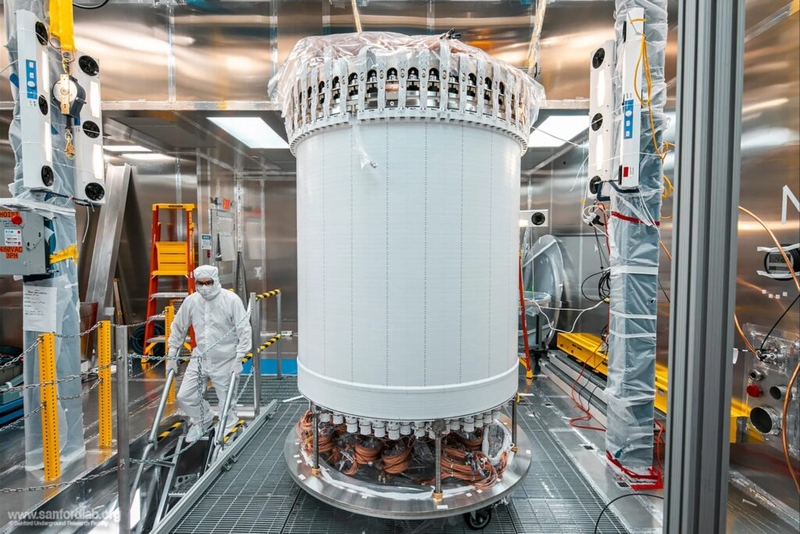
The LUX-ZEPLIN main detector in a surface lab before installation underground. (Photo courtesy of Matthew Kapust/Sanford Underground Research Facility)
An experiment deep underground in South Dakota’s Black Hills has reported its “most compelling hint of dark matter” to date.
A news release Tuesday from the LUX-ZEPLIN experiment announced the recording of a single particle interaction that researchers have difficulty explaining with known background signals from normal matter. The result does not yet meet the statistical threshold required to claim a discovery, the news release said.
“With only one event, we don’t want to get ahead of ourselves. We are not claiming to have seen dark matter,” said Rick Gaitskell, a professor at Brown University and the spokesperson for the experiment, in the news release. “But we have seen something interesting that we want to share with the scientific community for their input.”
Steel beams headed underground in SD for ‘largest science experiment ever attempted on U.S. soil’
Scientists have been trying to understand dark matter for the better part of a century. The invisible substance makes up roughly 85% of mass in the universe but has never been directly detected.
The experiment is an international collaboration of 250 scientists and engineers from 39 institutions. The detector is managed by the U.S. Department of Energy’s Lawrence Berkeley National Laboratory and operates nearly 1 mile below ground at the Sanford Underground Research Facility, in the former Homestake gold mine in the city of Lead. The facility is managed by the South Dakota Science and Technology Authority, which was created by the South Dakota Legislature and consists of members appointed by South Dakota’s governor.
The experiment uses a detector filled with 10 metric tons of ultrapure liquid xenon. Researchers look for signature flashes of light from energy deposited in the detector. The collaboration uses multiple methods to prevent or account for particle interactions caused by normal matter, including the mile of rock that shields the detector.
The new results were presented in a scientific talk at the 2026 TeV Particle Astrophysics conference in Japan. The paper will be released on the online repository arXiv and submitted to the journal Physical Review Letters. With additional data, researchers can test whether the finding continues to grow in significance or fades away, the news release said.
The experiment, which has been described as costing $60 million, is supported by the U.S. Department of Energy, the Science & Technology Facilities Council of the United Kingdom, the Portuguese Foundation for Science and Technology, the Swiss National Science Foundation, the Australian Research Council Centre of Excellence for Dark Matter Particle Physics, and the Institute for Basic Science, Korea.

Pierre, SD