SpaceX sweeteners: How did Louisiana lure Elon Musk’s rocket launch site to its coast?
Sep 01, 2026 | 12:09 pm ET
Description
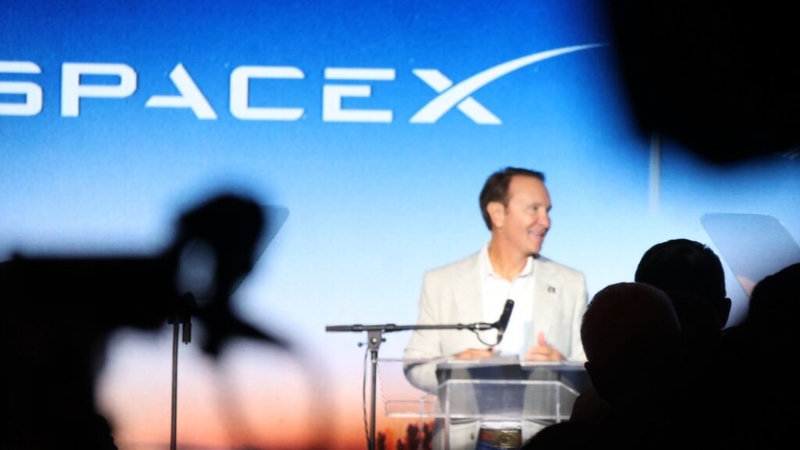
Gov. Jeff Landry speaks at Frank's Theatre in Abbeville during an event to announce the SpaceX project in Vermillion Parish on Aug. 25, 2026. (Photo by Wes Muller/Louisiana Illuminator)
Louisiana officials offered SpaceX what might be one of the largest single-project tax breaks in U.S. history to cinch a $100 billion deal to build its largest launch facility yet in coastal Vermilion Parish.
State and local governments are giving SpaceX a tax incentive package valued at an estimated $27.5 billion, according to documents obtained in a public records request from Louisiana Economic Development. They outline the state’s negotiations for what’s referred to as “Project Osprey” without using the company’s name or the proposed facility unveiled last week as Starbase Louisiana.
SpaceX, which had a market value as of Friday in excess of $1.8 trillion, is owned by Elon Musk, the world’s richest person with a net worth of $865 billion, according to Forbes.
The majority of the tax break, nearly $23.8 billion, results from exempting the company from having to pay property taxes to Vermilion Parish authorities for 25 years. In exchange for granting the exemption, the Vermilion sheriff, school district and police jury will share a $25 million flat fee that SpaceX must pay each year, records show. The payment-in-leu-of-taxes deal includes a provision that could increase SpaceX’s yearly payments based on inflation.
SpaceX will also get state sales tax rebates valued at an estimated $3.6 billion over its initial 20-year term, according to state documents. The remainder will come from the state’s High Impact Jobs grant program, which pays for 22% of each employees’ compensation, and Louisiana Economic Development’s recruiting and workforce training services.
‘Why do we need to give away this much?’
Broderick Bagert, a policy analyst with the progressive nonprofit coalition Together Louisiana, said a $100 billion facility in Vermilion Parish, before any exemptions, would generally have a property tax bill of roughly $1.3 billion per year once it’s completed. Under the tax exemption deal, SpaceX’s upfront annual payments come to just 2% of that amount.
The $23.8 billion in foregone property tax revenue for Vermilion Parish is by far the largest single-project tax exemption in Louisiana history and possibly U.S. history, Bagert said.
A recent analysis by Louisiana Legislative Auditor Mike Waguespack identified 99 payment-in-lieu-of-taxes contracts in the state’s six most populous parishes. None of those agreements come close to the amount given to SpaceX and even combined amounted to only $44 million in abated property and sales taxes during 2025, which would equate to $1.1 billion over a 25-year period.
Previously, the biggest commercial projects in Louisiana included Meta’s $50 billion data center in Richland Parish and Amazon’s $18 billion data center hub in Northwest Louisiana, though neither rivals the price tag of Starbase Louisiana.
Meta agreed to remit annual PILOT installments equal to 1% of its construction and equipment spending in Louisiana, starting with a $22.4 million payment in May to Richland Parish. Officials have not provided an estimate for what the incentives will cost the state or local government over the lifetime of the agreement.
Musk plans $100 billion SpaceX launch site in coastal Louisiana
Amazon will have 60% of its property taxes waived in Bossier and Caddo parishes for building its three data centers there, and it also qualifies for the state sales tax break on construction, equipment and software costs.
Jan Moller, executive director of the economic think tank Invest in Louisiana, agreed with Bagert’s assessment of SpaceX’s record-breaking tax break.
“It’s an astronomical amount,” Moller said. “It’s really hard to wrap my mind around it. …The most fundamental question is: If Louisiana is the only place on earth that really can accommodate this project, then why do we need to give away this much?”
Elsewhere in the country, recent commercial developments have included eye-popping, 10-figure incentive packages, but they all fall well short of what Louisiana has offered SpaceX.
Semiconductor manufacturer TSMC is expected to get about $15 billion in tax credits for its investments in Arizona. In New York, the Hudson Yards real estate development is expected to net the builder an estimated $6 billion in tax credits and government subsidies, and Centennial Yards in Atlanta includes $1.9 billion in development incentives.
OpenAI’s data center in Ohio, the largest ever constructed, received $1.5 billion in sales tax credits its first year, prompting state officials to pause the incentive program. If allowed to resume, the amount would rival that of Starbase Louisiana’s.
This also isn’t Musk’s first taste of billion-dollar-plus public incentives. In 2014, Nevada promised more than $1 billion in perks for Tesla to locate its “Gigafactory” that makes lithium batteries near Reno, The Hill reported.
LED: SpaceX must deliver results promised
Sited on the coastal marshlands of Pecan Island, the SpaceX development, known as Starbase Louisiana, will feature 10 launchpads, fuel production facilities, a power plant, deep-water shipping port, employee housing and an airport — all in an effort to make the base “self-sustaining” and not reliant on outside facilities for many critical services, according to company leadership.
The project site is well positioned because it provides an optimal launch point to reach orbit with a wide range of trajectories over a large open area and an abundance of natural gas for fuel and power. A Louisiana Economic Development news release described these factors as a “combination of advantages difficult to replicate elsewhere.”
SpaceX has committed to creating at least 3,000 permanent jobs by 2035 with an average annual salary of $92,600. A $27 billion incentive package puts the cost of each job at nearly $8 million over 25 years or $320,000 per job annually.
Company executives said the project could create more than triple the number of jobs beyond its commitment, though even at 10,000 jobs, the incentive cost would be $108,000 per job per year, according to Moller’s calculations.
“What about all the people who won’t be working for SpaceX?” Moller said. “Why isn’t the richest man in the world paying the taxes that everybody else in Louisiana pays?”
Responding to Moller’s calculations, Louisiana Economic Development Secretary Susan Bourgeois said it’s wrong to describe the incentives as a giveaway and pointed to the $100 billion investment that Louisiana is getting in return.
Musk has also promised to fund some of the state’s coastal restoration projects, which will help slow the erosion of vital wetlands.
“This is the first time we can marry an economic development project that creates thousands of jobs with coastal restoration and hurricane protection,” Gov. Jeff Landry said.
Details on the coastal projects weren’t in the documents Louisiana Economic Development provided in response to the public records request, though Bourgeois also considers them worthy of the tax breaks.
“Without this project, there is no $100 billion investment, no 3,000 high-paying jobs and no unprecedented private investment in coastal protection to incentivize in the first place,” Bourgeois said in response to questions. “The state incentives are the statutorily competitive tools Louisiana used to turn an opportunity into a historic win for our people and our coast — and SpaceX only earns them by delivering the results it promised. Without these incentives this coastal restoration, hurricane protection and economic opportunity simply doesn’t exist.”
Moller agreed the project will spur a lot of economic activity beyond the direct commitments outlined in its contract. This includes any future corporate income tax revenue from SpaceX, individual income tax revenue from the workers and a variety of other tax revenue from some of the businesses that will sell goods and services to those workers, he said.
“I don’t want to say this is gonna cost us money … There will be real downstream economic activity that will generate tax revenue,” Moller said. “It just seems wildly excessive when there are so many needs in these Louisiana communities.”
NDAs cloud negotiations
Another significant incentive Louisiana Economic Development did not attach a value to is what the agency’s records describe as the “Project Osprey VIP Permitting Initiative.” The state is expediting many of its technical and environmental permit requirements to speed up the construction. Also, federal agencies have proposed waiving 13 wildlife, water and public health laws that would help the project. The proposed federal permitting revisions were unveiled in late July.
Planning and negotiations for Project Osprey took place under the shroud of nondisclosure agreements. The use of NDAs by state and local elected officials has become a common recurrence behind the Landry administration’s major economic development deals, drawing criticism from transparency advocates who say the secrecy obscures the government’s deliberations over how to spend public money.
Angelle Bradford, a scientist and environmental advocate who volunteers with the Sierra Club, also pointed to laws the Louisiana Legislature passed this year that give aerospace companies legal protection from certain lawsuits.
The new laws take effect as SpaceX faces litigation from Texas homeowners who allege loud noise and sonic booms from its launch facility near Brownsville have shattered windows, cracked foundations and caused other problems in their communities.
Louisiana lawmakers also passed a law this year that will let aerospace companies keep many of their government contracts and related records confidential and exempt from the Louisiana Public Records Law.
“I think the question simply becomes: Why does the world’s richest man need to hide behind NDAs, need tax breaks and the protection of the Louisiana Legislature if this project is such a win?” Bradford said. “If you look at what other communities warn about Elon’s projects, his commitments versus his actual follow through, even with the momentum of this project, the secrecy is a concern.”
Construction on Starbase Louisiana is expected to begin next year with the first rocket launches to take place in 2029.
Baton Rouge, LA