Providers ‘stuck holding the bag’ for unpaid disability care amid agency delays
Sep 01, 2026 | 5:39 am ET
Description
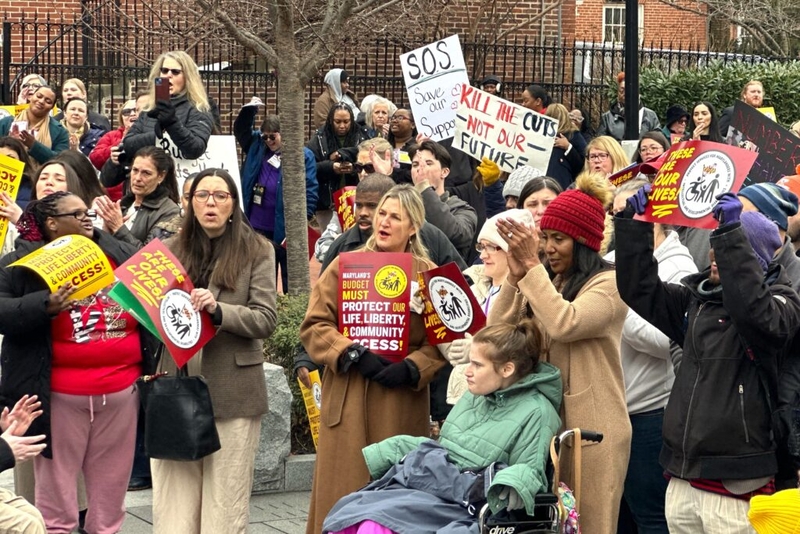
The developmental disabilities community along with care service providers and support staff rally outside the State House in February against proposed cuts in the state budget. (Photo by Danielle J. Brown/Maryland Matters)
After more than two years of erroneous Medicaid disenrollments, communication challenges and slow responses from state agencies, the nonprofits and companies providing developmental disability services say they are nearing a financial breaking point.
Developmental disability service providers say they won’t be able to absorb the costs of months of unpaid care much longer while their clients wait for Medicaid coverage to be restored by the state. Some organizations believe they’re owed hundreds of thousands to more than a million dollars for unpaid services due to lengthy lapses in Medicaid coverage.
With ongoing budget challenges at the state’s Developmental Disabilities Administration, providers feel they’re “stuck holding the bag” as they continue what is often complex behavioral and health care for a vulnerable population.
“What I worry is that the state is shifting costs from themselves to the provider system,” Katie Collins-Ihrke, executive director of the Arc of Howard County said. “We’re not just seeing cuts. Costs are being shifted to us on top of that.
“It’s a very scary time,” she said. “I feel like we don’t have state support … There’s all these changes coming federally too – it’s just a perfect storm.”
Meanwhile, providers fear the instability will start to impact the people with developmental disabilities who rely on those services.
“These are issues that are really going to have to be addressed sooner than later, because the bottom line is people with developmental disabilities cannot suffer because of these issues,” said Laura Howell, executive director of CEO for the Maryland Association of Community Services.
Disability community left with heads ‘spinning’ from sudden delay of proposed wage cuts
At issue are a series of financial and administrative challenges at the DDA, the state agency overseeing Medicaid waivers that covers people with developmental disabilities for a wide variety of services, from live-in caregiver support to transportation, respite care, employment services and more.
Each year, waiver recipients must prove that they are still financially eligible and still need coverage for their disability, in a process known as “redetermination.”
Annual redeterminations were suspended in March 2020, during the COVID-19 pandemic, when states were prohibited from canceling Medicaid coverage for most recipients. But since it restarted redetermination requirements in May 2023, advocates and providers say the department has struggled to keep pace with applications.
State officials say they are aware of the challenges and are trying to fix administrative operations to ensure that there is a longer grace period for waiver recipients to prove financial eligibility before being completely cut off from Medicaid coverage.
“Maryland is committed to the sustainability and integrity of the waiver program while supporting the health, safety, and independence of participants and promoting community living through both self-directed and community provider-managed delivery models,” the Department of Health said in a statement Friday.
It’s hard to get a firm number, but several provider organizations attest to dozens of waiver recipients who lost their Medicaid enrollment slot.
Over the years, these individuals fell out of the waiver slot at some point for a variety of reasons. A frequent challenge is the appearance that someone’s income is “over asset,” meaning they appear to earn too much to qualify for the Medicaid waiver.
That happened to a woman under the care of the Arc of Howard County, Collins-Ihrke said.
“The Social Security check hit before the first of the month, which can happen. What regulations state is that if it hits before the first of the month, you don’t count it in the current month, you count it in the next month because it’s next month’s income,” she said.
There are hundreds of people that this has happened to that are still in limbo. There are millions of dollars in unpaid claims for services provided by providers that had no other choice but to provide these services to protect the health and safety of people with developmental disabilities, lest they become homeless or end up in hospitals or perish.
“They [state officials] didn’t do that … she lost her Medicaid, they kicked her out of the waiver,” said Collins-Ihrke, who noticed the error swiftly enough to correct it with state officials and restore the woman’s coverage quickly.
She said since 2023, about 42 individuals at the Arc of Howard County have fallen out of the Medicaid waiver at some point.
While many of them were able to get their Medicaid coverage restored and the state paid some outstanding claims back, Collins-Ihrke believes she is still owed almost $400,000 in unpaid claims for developmental disability services over the years.
Another error occurred with a man who was erroneously disenrolled because it appeared he had too much income from a work program he was enrolled in. He was left out of the waiver for longer.
“We were told he was denied because … he was in another Medicaid program – which was incorrect,” Collins-Ihrke said.
“Because they denied him, he ended up falling off of the waiver because he came into some money,” she said. “We found out in the fall … and then he didn’t get back on the waiver until April of 2026. So, he was off the waiver for a year, maybe a little more.”
Because Maryland law prohibits a waiver program from discharging someone until they are taken in by another provider, the Arc of Howard County continued to provide services for him.
“We didn’t have an option to discharge him … he would be homeless. DDA probably wouldn’t allow us to discharge him, so we’re stuck holding the bag,” she said. “We still have $130,000 – $140,000 out there that we have to, I guess, now absorb.
Medicaid recipients sue state over ‘dysfunctional’ eligibility system
“My concern is that had I not caught that and not understood or had our staff not understood how it works – they might still not have their Medicaid,” she said. “People who don’t have providers who have the infrastructure to deal with these kinds of things are even more so lost.”
Greg Miller, president and CEO of Penn-Mar Human Services, says his organization has also provided services to people with developmental disabilities that should be covered by the Medicaid waiver.
“We have tried to work with our governmental partners to resolve this issue,” he said. “We’re basically told that they are not going to pay for services that we provided.
“My biggest concern is that although there are promises to fix this in the future, they have set a very, very dangerous precedent and one that cannot be repeated for people who are of vulnerable populations,” Miller said. “They’re making a very, very dangerous choice and that’s not something that is going to be acceptable to me or any other provider who have given their lives basically to help men and women with disabilities participate in our communities.”
A lawsuit filed last year by The Arc Montgomery County alleges it had, at the time of the court filing, provided $9 million in care to clients since January 2024 for DDA services that have not been reimbursed by the state.
Miller, Howell and advocates say other providers are considering their options, which could include legal action.
The department said in its statement Friday that it has “been working with participants and families, providers, stakeholders and advocates throughout the Moore-Miller Administration on ways to improve processes to support service delivery. This has included steps, such as creating a waiver help team, increasing the use of automation in application processing, and reviewing policies and practices that govern eligibility and enrollment processes.”
But ongoing fiscal challenges at the department, including two years of massive budget cuts to the DDA, may limit the department’s ability to restore those funds.
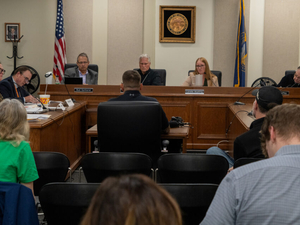
At a recent meeting of Developmental Disabilities Administration Waiver Advisory Council, Deputy Health Secretary Marlana Hutchinson said that, starting this month, waiver recipients would have three months to fix any financial discrepancy that may risk a loss of coverage. If recipients or their providers prove financial eligibility during that time, the coverage would continue.
“We do know we have had challenges where folks have gone over asset, going into a financial ineligibility time period, and that it’s taken longer for them to get back on the waiver program,” Hutchinson told the advisory council. “We are seeking to get this policy in place ASAP so that … beginning Sept. 1, individuals don’t have to go through that lengthy disenrollment process if it is done within the 90 days.”
Some of the other advisory council members argued that policy was already in place, but the state’s application of that policy changed in recent years. Providers and families were told in recent years that waiver recipients needed to go through the reenrollment process again to get their Medicaid restored, which is where the delays tend to occur.
Regardless, the new policy does not ensure that providers who have been giving months of care without payment will ever see those dollars returned, said Ande Kolp, executive director of The Arc Maryland, during the meeting.
“Something must be done for people who have endured this over the last 18 months,” she said. “It’s not going to be OK for us to just move forward.
“There are hundreds of people that this has happened to that are still in limbo,” Kolp said. “There are millions of dollars in unpaid claims for services provided by providers that had no other choice but to provide these services to protect the health and safety of people with developmental disabilities, lest they become homeless or end up in hospitals or perish.”
Annapolis, MD