The danger for the Alabama GOP in the data center issue
Aug 31, 2026 | 5:59 am ET
Description
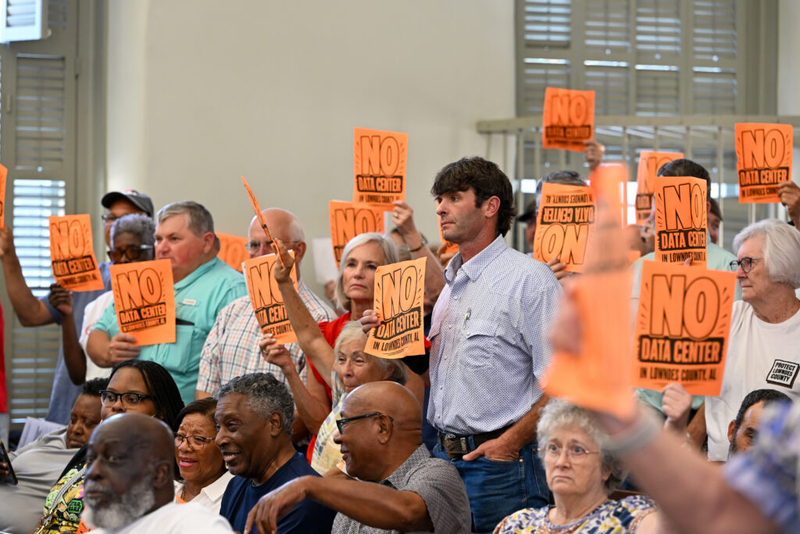
Residents of Lowndes County holding up signs that read "No Data Center" at a County Commission meeting on Aug. 24, 2026, in the Lowndes County Courthouse in Hayneville, Alabama. (Anna Barrett/Alabama Reflector)
There’s an apocryphal quote attributed to Fisher Ames, one of the first congressmen from Massachusetts. You can find different versions of it out there, but the idea is this.
Monarchy is like a trim wooden sailing ship, with a captain delivering orders to officers who execute them without question. The vessel is a marvel, swiftly slicing the waves and turning with precision. But if it hits a rock, it sinks quickly.
Democracy is like a raft. It’s slow; it’s hard to maneuver, and your feet are always wet. But if it hits a rock, it stays afloat.
The Alabama Republican Party is neither clipper ship nor inflatable. It’s more of a wooden tub. Yet it’s gotten so used to favorable winds and calm water that it appears to be overlooking a major reef up ahead.
Republican gubernatorial nominee Tommy Tuberville’s insistence that data centers are good and their opponents are communist stooges hasn’t stopped the public outrage over the facilities. One data center proposed in Lowndes County — taking up 800 acres and reportedly using enough electricity to power 42% of all the homes in Alabama — drew at least 150 people to a county commission meeting last week.
Lowndes County isn’t alone. Across the state, local governments have tried to stop data center development or heard from large numbers of residents demanding they do so. Democrats have gotten behind gubernatorial nominee Doug Jones’ call for a yearlong moratorium on the facilities.
Tuberville, meanwhile, treats them as inevitabilities and makes dubious claims that they’ll be important revenue sources for their communities. Downballot Republicans may be trying to soften the blow, but in that deferential, whatever-you-say-boss manner that tells you where they’ll land.
After all, the Alabama politician is a creature who believes that “economic development” is magic that can take the place of governing (even though it probably doesn’t work). The Alabama politician ignores your concerns and tells you the real problem in Alabama is the fact corporations pay taxes in the first place.
That’s Alabama’s top-down approach to governing. Politicians believe they can tell voters what’s important. Zealots and lobbyists, in turn, can convince those officials that their weird or destructive obsessions are what matter.
Let’s be honest. If you ran into someone at a party loudly complaining about transgender people, they would come across as an obsessive and likely a creep. Yet a handful of bigots ensured that the GOP embraced obsessive creepiness in 2022 and 2024.
I want my children to learn American history with all its inspiration and tragedy. But a small group of brittle men in the Legislature not only made the teaching of a vague list of “divisive concepts” difficult but gave schools like the University of Alabama an excuse to shut down spaces for Black and LGBTQ students.
Tuberville and other politicians bullied a Islamic school in Hoover and tried to make a controversy out of interfaith gatherings. With zero justification. And a spittle-drenched hatred straight out of Alabama’s Jim Crow era.
Did the public demand these attacks? Of course not. Ask Alabamians what they want from state government, and most will say a lottery or the end of the grocery tax.
Our grandees can’t deliver those. So they started telling voters in Alabama’s ever-lower turnout elections what they should care about. And it seemed to work.
No surprise, then, that the GOP’s gubernatorial nominee, cocooned in Alabama’s lickspittle conservative media, thinks he can order you to love data centers. If you don’t, he seems to assume that he can ignore the objections once elected.
And he’s probably right.
No other issue in recent years has better illustrated Alabama’s fundamental lack of democracy than data centers. County governments are often powerless to stop them because the state constitution denies them zoning authority (a point raised by both the Association of County Commissions of Alabama and the Lowndes County Commission). Even cities that have that authority are creatures of the Legislature. They may not want data centers, but anything they do – like setting a minimum wage – can be vetoed by lawmakers.
And the Alabama House and Senate? Dominated by Republicans, most of whom represent heavily gerrymandered, uncompetitive districts.
But despite all their institutional advantages, this is a genuine risk for Republicans.
Here is a broadly unpopular trend. Here are cities and counties rejecting the facilities. And here is a majority party that doesn’t see a problem.
Data centers will not turn Alabama purple. They will not magically transform Republicans into Democrats. What they could do is keep Republican voters home, a development the Alabama GOP can’t afford in a year where they face a clear enthusiasm gap. It’s possible screaming about socialism or Tuberville’s threats to subject Montgomery, a majority-Black city, to military occupation will draw some of those people to the polls. I wouldn’t count on it.
I’m not betting that Republicans will lose this fall. I’ve seen the great GOP ship steer confidently through trouble and over public opinion in the last 16 years. The data center issue may not be enough to sink it.
But the Republican captain is confident that it won’t. And he’s steering the vessel toward the rock.
Montgomery