Tuberville, AG, GOP ask Alabama Supreme Court to affirm residency challenge dismissal
Aug 31, 2026 | 5:57 am ET
Description
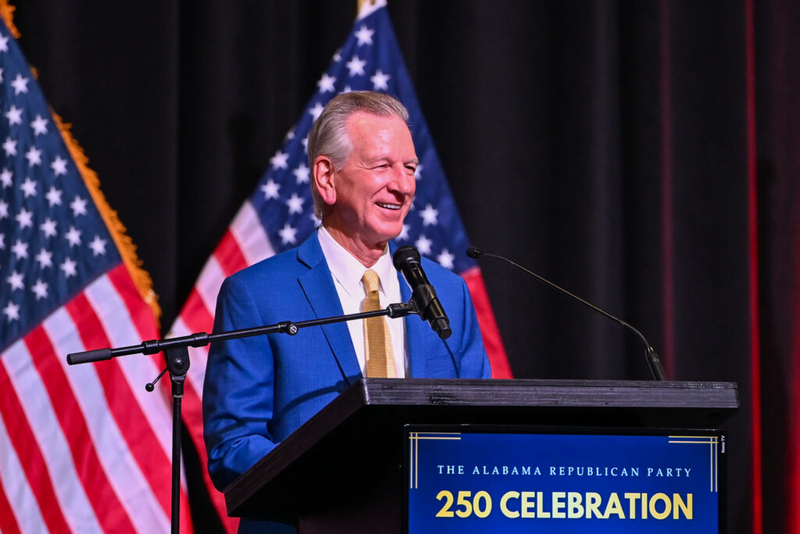
U.S. Sen. and Republican gubernatorial nominee Tommy Tuberville speaking at the Alabama Republican Party's Summer Dinner on July 31, 2026, at the Renaissance Hotel in Montgomery, Alabama. Tuberville on Thursday evening asked the Alabama Supreme Court to affirm the dismissal of a case challenging his residency. (Anna Barrett/Alabama Reflector)
Republican gubernatorial nominee Tommy Tuberville Thursday asked the Alabama Supreme Court to affirm a lower court’s dismissal of a case challenging his residency, with the backing of the state Attorney General’s Office and the Alabama Republican Party.
In a 62-page brief filed Thursday evening, attorneys for Tuberville called the plaintiffs’ appeal “preposterous,” writing that the Alabama Legislature has severely limited the courts’ abilities to hear election-related challenges under a law first passed in the 19th century.
“In truth though, there are multiple countervailing provisions of the Constitution that counsel against court action. To the extent that courts has a ‘special duty’ here because the Constitution is implicated, the duty extends to several other provisions,” the brief said.
Messages seeking comment were left Friday with attorneys for the plaintiffs challenging Tuberville; Tuberville’s campaign and his legal team.
The lawsuit argues that Tuberville does not meet Alabama’s seven-year residency requirement for the governorship. Tuberville has faced questions about his residency for years, and the plaintiffs’ complaint cites reporting including a homestead exemption in Auburn that Tuberville said he has been on since 2018 but was not added to until mid-2024, and a 2023 Florida driver’s license.
The case before the Supreme Court is not challenging Tuberville’s May primary win. It is seeking to allow the lower court to hear arguments about Tuberville’s residency.
Tuberville has maintained that he meets the requirement, but does not deny that he owns a home on the Florida coast. In the Thursday brief, his lawyers argue that temporary absences do not strip a person’s resident status.
“People that spend most of their time as agents of the state in Washington DC – like a U.S. Senator – would not lose their status as a ‘resident,’” it said. “Nor would they lose Alabama ‘resident’ status because they made regular visits to a Florida beach house they own or leave to go out of state on business every Sunday night to return on Friday night.”
His lawyers did not make it clear that Tuberville’s Auburn home – the listed address for his Senate candidacy, and often referred to as the “Game Day House” – is his primary residence.
“Above all, (Section) 117 of the Constitution calls for the governor to be a ‘resident.’ In common parlance that probably means a shelter with a roof and walls that could be used as a place for sleep,” the brief said. “It does not obviously mean that being a ‘resident’ of some other place is forbidden. There is no adjective that disqualifies if the place is not a ‘primary residence.’”
The lawsuit made its way to the Alabama Supreme Court after Montgomery County Circuit Judge Brooke Reid dismissed the case in July due to a lack of jurisdiction after an hourslong hearing. Reid did not rule on the merits of the case.
Does the Alabama Supreme Court have jurisdiction?
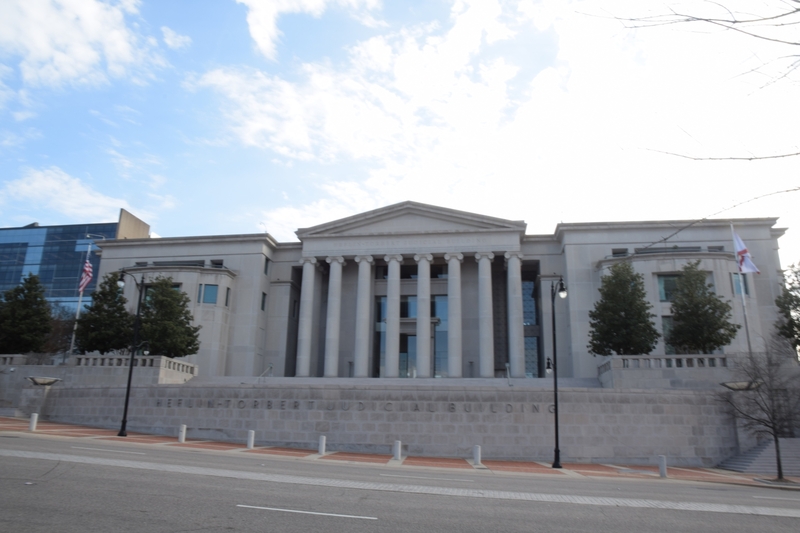
Alabama Attorney General Steve Marshall and the Alabama Republican Party also submitted amicus briefs on Tuberville’s behalf on Thursday.
Plaintiffs are seeking relief known as quo warranto, Latin for “by what authority,” challenging Tuberville’s right to hold office. Marshall argued that while courts do have jurisdiction over quo warranto cases and election challenges, the plaintiffs in this case erred in asking for it in this instance. He said that the case is a political issue, and it is up to the Legislature to resolve any election challenges.
“Courts have a vitally important role to play in many election disputes, but not this one,” he wrote in a 46-page brief.
Plaintiffs challenging Tuberville’s residency have argued that quo warranto it can be applied to party nominees like Tuberville as “quasi-officers” like Tuberville. Tuberville’s lawyers disagreed in Thursday’s brief.
“Alabama precedent rejects the conclusion that ‘quasi-officer’ status is sufficient to be challenged in a quo warranto action,” the brief said.
Marshall wrote that Tuberville is only a public officer if he can perform the “sovereign functions” of the office, which he says the U.S. Senator cannot do as a gubernatorial nominee.
“A role defined by party governance and subordinate to party control is not a public office,” he wrote. “So the quo warranto statute, limited by its terms to public officers, does not extend to such party positions.”
During the lower court hearing, Tuberville’s lawyers asserted that the Alabama Republican Party and the Alabama Legislature have the authority to decide if the U.S. Senator meets the constitutional requirements for governor. The Alabama Republican Party dismissed a primary election challenge against Tuberville in June.
In a Thursday afternoon brief, attorneys for the ALGOP argued that any further challenges should be dealt with by the Legislature.
“Moreover, the Legislature intentionally limited courts’ jurisdiction from hearing election disputes, instead granting the State’s political parties’ exclusive authority to settle their respective primary election contests,” the 31-page brief said.
Tuberville’s lawyers said the lawsuit is not “justiciable,” and nothing about that changes because the Legislature is a Republican supermajority.
“Changing the rules in the middle of an election is not good politics and sometimes becomes judicially actionable,” the brief said.
Plaintiffs also requested oral arguments, but only if the justices have questions that are not answered in the briefs filed this month. Tuberville’s lawyers and Marshall objected to the request.
“There is no need to explore in oral argument the wisdom of an ‘extension’ of existing law. In the event this case cannot be resolved by summary disposition, it is likely moot, given the pace of the election process,” Tuberville’s brief said.
The Secretary of State certified all opposed state and federal candidates on Wednesday. The last day to withdraw from the ballot was Aug. 24.
Tuberville’s lawyers also argued that the case is irrelevant because there can be no feasible relief at this point, since ballots are certified.
“As the debate is limited by the relators not to involve the elections, and no relief sought against any official that confers anything on Tuberville. Moreover, there is no person injured by Tuberville’s merely being a nominee,” the brief said. “Thus, in claiming they do not care that Tuberville won that election, they are the kind of litigants who merely want to debate, not resolve an injury in just fashion.”
The plaintiffs have one week to file a reply brief.
Montgomery