Michigan Democrats finalize nominations, continue calls for unity heading into November
Aug 30, 2026 | 6:30 am ET
Description
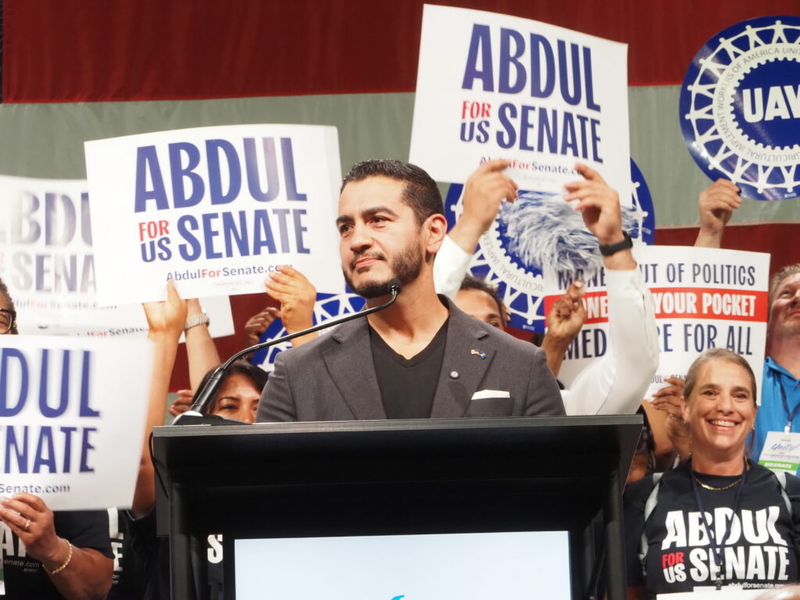
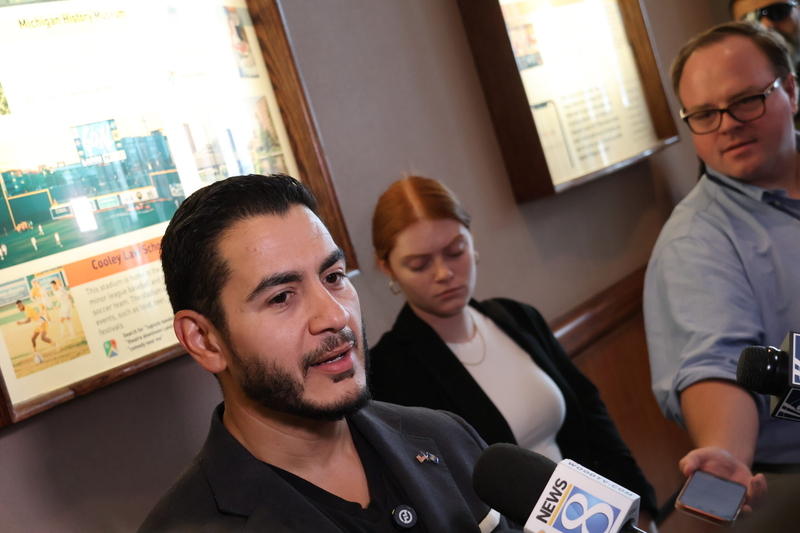
Abdul El-Sayed, Michigan's Democratic nominee for U.S. Senate, at the Michigan Democratic Party's nominating convention on Aug. 29, 2026. (Photo by Kyle Davidson/Michigan Advance)
Michigan Democrats on Saturday gathered to finalize their nominations for several key offices as the party shifts its members into gear for the Nov. 3 general election.
The Michigan Democratic Party held its 2026 nominating convention at the Lansing Center, where it formally nominated its candidates for lieutenant governor, secretary of state, attorney general, the State Board of Education, University of Michigan Board of Regents, Michigan State University Board of Trustees, Wayne State University Board of Governors and State Supreme Court.
While the party’s spring endorsement convention showcased the divisions between the party’s more moderate and progressive wings — and its divide over Israel’s war against Gaza — party leadership and nominees at Saturday’s event preached a message of unity against rising costs and President Donald Trump’s administration.
As Democrats look to defend their control of the governor’s seat, the attorney general’s office and the Department of State, in addition to flipping Republican seats in Congress and the Michigan Legislature, Michigan Democratic Party Chair Curtis Hertel stressed to attendees, “If you’re waiting for the cavalry to come, we are the cavalry.
While some Democrats, like Michigan Attorney General Dana Nessel, said they planned to forgo the convention out of concerns of harassment and antisemitism, Hertel circulated a message to party members in the days leading up to the gathering emphasizing that “disruptive behavior or harassment of any kind will not be tolerated.”
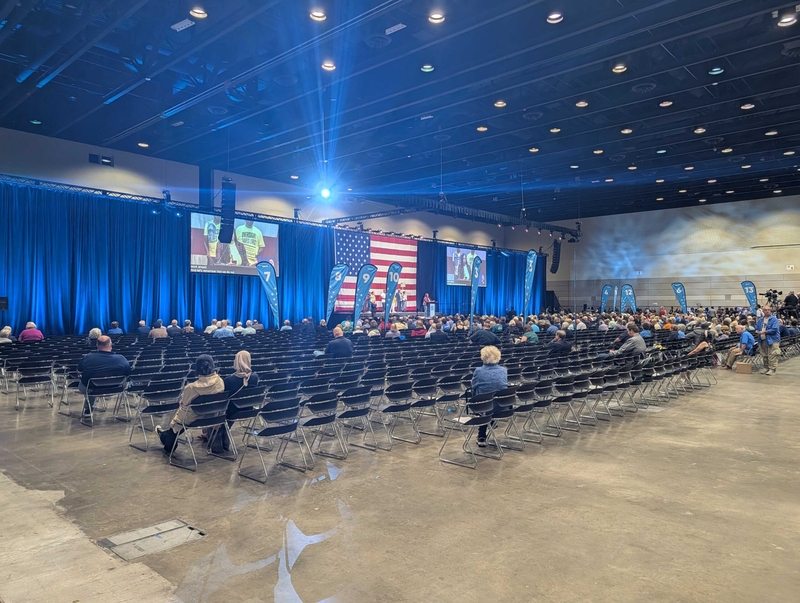
Ultimately, the nomination process proceeded without disruption, though the convention held more than a few empty seats which grew in number as nominations continued.
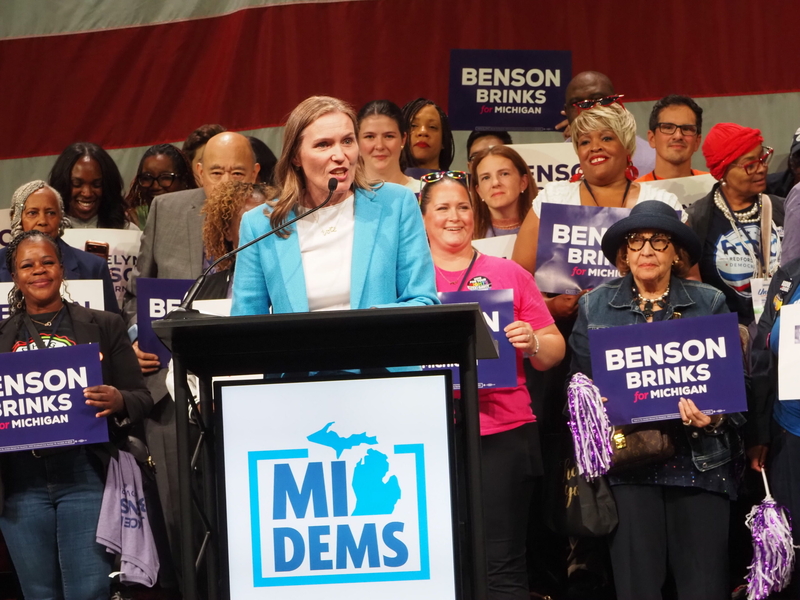
Party delegates nominated Michigan Senate Majority Leader Winnie Brinks (D-Grand Rapids) to run alongside Michigan Secretary of State and Democratic nominee for governor Jocelyn Benson, formalizing Benson’s selection for a running mate.
While accepting the nomination Brinks pointed to her 13 years of experience serving in the Michigan Legislature, including the last three, where she’d served as the state’s first female Senate Majority Leader.
“Together, we delivered historic change, cutting taxes for working families and seniors, guaranteeing free breakfast and lunch for every Michigan school student,” Brinks said. “Protecting reproductive freedom and LGBTQ rights, strengthening gun safety laws, restoring workers’ rights, and investing in clean energy. But Michigan Democrats, I am here to tell you I am not done yet.”
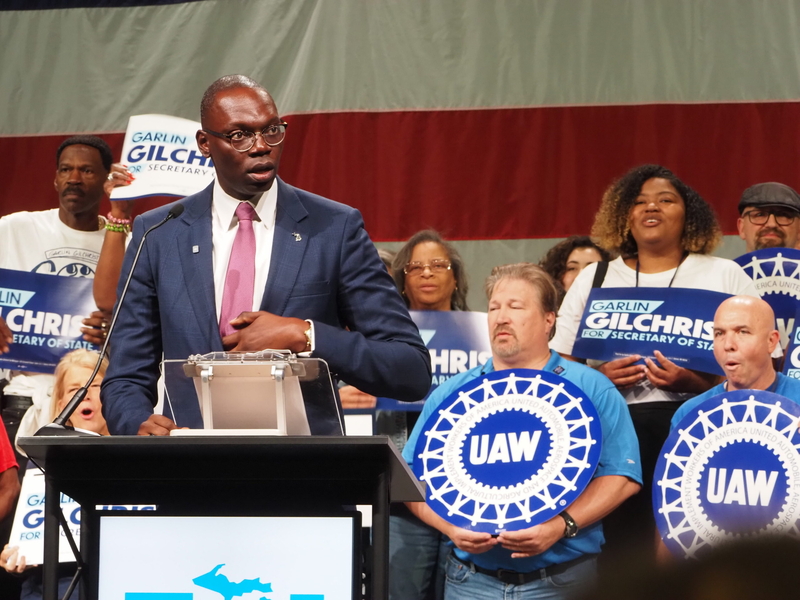
The party also nominated Lt. Gov. Garlin Gilchrist for secretary of state and Washtenaw County Prosecutor Eli Savit for attorney general. Both Gilchrist and Savit pledged to stand against the Trump administration if elected.
“I want to be really clear about this moment, about the stakes and what we face. Donald Trump is coming for our votes and our election system in the State of Michigan,” Gilchrist said, noting that just this week the U.S. Supreme Court, which has a 6-3 conservative majority, had allowed an executive order restricting mail-in voting to move forward.
The executive order remains blocked under a separate court ruling.
While the U.S. Department of Justice has sought access to Michigan’s voter rolls which contain information such as voters’ birthdates, driver’s license info and Social Security numbers, Gilchrist told delegates that when he is elected “your data will belong to you and not the federal government.”
“That data doesn’t belong to Donald Trump,” Gilchrist continued. “It doesn’t belong to his political appointees, and it is not theirs to use as a weapon against the people of the state of Michigan. As your next secretary of state, I will stand tall in between this administration and Michigan voters every single time they try to interfere with your rights and our elections.”
Savit said Democratic attorneys general across the nation have stood up to the Trump administration, recovering federal funding that otherwise would have been eliminated by the federal government.
“What I can tell you is this: as Attorney General, I will stand up for the people of the state of Michigan, each and every time any president violates the law and hurts us, and that includes attacks on our right to vote,” Savit said.
The party also nominated its candidates for the Michigan Supreme Court, State Board of Education and the governing boards of the University of Michigan, Michigan State University and Wayne State University.
Delegates re-nominated Judith Pritchett and Tiffany Tilley for State Board of Education.
For the university boards Amir Makled was nominated to serve on the University of Michigan Board of Regents, while Regent Paul Brown was renominated. The party also nominated MSU trustees Kelly Tebay Zemke and Brianna Scott for another term. For Wayne State, the party nominated Shereef Akeel and Richard Mack.
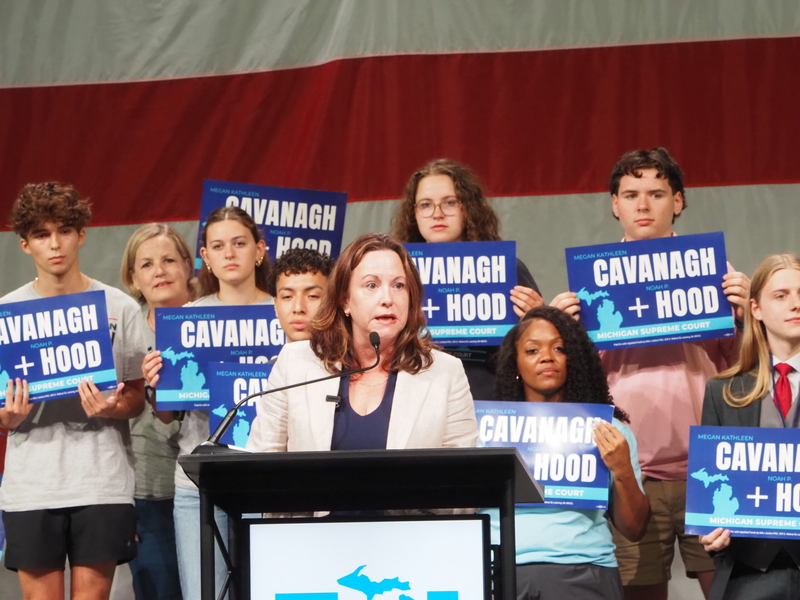
The Michigan Democratic Party also nominated Chief Justice Megan Cavanagh and Justice Noah Hood for reelection to the supreme court.
El-Sayed aims to mend fences with Jewish Dems, apologizes for Temple Israel comments
In the weeks since the primary election, Michigan Democrats have stood divided over the party’s Senate nominee, former Wayne County Health Director Abdul El-Sayed, who secured a narrow primary victory against U.S. Rep. Haley Stevens (D-Birmingham) with just under 1% of the vote.
El-Sayed’s criticism of Stevens over her connection to the American Israel Public Affairs Committee, his opposition to the U.S.’s support Israel – which he, along with multiple international organizations, says is committing genocide in Gaza – and his previous decision to campaign with the controversial streamer Hasan Piker, have alienated some Jewish Democrats.
While speaking with reporters on Saturday, El-Sayed noted that while meeting with the Michigan Democratic Party’s Jewish Caucus Saturday, he was asked about comments he’d made in the wake of the attack on Temple Israel in West Bloomfield Township, in which a gunman drove a Ford F-150 into the synagogue before dying of a self-inflicted gunshot wound during an exchange of gunfire with security.
El-Sayed condemned the attack, but stated that “Hurt people, hurt people,” noting that the gunman’s family had lost family members in an Israeli airstrike in Lebanon.
“My comments might have been misconstrued to be justifying something I did not intend to justify,” El-Sayed said. “To anybody who feels like my comments might have been hurtful, I’m really sorry that was not my intention. We condemned that terrorist attack. We condemned it outright. What I was trying to do was offer context for why it happened, but it wasn’t the time for context. And you don’t ever want to trample somebody’s pain.
However, when asked about Jewish Democrats’ concerns over his ties to Piker, El-Sayed shut down the question.
“We’re in the state of Michigan,” El-Sayed said. “If you want to make this race about a streamer in California, I just think you’re missing the boat. This is about affordability in Michigan. This is about being able to see a doctor in Michigan. This is about Donald Trump’s disastrous policies in Michigan. That’s what I’m focused on right now. I am not interested in a conversation about a social media person in California.”
While El-Sayed met with the party’s Jewish Caucus on Saturday and he told reporters he would continue having conversations with Jewish Democrats.
They may not agree on everything, El-Sayed said. While he believes deeply in equal rights, peace, dignity and self-determination for Palestinians and Jewish Israelis alike, El-Sayed said he would not stop fighting for Palestinian self-determination, arguing that the money the U.S. has spent supporting Israel’s military should have been spent in the United States.
“People get real mad about that, I understand,” El-Sayed said. “But that does not mean that I will not stand up forthrightly for safety for all communities, and I believe in the safety and the dignity of Jewish kids like I believe in the safety and dignity of my own kids.”
Are Michigan Dems United?
Closing out the convention, El-Sayed and Benson each offered remarks to rally attendees, though they did not appear on stage together.
When speaking with reporters after her speech Benson was met with a crucial question that Democrats face heading into the general election: “Are Democrats united right now?”
“We are united around our vision of lowering costs to the people of Michigan, of fighting corruption, of ensuring that we have people-driven leaders at every slot in this ticket. And I think that’s what you heard a lot from today,” Benson said. “We’re all singing the same song, all talking about the same thing, particularly when it comes to health care, ensuring everyone has access to affordable, accessible care.”
When another reporter pressed her on that answer, Benson re-stated that Democrats are singing the same song.
“I do believe we’re all talking about raising wages, driving down costs, and I think you know what I love about democracy and what I believe in is a true multiracial, multiethnic, multifaceted democracy is that we all have space to be our own individuals while also fighting for the same things for the people and for what the people of Michigan need,” Benson said.
Lansing, MI