University of Iowa researcher helps identify potential gems on Mars
Aug 28, 2026 | 5:36 pm ET

Description
University of Iowa assistant professor Valerie Payré was part of a NASA project that found evidence of the mineral that forms rubies and sapphires on Mars. (Photo by Brooklyn Draisey/Iowa Capital Dispatch; inset photo courtesy of Valerie Payré)
A University of Iowa researcher is helping to unearth the geological secrets of Earth’s planetary neighbor, with recent findings of a necessary mineral to create certain precious gemstones and future study into the largest canyon in the solar system identified so far.
Valerie Payré, an assistant professor in the UI School of Earth, Environment and Sustainability, said striving to learn about the history and geological makeup of Mars’s surface can help in better understanding Earth’s own history.
Based on previous study of the surface of Mars, Payré said she expected the Mars Perseverance rover to show her “silica-rich rocks” like kinds of granite. What she wasn’t expecting to see were white-colored pebbles that held corundum — a mineral from which rubies and sapphires are made.
“It’s so unexpected because on Earth it’s (made) from the specific conditions; we were not expecting to find those on Mars,” Payré said. “So it was a very exciting discovery, and I was looking at so many papers to try to understand how that happened.”
A NASA research team comprised of Payré and other scientists published a research letter detailing their findings this month, based on the data gathered by the SuperCam instrument on Perseverance. Payré served as co-investigator on the Perseverance team.
The geologist said researchers have yet to figure out if the corundum on Mars has actually formed precious gems rather than a different form of the mineral. But if and when the pebbles’ origin is found, Payré said her team and others involved with the Perseverance rover will be using all of the instruments at their disposal to learn all they can.
On Earth, corundum is formed in conditions involving fluids, high temperature and high pressure. These conditions could have been made by the impact to Mars’s surface that created the area where the pebbles were found, called Jezero Crater. However, Jezero Crater is located within an even larger crater, one Payré said is more than 1,000 in diameter, so the corundum could have been created through that impact instead.
Corundum is made of aluminum and oxygen, Payré said, and is more common in aluminum-rich environments rather than the silica-rich rocks she thought she’d see.
“It’s the first time we’re seeing those types of compositions at the surface of Mars, so we’re still trying to understand how that could happen,” Payré said.
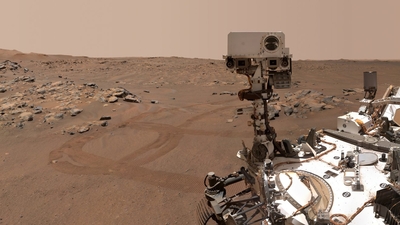
Jezero Crater was formed more than 3.5 billion years ago and “shows promising signs of a place that was likely friendly to life in the distant past,” according to information posted by NASA online about the Perseverance mission. As many as 400 people are working on different aspects of the mission, split into teams to focus on each of the rover’s 10 instruments and what they find.
As the SuperCam was the only instrument that could analyze the pebbles, since they were small and not close to the rover’s location, Payré said the team was able to publish its own findings. Additional researchers are working with everyone involved with Perseverance to bring together all of the data collected by the rover.
Included in the SuperCam are “at least six techniques” for gathering information about the surface of Mars, Payré said, including different lasers to study the chemistry and crystals within rocks, a camera and a microphone to measure how hard a rock is based on the sound a laser makes when hitting it.
Since the rover found the pebbles last year, Payré said the team has been looking for a larger outcropping where they may have come from using orbital observations and photos from Perseverance to identify rocks with the same coloring. However, Mars’s landscape limits the rover’s ability to go to certain areas, as it needs to be protected from sandy areas, pointed rocks and slopes that could cause it to tip.
Another area of Mars’s surface Payré is examining for possible corundum formation is Valles Marineris, a canyon that stretches 2,400 miles in length and has a depth of close to 6 miles at its deepest. The geologist is principal investigator of a UI research team awarded a two-year, $100,000 NASA grant to study the rocks found within the canyon, with a future goal of developing a helicopter that could fly into the canyon to study rocks close-up rather than through orbital imagery.
Both of these projects are focused on shedding new light on the chemistry of the crust of Mars in different ways, Payré said, through study of the planet’s internal geology through Valles Marineris and surface impact areas like Jezero Crater.
Payré said one thing she’s learned through the Perseverance mission is the importance of impact craters on “shaping the geology of Mars” and if this happened to Earth’s neighbor, it could have happened here as well.
“It’s part of the story. We want to understand what the crust is made of, and corundum is part of that story,” Payré said. “There’s aluminum-rich rocks out there. We don’t know how they formed, but that’s part of what the crust is made of.”

Des Moines, IA