To save SC’s historic Black schools, nonprofit launches statewide coalition
Aug 28, 2026 | 4:08 pm ET
Description
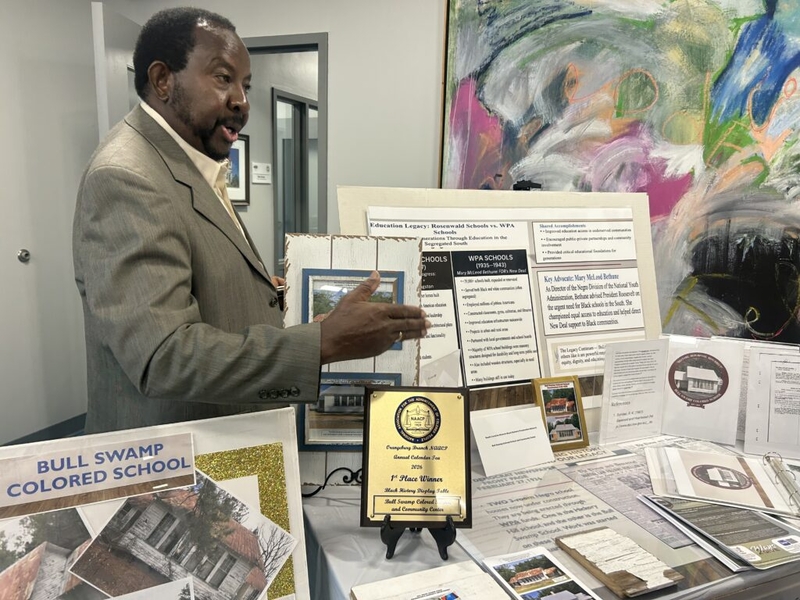
Wilfred Pace, who is helping lead an effort to save Bull Swamp Colored School and Community Center in Orangeburg, describes the school's history at Central Carolina Community Foundation's office in Columbia, S.C., on Thursday, Aug. 27, 2026. (Photo by Skylar Laird/SC Daily Gazette)
COLUMBIA — Helping save Lakeview School in West Columbia is Earnestine Holden’s retirement job.
Like many of the people trying to save historic Black schools, Holden, who graduated from the school in 1967, isn’t a professional historian or grant-writer. She’s a passionate alum who wants to see the school she graduated from preserved for future generations to see.
Recognizing the difficulty many alumni associations face in navigating complicated barriers to saving the state’s historic Black schools, the Central Carolina Community Foundation on Thursday officially launched the South Carolina Historic Black Schools Preservation Network.
Proposed national historic park would highlight history of SC’s Rosenwald schools for Black students
The network is meant to act as a way for alumni associations and nonprofits to pool their knowledge and resources about funding sources, historical designations and research, said Georgia Mjartan, the foundation’s president.
So far, the effort involves about a dozen long-closed K-12 schools. But the work is also open to historically Black colleges and universities, said Trimease Carter, the foundation’s director of community impact.
Each endeavor is starting from a different place, with different needs, which allows the nonprofits and alumni associations behind their preservation to help each other out, she said.
“No matter where your school is along this preservation network, we want to be here to be a help and support,” Carter said.
Starting a network
South Carolina once had thousands of Black schools. The exact number is unclear, said Virginia Harness, a researcher for the state Department of Archives and History.
Many closed as the school systems were required to desegregate. They were then left to deteriorate, often forgotten by surrounding communities.
But the schools played a vital role in the state’s history, alumni said. Children’s futures depended on the schools that provided their only opportunity for education, Holden said.
“There were so many kids who would never have gotten to college if it were not for the nurturing they received at these Black schools,” Holden said. “I can tell you story after story after story.”
Wanting to save the schools, alumni started calling the Central Carolina Community Foundation asking about opportunities for funding. After several similar requests, Carter asked one caller if the schools had some sort of collective that would make it easier to work together.
“Not that I know of,” replied Deloris Pringle, an alumna of Lincoln High School in Sumter. “Would you all be willing to host this?”
The foundation decided to act as a connector, giving alumni a space to meet and help in finding resources. Although the foundation typically serves the Midlands, the network is open to schools across the state, Carter said.
“I feel like so many were working in silos, and they were trying to do things by reinventing the wheel,” Carter said.
Historic designations
Many preservation efforts are led by established nonprofits, but saving Black schools typically falls to passionate alumni. Some might have a background in running a business or working in government, but most know little about what opportunities are out there or how to get them, Carter said.
For instance, getting a spot on the National Register of Historic Places can offer certain protections, said Virginia Harness, who oversees that process for the state Department of Archives and History. But the designation comes with a set of requirements, and most applications are written by professionals, she said.
“It’s serious business,” Harness said. “It’s sort of like a graduate-level research paper.”
At least 67 schools are listed on the national register, Harness said. That doesn’t include schools that are part of a larger historic district, such as the one encompassing downtown Charleston, since they aren’t listed separately, she said.
Most of the listed schools are general public schools built to educate Black students. About a fifth are Rosenwald schools, founded by Sears CEO Julius Rosenwald to give rural Black students in the South an education. Another fifth are equalization schools, which were built in the 1950s with the state’s inaugural 3% sales tax in a failed effort to thwart desegregation by proving public schools could be “separate but equal.”
Some rarer examples of schools include Faith Cabin Libraries. Around 100 of the libraries were built across South Carolina and Georgia to make sure students, including those who attended school elsewhere, had access to books at a time when most libraries remained segregated.
The state also has one Black mill school still standing, which is a rarity, Harness said. Marysville School in Spartanburg County was built to educate the children of Black families who worked in Pacolet’s textile mills between 1915 and 1954.
Historians have found 33 other schools that would likely qualify but haven’t applied. Other schools that were demolished, repurposed or rebuilt over the years are out there but don’t qualify for that designation, she said.
Interest in saving historic Black schools has grown in recent years, Harness said. In the last decade, the Department of Archives and History recommended adding 17 schools to this list. Less than six years into this decade, the agency has recommended 18.
“We’re definitely seeing a big increase in interest in listing these properties,” she said.
Recent statewide efforts to save Rosenwald schools are part of that. Pushes from alumni associations are another, she said.
Even professional historians sometimes need some help in filling out those types of applications. The register initially rejected a bid to list Booker T. Washington High School in Columbia because renovations to save the building “impacted the historical integrity of the original building,” said Bobby Donaldson, a history professor involved in the effort.
“I said, ‘You’ve got to be kidding,’” said Donaldson, who leads the Center for Civil Rights History and Research at the University of South Carolina, located in the former high school built in 1956 as part of the so-called equalization effort.
So, he called up Pringle and others working on Lincoln High School, which also underwent extensive renovations and got listed. They gave some advice on how to phrase the application, and, sure enough, Booker T. Washington got added to the list, Donaldson said.
Getting a spot on the national register can open up federal funding, but it’s far from the only resource associations might need help with, Carter said.
Many of the schools want to open museums for the public to see what learning was like for Black students during segregation. Some want to expand and become community hubs.
Bull Swamp Colored School in Orangeburg, for instance, is planning to add a commercial kitchen, food pantry, media lab and activity center to the 2 acres surrounding the historic three-room school house, said Wilfred Pace, who is helping lead the effort.
That sort of work is only fitting, since the schools once served as hubs for Black communities, Pringle said.
“Even though we were unequal in terms of our facilities, these schools just were the heart of these African American communities,” Pringle said.
Funding
The biggest barrier for most is fundraising, Carter said.
School groups typically cobble together money from various sources.
Bull Swamp has gotten money from various federal grants, as well as from donations and local partnerships, for its $1.2 million renovations, Pace said. Lakeview High School is in the process of getting nonprofit status to collect donations from alumni and apply for grants, said Holden.
SC had 500 Rosenwald schools for Black children. Nonprofits want to save the 44 that remain.
Long Point Schoolhouse in Mount Pleasant has gotten $150,000 from the state budget, with $250,000 more expected in a bill legislators sent to the governor this week. St. George Rosenwald School in Dorchester County received an agricultural grant for repairs, showing how schools can get creative, Harness said.
Getting funding often requires going through complex processes involving lots of paperwork and research on a school’s importance.
That’s not knowledge most people have, Carter said. But it is something the Central Carolina Community Foundation and other partners know about and can help with, she said.
The spirit of collaboration is built into the schools, Pace said. Without help from various places, including government funding, philanthropy and community support, most of the schools would never have existed, he said.
“It just shows you the resilience of working together and having a vision for the future and then living that dream,” Pace said.
Columbia