FEMA still hasn’t approved most disaster aid for Texans hit by this year’s July floods
Aug 28, 2026 | 11:23 am ET
Description
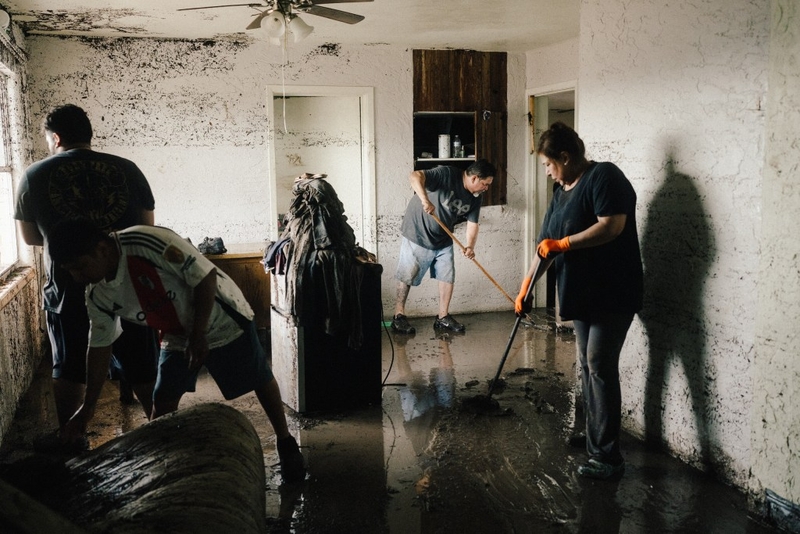
People clean up a flooded home in Kerrville on July 16, 2026. (Brenda Bazán for The Texas Tribune)
Six weeks after extensive floods damaged homes, bridges and roads across southwest Texas, President Donald Trump still has not made most of the requested federal disaster assistance available to individuals and local governments working to recover.
The limbo leaves places such as Uvalde County with dozens of roads and multiple bridges in need of permanent repairs. Local residents keep asking Uvalde Mayor Hector R. Luevano where the federal help is, and he said he has nothing yet to tell them.
“That’s what we’re looking for: help,” Acting Uvalde County Judge Jerry W. Bates said.
In Kerr County, where many residents are recovering from a second flood in two years, the community doesn’t have the money to give everyone the needed temporary places to stay, help fixing or replacing vehicles and help making homes liveable again, said Todd Bock, executive director of the Kerr Economic Development Corporation.
“We’re in desperate need of that (federal aid) in order for us to start on what we call a full recovery,” Bock said.
Last year, Trump signed off on major FEMA help including for individuals within days of the deadly July 4 flood, which received significant media attention and caused at least 137 deaths, including 119 in Kerr County alone.
This year’s six-week wait follows a national pattern: Since Trump returned to the White House, his administration is taking longer on average to approve major disaster funding than other recent administrations, according to research of Federal Emergency Management Agency data by Andrew Rumbach, a senior fellow at the Urban Institute, and analysis by The Texas Tribune.
During the current administration, communities have waited an average of nine-and-a-half weeks for a final decision on major federal disaster funding, Rumbach found. That’s roughly three times longer than the average of about three weeks for other administrations since 2000.
“Either a delay or a denial can really slow down the recovery process, and often it can compound the difficulty of recovery,” Rumbach said.
Presidents have to declare major disasters in order to open up major FEMA funding for individuals as well as city, county and state governments. The president can also issue emergency declarations to make more limited funding available for health and safety measures.
The president quickly approved the more restricted federal emergency funds on July 18, but that type of support is typically limited to $5 million. Texas’ initial request for a more expansive major disaster declaration estimated $489.7 million in costs.
The Federal Emergency Management Agency site shows the agency thus far has only authorized funding for direct federal emergency work. The agency had still not cleared funding for long-term fixes to public infrastructure or funding for individuals, which requires a major disaster declaration, according to its website.
Major FEMA assistance is meant to support state and local governments and individuals and families with the immediate aftermath of a disaster, said Maddie Sloan, director of Disaster Recovery and Fair Housing Project with nonprofit Texas Appleseed.
Without it, people who don’t have other resources might be living in homes that aren’t safe, or unable to replace a computer for a child to have at school or tools needed for work, Sloan said. Local governments also have no guarantee of being reimbursed for debris removal or long-term infrastructure repairs.
“That leaves local communities in a position where they have to try to make decisions about how much can they spend on recovery,” Sloan said. “If they can’t get reimbursement or get help from the federal government or from the state, that is going to mean disaster-affected communities are going to have to make some very hard choices with their budgets.”
The Tribune’s analysis found that the federal government has previously acted faster to approve individual and public assistance, including in Texas. Over the past decade, Texas communities have received a major disaster declaration in less than a month in 13 out of 20 cases over the past decade. Of the seven decisions that took more than a month, four were later approved and three were denied.
The government has also denied a higher percentage of requests during Trump’s second presidency than other administrations since 2000, Rumbach found. So far this year, as of Aug. 24, the Trump administration denied 22 requests for major disaster declarations — the most in any single year since at least 2000, according to the Tribune analysis.
White House spokesperson Lauren Bis said in a statement that Trump responds to requests for disaster funding “with great care and consideration” to make sure tax dollars are well-spent and that the federal government isn’t stepping in where states are responsible.
“President Trump conducts a more thorough review of disaster declaration requests than any Administration has before him,” Bis said.
FEMA said in a statement Thursday: “The law and regulations require FEMA to review each request closely and consider the unique circumstances of disaster-caused damages as well as state and local capacity.”
A council appointed by Trump to review FEMA in May recommended shifting leadership for emergency response efforts to state and local governments. But Texas currently has no program to help individual survivors and families or governments, Sloan said.
“How is the state of Texas going to come up with — I think billions of dollars is a fair estimate — every single year for disaster recovery if the federal government is essentially withdrawing from disaster response and recovery?” Sloan asked.
Local governments and people often cannot fill in the gaps on their own, said Jim Elliott, a sociology professor at Rice University. Rural counties can have a harder time bouncing back than wealthier cities because of their relative geographic isolation, weak labor markets and difficulty meeting federal thresholds.
The bigger the delay in aid, the longer people can be left in limbo trying to figure out how to recover.
“When you take that assistance away, who’s going to suffer most?” Elliott said. “The people who aren’t richer, who don’t have the resources to recover themselves.”
Gov. Greg Abbott requested assistance for governments in 28 counties on July 17, on the heels of days of severe flooding that impacted a large part of the state stretching from San Antonio to the Texas-Mexico border.
Abbott later said the state would ask for assistance for individuals in 30 counties. Preliminary state analysis identified 4,778 structures in flood-impacted areas, according to Abbott.
The state was dealing with “an unprecedented frequency of disasters,” including record-breaking wildfires and Hurricane Beryl in 2024, Abbott wrote in his first request. Ten of the counties needing help this year also suffered similar damage in the July 2025 floods, including Kerr County.
Climate change is making heavy rain more likely and lengthening fire seasons. Debris still remained to be picked up from last year’s floods in some places when this flood struck.
“The cumulative impacts of these disasters continue to strain the capabilities of state and local governments and the resilience of affected communities,” Abbott’s letter said.
Politicians appealed to the president for help, including U.S. Sens. Ted Cruz and John Cornyn, who urged Trump on July 21 to approve the declaration.
Kerr County Commissioner Rich Paces wrote in a letter dated July 30 that the damage this year exceeded the year prior, with 384 homes at that point confirmed destroyed or majorly damaged. Nine of the county’s 11 bridges were damaged, as were numerous private and public roads.
“Kerr County does not have the resources to respond and recover from a second major disaster just one year after the last,” Paces wrote.
In Uvalde, Mayor Luevano said his house flooded along with those of a lot of other residents in the area. And like many others, Luevano said he didn’t have flood insurance. He’s been staying with family members and piecing the house together as he can.
“It’s FEMA’s turn to act,” Luevano said. “We just kind of wait and see.”
Disclosure: Rice University and Texas Appleseed have been financial supporters of The Texas Tribune, a nonprofit, nonpartisan news organization that is funded in part by donations from members, foundations and corporate sponsors. Financial supporters play no role in The Texas Tribune’s journalism. Find a complete list of them here.
Austin, TX