McKee campaign slams new poll saying he’s down 38 points days after another survey found gap closing
Aug 27, 2026 | 6:09 pm ET

Description
Gov. Dan McKee arrives at WPRO in East Providence for a gubernatorial debate on Monday, Aug. 3, 2026. (Photo by Nancy Lavin/Rhode Island Current)
Has Gov. Dan McKee closed the gap with his Democratic primary opponent, Helena Buonanno Foulkes, as a WPRI-TV 12 poll published Tuesday indicates? Or, is the incumbent trailing by an even more significant margin while Foulkes picks up support from previously undecided voters?
The latter is the finding of a University of New Hampshire poll published Thursday.
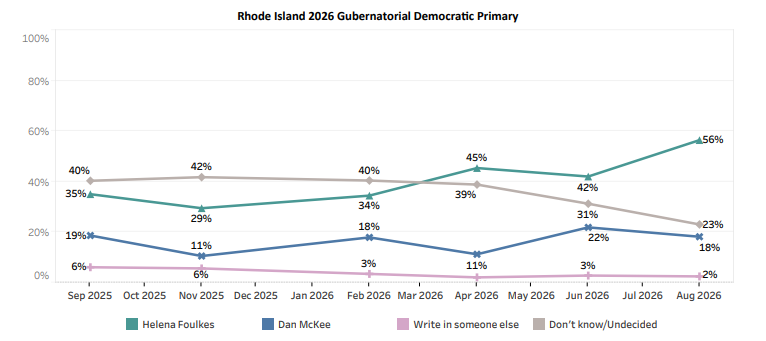
The online survey of 851 voters — including 446 likely Democratic primary voters — conducted Aug. 20 to Aug. 24 shows Foulkes leading McKee by 38 points, with a 4.6% margin of error. It’s the widest gap between the gubernatorial rivals of any poll to date, including prior iterations of the same UNH survey.
When the same survey was last conducted in June, Foulkes led McKee by 20 points, with nearly 1 in 3 likely primary voters undecided. The new survey shows fewer voters have not made up their minds (23%) while more than half back Foulkes. Fewer than 1 in 5 support McKee.
The WPRI poll showed a 15-point gap between the two candidates.
McKee’s campaign dismissed the poll as “bogus.”
“UNH has been an unreliable pollster across New England for years, and this is not an accurate reflection of the current state of the race,” Sophie Mestas, a campaign spokesperson said. “Governor McKee will close this campaign on a message of fighting for working families and delivering the results Rhode Islanders need and deserve — and that’s a message that wins.”
Andrew Smith, director of the UNH Survey Center, defended the poll’s methodology, which relies on the same probability model used by other leading scientific survey groups like Gallup and Pew Research Center.
But Smith acknowledged the difficulty of accurately projecting results in primary races due to low turnout and last-minute decisions by undecided voters.
Primaries are a different animal,” Smith said. “You tend to get a lot of people saying they’re going to vote and they don’t.”
Smith also pointed to McKee’s consistently low approval rating, including among Democrats, as further evidence of his lackluster support in the primary race.
“He’s kind of burned his bridges with the Democratic base there,” Smith said. “That, to me, is the real problem.”
Foulkes’ campaign took the results as further evidence of her traction with voters.
“Poll after poll shows Rhode Islanders are ready for change,” Angelika Pellegrino, a campaign spokesperson said. With early voting underway, the momentum in this race is with Helena.”
Foulkes trumped McKee in nearly every demographic category of primary voters, including every age bracket, geographic area, party affiliation and education level. Her support was highest among self-described progressive voters, men, and voters ages 18 to 34. McKee’s support came from self-identified conservative and libertarian voters, those 50 to 64 years old, and voters who supported Donald Trump in the 2024 presidential election.
Already dogged by low approval ratings, McKee’s favorability worsened compared with the June survey. Eight in 10 voters surveyed disapprove of his job performance, including more than 7 in 10 Democrats. Infrastructure, specifically roads and bridges, was the top source of voter frustration with McKee, a recurrent theme in the wake of the late 2024 closure of the westbound Washington Bridge.
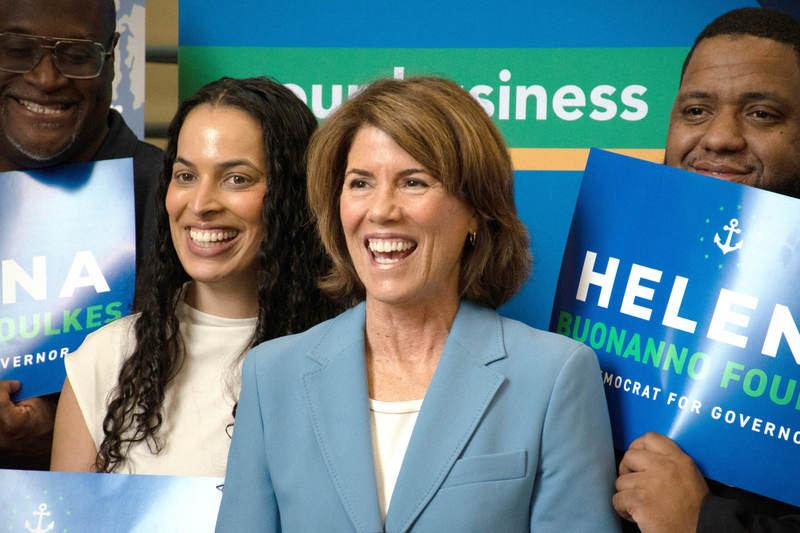
Foulkes, who has frequently criticized the governor for his handling of the rebuild process, has gained favorability compared with two months ago. More than one-third of primary voters view her favorably, 8 points higher than the share of voters who view her unfavorably. And more survey participants know who she is — unsurprising given TV ads by the campaigns and three live debates since the survey was taken in June.
Despite their frequent headbutting on policy and professional track records, the primary rivals share one thing in common: both candidates’ supporters say the No. 1 reason to vote for them is that they are better than the other. Roughly 3 in 10 voters back McKee as the better of the two, with nearly as many Foulkes’ supporters naming the same reason for their support.
However, another 28% of Foulkes voters say she “represents change,” while 20% are won over by her competence or qualifications. Just over 10% of McKee voters cite his qualifications or policies, respectively, as reasons for their support.
On issues, housing topped the list of concerns for survey respondents, named by 1 in 5 participants across the political spectrum. Cost of living was also a top priority, followed by jobs and the economy.
The poll also asked participants about the controversial three-year charter school moratorium signed into law by McKee in June. More than one-third of respondents overall support the new law, rising to 50% among registered Democrats. But nearly as many Republicans and independents oppose the ban on new charter schools.
Similar ideological divides characterize attitudes toward the state’s property on high-value second homes, known as the “Taylor Swift tax.” The surtax, approved by lawmakers in the fiscal 2026 budget with a July 1, 2026, start date, was backed by 8 in 10 Democrats, while 6 in 10 Republicans opposed the higher tax. Independent voters were nearly equally split, though slightly more opposed the tax hike.
The margin of error for questions open to all voters, regardless of party affiliation, is 3.4%.
Providence, RI