The Idaho National Laboratory can thrive without becoming a permanent nuclear waste repository
Aug 27, 2026 | 6:00 am ET
Description
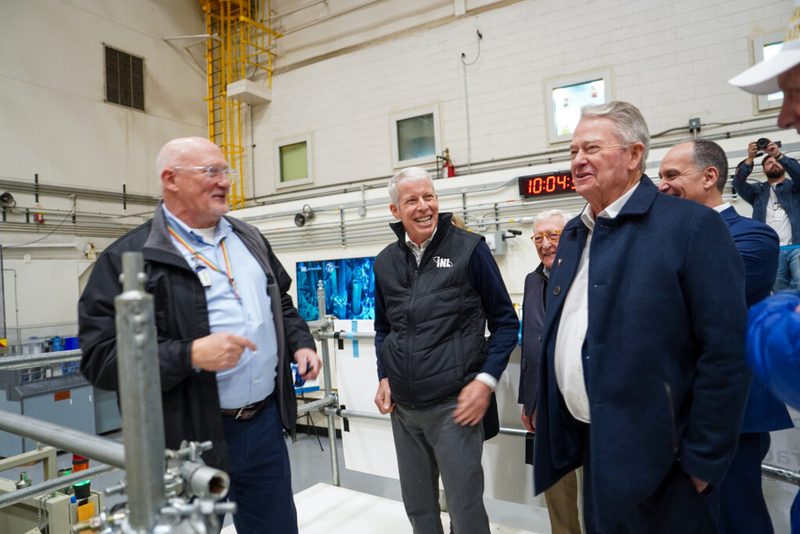
U.S. Energy Secretary Chris Wright (center) visits Idaho National Laboratory with Idaho Gov. Brad Little (right) in December 2025. (Photo courtesy of Sarah Wood/U.S. Department of Energy)
Editor’s note: This is the third in a series of three op-eds written by columnist Jim Jones that discuss Idaho’s application to become the host of one of three Nuclear Lifecycle Innovation Campuses in the U.S. The first column, “With lifecycle campus plan, is Idaho getting ready to buy a nuclear waste pig in a poke?” ran Tuesday, and the second, “Water is a missing element in the grand plan to build up the Idaho National Laboratory,” ran on Wednesday.
It is not likely that most Idahoans would support the state of Idaho becoming a permanent host for one-third of America’s nuclear waste. But that will be our lot if Gov. Brad Little signs a Host Agreement with the U.S. Department of Energy for establishment of a Nuclear Lifecycle Innovation Campus at the Idaho National Laboratory.
The governor claims that Idaho will not be the permanent resting place for the waste, but common sense and history tell us otherwise.
Water is a missing element in the grand plan to build up the Idaho National Laboratory
The Trump administration’s grand plan for promoting nuclear energy and handling nuclear waste originated with Project 2025, which was Trump’s blueprint for remaking America in his image. Russell Vought, Trump’s budget director, was a chief architect of Project 2025. It initially called for the Yucca Mountain site in Nevada to become the permanent nuclear waste dumping ground, but Trump distanced himself from that recommendation because of concerns raised by GOP officials in Nevada.
Last May, Trump issued four executive orders designed to speed up development of nuclear energy. Among other things, he “directed DOE to designate AI data centers as critical defense facilities and tasked the Secretary of Energy with utilizing all available legal authorities to site, approve, and authorize deployment of advanced reactors to power them.” That appears to be exactly what is planned for the INL. The intent is to use a critical defense facility designation to get around every state and federal law that may get in the way.
Furthermore, Executive Order 14302 calls for disposal of nuclear waste generated by recycling or reprocessing through a “permanent disposal pathway.” There is no indication of parking any waste at a temporary location.
When the Yucca Mountain site fell through, it appears the Trump administration decided on a dodge to limit public objections from any applicant for an Nuclear Lifecycle Innovation Campus designation.
First, it was claimed that the three selected sites would only be temporary repositories. Second, the applicants have been promised great, but unspecified, benefits.
Those promises are just unenforceable fluff. No jurisdiction will step forward to be a permanent dumping ground, and none of the applicants will receive a guarantee that the nebulous benefits will ever be forthcoming.
The governor has thrown caution to the winds to support this presidential boondoggle. It should be noted that INL has been prohibited from bringing in new loads of nuclear waste ever since 1995, when the state and Department of Energy entered into a written agreement.
Opponents of that agreement tried to kill it with a voter initiative in 1996. Idahoans rejected the initiative by a vote of 304,886 to 182,710.
Despite the 1995 agreement, INL has grown and prospered. It is the jewel of the nation’s nuclear crown.
That is because of its highly-skilled and dedicated workforce. It is strongly supported by local communities and folks across the state.
Innovation is the name of the game in this complex industry and that rare commodity is in great abundance at the INL. The other four Nuclear Lifecycle Innovation Campus finalists can’t hold a candle. With its stellar qualifications, INL does not have to be a meek supplicant, begging for some transitory scraps from the federal table.
If the Department of Energy wants to bring in additional waste, officials should do it in compliance with the terms of the 1995 agreement. They have sought and obtained exemptions in the past, and things have generally worked out for both sides.
If we are silly enough to agree, sight unseen, to take one-third of the nation’s nuclear waste, it should be in small increments, with a clear understanding and written agreement as to when each increment will be sent back out of state.
I would posit that INL will continue to be the premier nuclear innovator in the country, even if Idaho does not get the campus designation. Just a couple of weeks ago, NASA’s administrator announced in Idaho Falls that the “INL is key to NASA’s space plans.” Those plans call for using nuclear power to go to Mars, and perhaps beyond.
Oklo Inc. broke ground for its first Aurora Powerhouse sodium-cooled fast-neutron reactor at INL last September. The Secretary of Energy, Chris Wright, is a former board member of Oklo and vitally interested in the success of that company.
Last December, the Trump Media and Technology Group became a nuclear power. Trump entered into a $6 billion merger with TAE Technologies, a fusion power developer. TAE is currently looking for a site to construct a speculative utility-scale fusion power plant.
Rather than making INL a waste dump, Gov. Little might invite TAE to locate there. Giving Trump a piece of the action might incentivize him to protect his investment from nuclear waste contamination.
Boise, ID