Sen. Capito is right about rural hospitals, but what about H.R.1?
Aug 27, 2026 | 5:55 am ET
Description
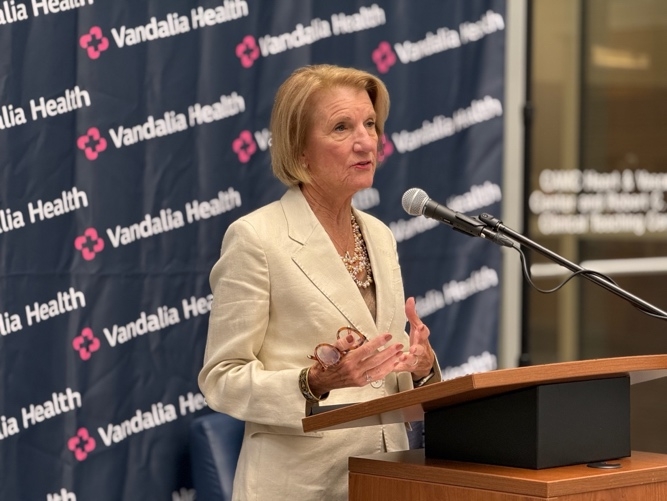
U.S. Sen. Shelley Moore Capito, R-W.Va., celebrates the Congressionally Directed Spending award to Charleston Area Medical Center with U.S. Sen. Jim Justice and local healthcare leaders in Charleston, West Virginia, on Wednesday, August 12, 2026. (Photo courtesy of Sen. Shelley Moore Capito's press office)
It’s not often I agree with Sen. Shelley Moore Capito, but she is right about one thing: West Virginia’s rural hospitals are facing enormous financial challenges, and preserving access to healthcare close to home should be a priority for every elected official.
Earlier this month, Capito joined a bipartisan group of senators in introducing legislation to strengthen the Rural Emergency Hospital designation and provide additional flexibility and resources to rural hospitals at risk of closure.
In announcing the legislation, Capito said, “Keeping healthcare close to home strengthens our communities and gives families the confidence that care will be there when they need it most.”
At West Virginians for Affordable Health Care, we couldn’t agree more. Which raises an important question: If H.R. 1 is good for West Virginia, why are its supporters already introducing legislation to help hospitals survive its consequences?
H.R. 1 cuts more than $1 trillion from Medicaid over the next decade, while imposing new eligibility and reporting requirements that will push eligible people off the program.
Beginning Jan. 1, 2027, more than 160,000 West Virginians enrolled through Medicaid expansion will become subject to new work reporting requirements. Adults ages 19 to 64 will have to prove every month that they worked, volunteered, attended school or participated in another qualifying activity for at least 80 hours to maintain their health coverage.
Experts estimate that between 40,000 and 75,000 West Virginians could lose their Medicaid coverage. Not necessarily because they don’t work, but because they can’t navigate the paperwork.
Miss a deadline. Misunderstand a notice. Fail to upload the right documentation. Experience a technical problem. Any one of those things could cost an otherwise eligible West Virginian their health insurance. It’s not about identifying and eliminating waste, fraud and abuse. It’s about dismantling Medicaid, and H.R. 1 takes an enormous step in that direction.
We’ve already seen what happens when states impose these kinds of requirements. When Arkansas implemented Medicaid work reporting requirements in 2018, more than 18,000 people lost coverage in just seven months. Independent evaluations found no meaningful increase in employment. Instead, eligible people lost insurance because they couldn’t successfully navigate the reporting requirements.
It wasn’t really a work requirement. It was a paperwork requirement. And every West Virginian who loses Medicaid represents more than one person without insurance.
It represents another patient who may delay preventive care, skip medications or postpone treatment until a medical problem becomes an emergency. It represents another uncompensated-care bill for a hospital. Another financial strain on a community health center. Another challenge for a rural healthcare provider already struggling to recruit staff and keep services available.
That’s why the consequences of H.R. 1 extend far beyond the Medicaid rolls. Rural hospitals across the country are already preparing for the financial impact of the law. Hospitals and health systems are freezing hiring, delaying capital investments, reassessing services and planning for increased uncompensated care as Medicaid funding is reduced.
West Virginia can’t afford another blow to its rural healthcare infrastructure. Our hospitals already operate in one of the most challenging healthcare environments in the country. Nearly three out of every four hospital patients in West Virginia are covered by government insurance, including Medicaid, Medicare and the Public Employees Insurance Agency.. Medicaid is not a small program on the margins of our healthcare system. It is part of the financial foundation that allows hospitals to serve their communities.
That is why West Virginians for Affordable Health Care spent last year traveling the state on its Cuts & Consequences Tour, educating communities about exactly what deep Medicaid cuts would mean. We warned that fewer people would have coverage. We warned that hospitals would face greater financial pressure. We warned that providers would be forced to make difficult decisions about services. And we warned that rural communities — where there are often few or no alternatives — would bear the greatest consequences.
Those warnings are no longer hypothetical. They are unfolding before our eyes. Which brings us back to Capito’s new rural hospital legislation.
The Rural Emergency Hospital Designation Improvement Act may provide meaningful assistance to some rural facilities. Strengthening rural healthcare is a worthy goal, and every effort to preserve access to care in underserved communities deserves serious consideration.
But we must be honest about the larger picture. A bill designed to help rural hospitals cope with financial instability does not erase the fact that H.R. 1 is making that instability worse. It is like creating a larger hole and then taking credit for handing someone a ladder.
As the fourth-most senior Republican in the United States Senate, Capito was in a uniquely influential position during the debate over H.R. 1. She had the standing and opportunity to push for changes that would protect West Virginia from the law’s most damaging consequences. Instead, she supported it. So did Sen. Jim Justice, R-W.Va.. So did Reps. Carol Miller, R-W.Va., and Riley Moore, R-W.Va. Every member of West Virginia’s congressional delegation voted for H.R. 1.
Now, as the consequences begin to emerge, Congress is being asked to help the rural hospitals that will have to absorb some of the damage.
If the goal truly is to keep healthcare close to home, the question shouldn’t be how we help rural hospitals survive after Medicaid cuts. The question should be why we enacted cuts that put those hospitals at greater risk in the first place.
West Virginia doesn’t need policies that help communities cope with the consequences after the damage is done. We must have policies that prevent the damage in the first place.
Because the best way to protect a rural hospital isn’t to help it survive after its financial foundation has been weakened. It’s to protect that foundation before it’s too late. And beginning Jan. 1, 2027, West Virginians will begin seeing exactly what happens when we don’t.
Charleston, WV