Staff of two suppressed University of Alabama student magazines go to federal appeals court
Aug 26, 2026 | 4:53 pm ET
Description
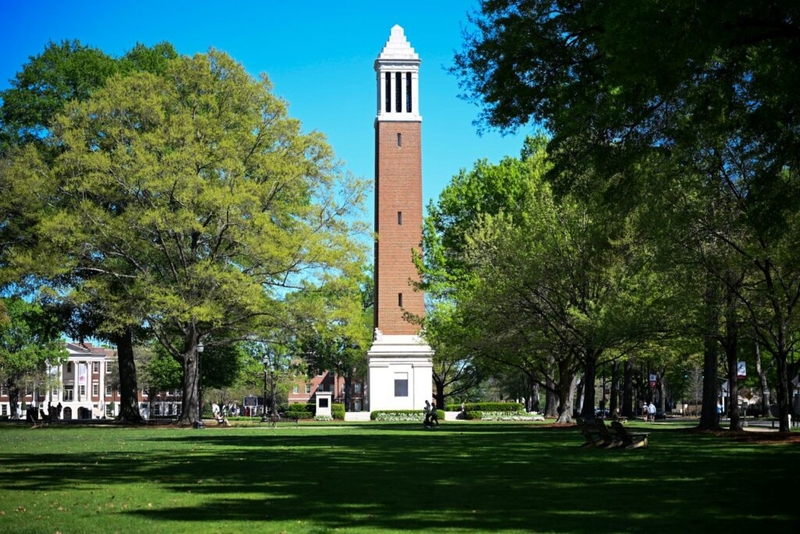
The Denny Chimes at the University of Alabama as seen on March 28, 2026. Student staff of two magazines filed an appeal with the 11th Circuit seeking a preliminary injunction to stop the university from terminating the publications.(Andrea Tinker/Alabama Reflector)
Attorneys representing student staff at two University of Alabama magazines shut down by the school late last year appealed a lower court ruling to the U.S. 11th Circuit Court of Appeals Wednesday.
A U.S. district court in May refused to issue a permanent injunction to halt the suspension of Alice, a magazine that focused on issues related to women, and Nineteen Fifty-Six, that highlighted subject matters that dealt with the Black student community on campus. The school claimed that continued publication of the magazines could violate federal guidance on diversity, equity and inclusion programs.
“Closing these magazines because of their editorial perspectives related to race and gender perpetuates discrimination, rather than fighting it as the university claims,” said Sam Boyd, senior supervising attorney with the Southern Poverty Law Center, in a statement. “We urge the U.S. Court of Appeals for the 11th Circuit to protect the First Amendment rights of the students and editors at these magazines and stand up for all students at the University of Alabama and beyond.”
A message was sent to the Alabama Attorney General’s Office and the University of Alabama on Wednesday seeking comment.
The students’ lawsuit alleges that suspending the two student-led publications amounts to viewpoint discrimination and violates their First Amendment protections in the U.S. Constitution.
The university cited a memo sent by the former U.S. Attorney General Pam Bondi that provided recommendations to remain compliant with policies ordered by President Donald Trump that targeted diversity, equity and inclusion.
U.S. District Judge Edmund LaCour Jr., a former Alabama solicitor general, ruled against the students in May, writing that UA has the authority to regulate content so long as it is not a pretext for viewpoint discrimination and that the university made the selections based on content and not viewpoint.
“A decision to exclude either of them from board affiliation would be a decision based ‘on specific topics … not a decision to discriminate against a ‘sports viewpoint’ or ‘historical viewpoint,’” LaCour wrote in his ruling.
Attorneys representing the student staff said in the appeal that UA terminated support for the publications because of the “missions and perceived demographics of the magazines’ respective audience, relying on its flawed interpretation of the Bondi Memorandum as justification for the suspension.”
The magazines were created to publish the views of people who were aligned with the stated purpose for the creation of the publications.
“It is, in part, these viewpoints communicated through the magazines’ editorial choices that attracted readers to Alice’s and Nineteen Fifty-Six’s content and that the University finds unwelcoming,” the appeal states. “But ‘the government may not insulate a law from charges of viewpoint discrimination by tying censorship to the reaction of the speaker’s audience.”’
Emily Waugh, a student plaintiff in the case, said that Alice provides students with a platform to tell their stories.
“Students should be able to write, create and express themselves without fear that their publications will be silenced simply because a university dislikes a publication’s focus on topics related to gender, sexuality and race,” she said in a news release.
Jermaine Ball, a student plaintiff in the case, said students filed the lawsuit for future students.
“We are fighting not just for us, but for the students who will come after us — because student-operated publications give students the vital opportunity to shape the conversations happening around them while ensuring that a diversity of experiences and perspectives are represented,” he said in a news release. “Protecting student publications means protecting our constitutional right to be heard.”
Montgomery