Meta to pay North Carolina up to $645 million dollars in landmark settlement
Aug 26, 2026 | 3:24 pm ET
Description
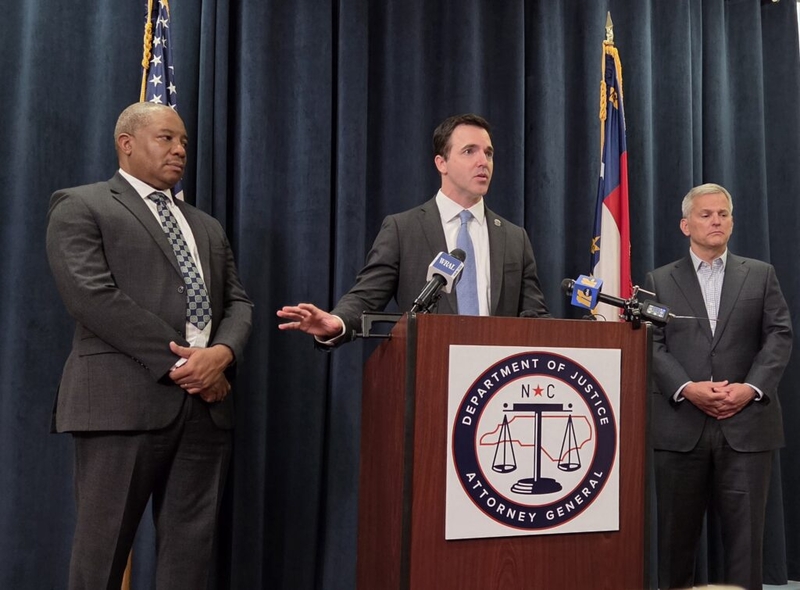
North Carolina Attorney General Jeff Jackson (center) with Superintendent Mo Green and Governor Josh Stein discuss the new safety upgrades Meta will be required to make in a settlement that will secure up to $645 million for North Carolina. (Photo: Clayton Henkel/NC Newsline)
Attorney General Jeff Jackson announced Wednesday that Meta, the owner of Instagram and Facebook, will pay North Carolina up to $645 million and make major safety upgrades in a landmark case involving 47 states. Meta will pay unto $17.1 billion to the states in the second-largest state consumer protection settlement in history.
“My wife and I have three kids. We know how hard it is to argue with them about screen time,” Jackson said.”Part of the reason that it’s so hard is because parents are up against technology that has been engineered specifically to capture and hold their child’s attention.”
In 2023, under then-Attorney General Josh Stein, North Carolina joined 32 other states in suing Meta for violating consumer protection laws with apps designed to increase the amount of time children spent using them, while downplaying the risks. The states also alleged that Meta collected data from minors without the consent of their parents.
Based on Meta’s own internal documents, researchers knew which features hooked children into coming back, and which delivered a dopamine response. They knew millions of children were using Meta’s platforms between midnight and 4 a.m., interrupting their sleep cycle and disrupting their school days. Other documents showed Meta’s own employees warned that face-altering filters could mimic cosmetic surgery and contribute to body-image issues for its teenage users.
Jackson said under the agreement, new measures will be installed to help keep children under 13 off Meta’s platforms. The apps will now have default time limits, giving parents more control over how much screen time their children have.
“The data shows that nearly 80% of teens use social media for over two hours a day and nearly 40% of them use social media for over five hours a day,” said Jackson. “That is why the first provision is a daily limit of two hours.”
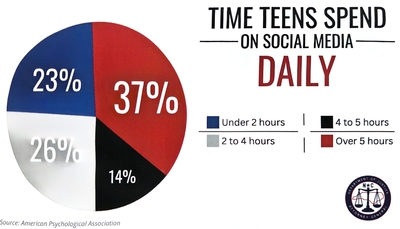
Parents will have the power to change the settings by dialing them up or dialing them down, but that is a decision that will be made by parents, Jackson said. Parents will also be able to get data about their teen’s social media use.
There will also be scrolling pauses to prevent hours and hours of mindless scrolling by teens. Under this safety feature, after 15 minutes of continually using an app like Facebook or Instagram, a pop-ad will discourage the young person from scrolling endlessly.
One of the most disruptive ways social media can impact a young person is by interrupting their sleep.
“A significant percentage of young people are using social media after midnight. The new default will be that those feeds will be disabled between midnight and 6 a.m.,” Jackson said.
Meta will be required to establish a new school mode to prevent push notifications from going off during school hours.
Teens also won’t see the number of likes and reactions on posts by default.
Stein said as attorney general he spoke with fearful parents worried about video content that encouraged weight loss and glorified eating disorders. Stein said the tech giant knew about those harms and did nothing to protect children from becoming more addicted to the apps.
“Meta did not see children as precious beings to be protected. They saw them as dollar signs to be exploited,” Stein said at Wednesday’s press conference.
In a statement, Meta said that all social media platforms should embrace the changes agreed to in the settlement:
“For meaningful progress to happen, we urge TikTok and YouTube to join us and state attorneys general in adopting this new standard, to ensure teens use social media in a healthy and responsible way.”
Settlement money will target youth mental health
North Carolina is guaranteed at least $451 million from Meta to resolve the claims. An additional $194 million will flow to the state when YouTube and TikTok agree to similar online safety strategies. The attorneys general are pushing for industry-wide adoption of these protections.
“I look forward to working with the attorney general, with the legislature, Department of Health and Human Services, the Department of Public Instruction to figure out how we can best utilize these dollars to make the biggest impact on improving young people’s mental health,” Stein said.
The states alleged that approximately 22 million teens log on to Instagram daily in the U.S. And teens who exceed three hours a day on social media face double the risk of anxiety and depression, according to the U.S. Surgeon General.
North Carolina Superintendent of Public Instruction Mo Green said the settlement will go a long way toward improving mental health support for students.
“We don’t have nearly enough programs or personnel like school counselors, school social workers, school psychologists, and school nurses,” said Green.
North Carolina high schoolers show improvements in mental health
The recommended ratio for school social workers is one for every 250 students. In North Carolina, it’s currently one for every 1,055 students. For school psychologists, the recommended ratio is one for every 250 students. Last year in North Carolina, the ratio of psychologists was one to every 1,954 students.
“The resources and commitment announced today are essential to closing these gaps,” Green said.
The first payment of $45 million to North Carolina will come 30 days after the settlement is approved by the court. Additional installments will be made every Jan. 15.
Jackson said the speed of this settlement will mean child safety upgrades are made to Meta’s platforms in months rather than after years of costly litigation.
“It would risk losing another generation, and that’s a risk we cannot take,” said Jackson.
Raleigh, NC